


One of Peter Sloterdijk’s better essays, which I have found myself reading several times, is Rules for the Human Zoo. This essay is actually a response to Heidegger's Letter on Humanism, which itself is a response to a French student of Heidegger who asked him about Sartre's identification of existentialism with humanism. This somewhat complex historical background—on which I have written elsewhere—serves Sloterdijk to reopen the question of humanism.
In the general introduction and preface, Sloterdijk argues that humanism, in all its forms, can be explained using a model of a community of letter writers. The humanist writes letters to unknown recipients and reads letters from writers who lived far from him in time and space. Writing letters is an erotic act that Sloterdijk classifies as "love from a distance" (or what we tend to call a 'long-distance relationship'). Because it involves an erotic relationship (in the Greek sense), the paradigmatic social relationship it creates is that of friendship. The friendly connections of so many people establish, for Sloterdijk, a community (although it is worth debating whether such a community indeed emerges in this way), and this humanist community serves as the political model according to which various humanists sought to shape human society.

The idea is that in Rome there were different paths of life: those who lived by the book and those who lived by "bread and circuses." The former disciplined themselves through their membership in the community of readers, while the latter became more animal-like by gradually shaping their character to that of herd animals. This Roman model of humanism through reading as an alternative to human herd-animality is the model that has been adopted as the humanist model par excellence of European civilization. What is surprising, something I will return to later, is that all the speakers in the current discussion about humanism—Sartre, Heidegger, Sloterdijk—completely ignore the paradigmatic example of Italian humanism. Sloterdijk, for instance, mentions it in a few words, but it is evident that what interests him most is actually the national humanism of the 18th and 19th centuries. This is precisely the humanism of people like Masaryk and Humboldt, where the model of the community they participate in transcends their immediate nationality and according to which they wish to shape their immediate nation is the Republic of Letters of the 17th and 18th centuries, in which Sloterdijk sees the peak of humanism in the sense he discusses. Closer to Sloterdijk himself, it is the national classicism of Goethe and Winckelmann that created the myth of Bildung for national cultures, which is, in fact, a literary community.
In any case, Sloterdijk clarifies that it is not only an intellectualist idea but almost a bibliophile one. Historically, there is some truth to the claim that the national movements of the 19th century were, in fact, 'led' or 'invented' (see Anderson, or the excellent article by Ephraim Podoksik on modern nationalism) by a relatively small elite of bookish people. Even if this is an exaggeration, and it is that, there is some genuine truth to it: much of the construction of modern national consciousness included the building of a specific national literary canon in addition to the general classical one. I don't remember who I heard this claim from, but the specific Jewish national movement is perhaps the most extreme case of a nation that was genuinely a literary fiction of an intellectual elite that gained flesh and skin and became realized in reality. Again, this is an exaggeration to illustrate a point. In fact, the idea was that the small community of educators who live in the literary community would shape the nation according to the idyllic model of this very community, that is, they would serve as educators to the masses, developing in them a national consciousness that is both a quasi-literary consciousness distinguished by which texts it reads and texts it does not read.
Sloterdijk's critique of the Heideggerian conception of humanism is surprisingly subtle, and I cannot do justice to it here without really making it the subject of this brief review. However, it is certainly possible to say a few words. Sloterdijk perceives Heidegger (incorrectly) as a quasi-extreme idealist (he is not the only one who understands him this way) because he believes that humans are much closer to angels than to animals. The human is not the focus of philosophical activity (or educational, in contrast to the humanists' position, which is an ideology of educating humans out of their innate animal tendencies, as mentioned) but rather being itself. Being itself breaks through language. In this story, the human is a neighbor of being. His world is the world of language. As a side note, I should mention that the most brilliant distinction regarding the texts of the Holzwege at the political level I read in Strauss's correspondence with Kojeve. According to Strauss, the Holzwege (the texts published for the first time with the sharp turn towards the philosophy of language in Heidegger) were intended to propose a political alternative in an era of the decline of nationalism after World War II: according to his proposal, the basic political units through which the world would function would be those of speakers of natural languages. But this is, as mentioned, another story.
Again, according to Sloterdijk, Heidegger actually formulates a complete conception of the type of humanism that might have been relevant had humans lived only within 'the world,' or within 'the clearings of the forest' (the illuminated, comprehensible area of being). Had humans really lived in the language, and didn’t have the proximity they do with their animal neighbours.
However, according to Sloterdijk, Heidegger ignores the social history of that world or clearings of the forest in which humans operate. Sloterdijk's reading is somewhat unfair and somewhat filled with errors in this context, but according to his critique of Heidegger, the species of humanity is the platform upon which the human world—within which humans actually live—breaks through. This platform has a social history, as our species has one as well. In our time this history became one of technological manipulation—which Sloterdijk traces back to Plato himself following Heidegger’s reading. Concealed in Sloterdijk’s critique is what I would call the ideology of the third age of the left Hegelians, according to which we are entering an age where not only thought is a product of human activity, but the world itself that is being thought about is at once both a product and the object of human activity.
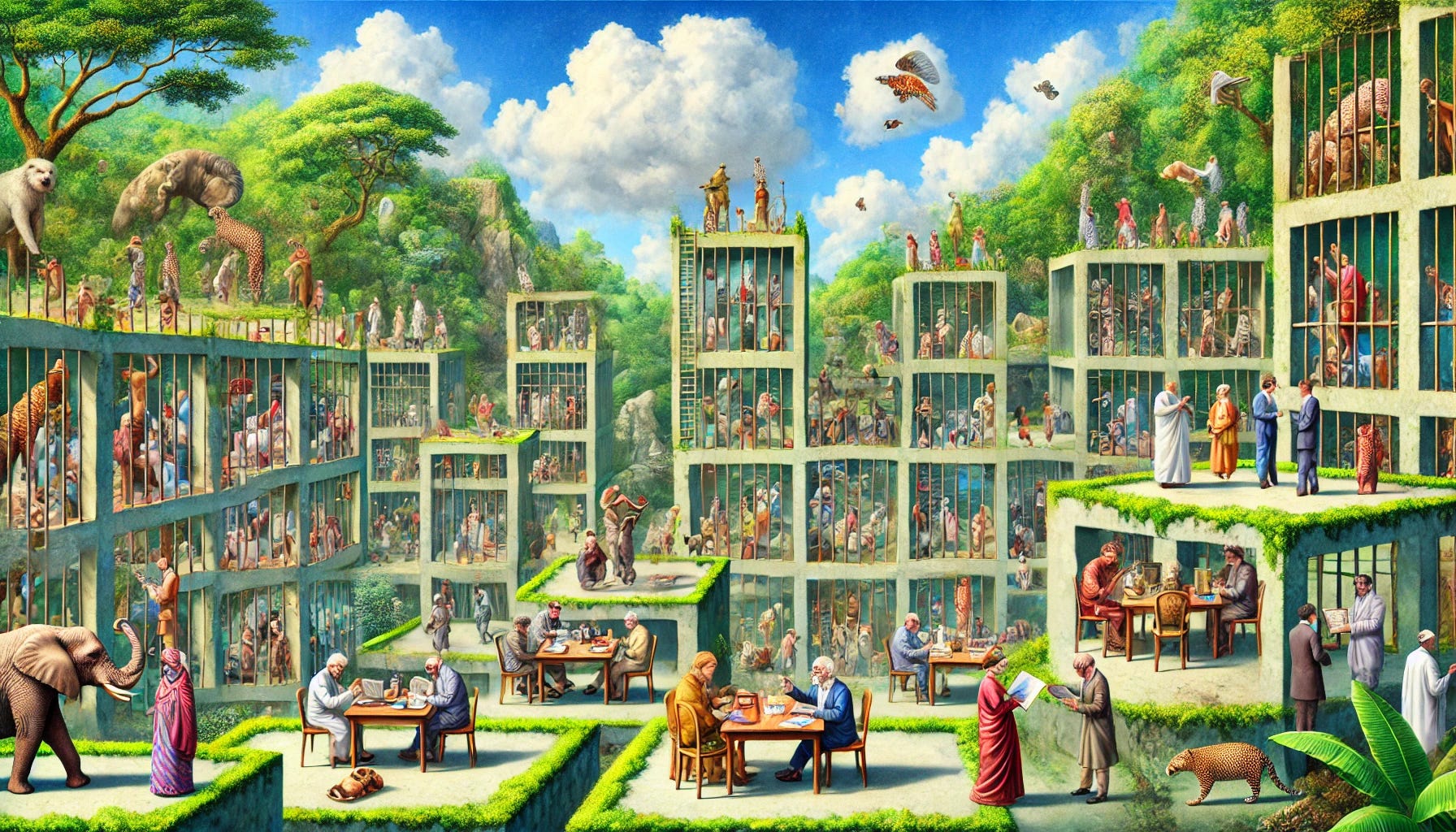
Sloterdijk's critique amounts to an agreement and refusal towards Heidegger: agreement, indeed, if the human world were really only language then radical humanism, the most educated human, would be the most passive (non-animalistic) being conceivable. This is implied in the concept of a human as a language dweller. The human is not just a "reader who generously trusts the text" but is truly "completely devoted to the text." The text as language incarnate. Think about these statements in the context in which the act of reading itself functions as part of the activity that is supposed to be paradigmatic for practical politics. Radical passivity is an adherence to the essential nature of spoken language. Hence, Heidegger's transition from the classical humanist image of society to the image of sheep herding—an interesting image in the educational context that Sloterdijk provides us with some of its history in the context of what he understands as humanism. A refusal of Heidegger, because as his argument goes, the nature of humans is too animal, and hence social, to allow for such individualistic devotion without a communal ideology that mediates the activity of reading and shapes it postively.
Finally, Sloterdijk moves to a thinker who, in his view, was completely aware of the dimension of the social history of the human species. The human species as a product of social history itself. Sloterdijk returns to discuss a thinker with whom he is clearly much more comfortable, Nietzsche. The claim, broadly speaking, is that Nietzsche was aware that human beings have the power to perform "natural selection" on the species of humanity itself. Sloterdijk, notoriously, has his eye on the burning issues of human genetic enhancement. The dystopia/utopia of humanity creating itself, whether towards a "brave new world" or a more noble direction, is constantly in the background of the text. It is clear that such a conditioning "tilts" the table of the world in which human beings participate in a way that Heidegger "did not notice." Beyond that, the perceptive individuals like him and Nietzsche, in his opinion, saw the history of this activity of natural selection in the educational philosophies that humanity produced until now. One could almost say that for Sloterdijk, both humanism and the various philosophies served as old technologies for creating a different and distinct human species. In this sense, Sloterdijk sees, for example, the difference between literate people and those who were not as the most radical difference that the technology for changing the human species could replicate and deepen.
So far, this is a somewhat incomplete overview of Sloterdijk. What interests me in this text by Sloterdijk is precisely what I identify as his mistake, but a particularly interesting mistake. The idea which until now, humanism has de facto served as an arbiter of human sexuality .The politics of reading serving as the criteria for differentiation. Sloterdijk sees the act of reading as the model by which—at least until now—different shepherds of humanity have "selected" it (in the sense of natural selection, a kind of social Darwinism). Reading is simultaneously the means and the end that human shepherds have set for themselves for humanity. The initiation of a person into the community of "shepherds" is, in fact, identical to his initiation into the community of "readers."
First and foremost, I think this is a historical mistake. As mentioned, the model of the reading community as a community of humanists is not an image that existed among the Romans or the Greeks. This is a model that could only develop after Gutenberg, and indeed, only from this stage does Sloterdijk’s history manage to be convincing—more or less. The Italians are indeed a borderline case, but their prominent absence from the discussion on humanism by all the speakers indicates, in my opinion, a discomfort that the humanists like Lorenzo Valla or Erasmus did not share in any modern and megalomaniac fantasy of dividing human beings into different species or in the half-imperial projects of transforming human masses that characterized the modern humanists to whom Sloterdijk refers to as paradigmatic.
But the historical mistake is a partial mistake, as it can still be intentional. This is a possible reading of history that, to a large extent, the future could still vindicate (perhaps this is how one can distinguish interesting historical readings). No, the interesting mistake is found, in my opinion, elsewhere. Sloterdijk focuses on the political aspect of one of the least political texts of Plato, The Statesman, to provide content for his Nietzschean reading of Plato—and thus to establish the humanism he discusses regarding antiquity. However, his reading there... is clearly unconvincing. Concerning the specific Platonic text of The Statesman and certainly concerning the corpus of Plato that we have - Sloterdijk’s reading is too willful.
Sloterdijk’s attempt to base his Nietzschean humanism on antiquity in general and on Plato specifically seems almost necessary, but it is founded on a mistake. We have seen that Sloterdijk understands the humanist tradition as a community of readers. In the end, if you will, a human being is the reader, or at least, this is the most radical form of culture that historical humanity has known. However, the ancients themselves thought differently. From Plato's perspective, ultimatley, a human being is a member of the celestial city-state. In the Timaeus, Plato gives us the image of the philosopher as a citizen of the celestial city, and in The Republic, he preaches to all those philosophers who disgrace the celestial city by being, in fact, bad ambassadors of it (i.e., bad citizens of their real city). The educated man, the philosopher, is ultimately a citizen of the ideal city. The philosophical project of converting opinions into knowledge is analogous to the transition of a person from the citizenship in the city of his birth to the citizenship of the human in the ideal city. Plato’s myth is almost always reflexive: the ideal city is ruled by the philosopher who knows.
But Plato was not alone. The Cynics, whom Sloterdijk especially likes to associate himself with, also (following Zeno's The Republic) saw themselves as citizens of the ideal city. However, their ideal city was the cosmos, and in fact, the Stoic-Roman concept of cosmopolitanism largely comes to us from the Cynics. I highly recommend an article by John Sellars on this subject to anyone interested in the political philosophy of the Cynics and Stoics. The difference was that the Cynics presented a dismissive attitude towards the city into which a person was born on earth. The Stoics also oscillated between denial and apathy of this primitive locality. What they all had in common was that they saw citizenship—of one kind or another—as the fundamental activity of human belonging. The Cynics were probably more intellectual than Plato in that they believed that in the future, the whole world would consist of one city whose citizens are wise and righteous people, but again, the common idea was that citizenship, and not reading (which was perceived almost as a parasitic activity often left to slaves, who would read the texts to their masters), constitutes humanity in its fullest sense.
The fundamental tension of ancient political philosophy, at least from this prism of the ultimate belonging of the good person, arose from the tension between the corrupt yet realistic actual city and the speculative good of the ideal city. A person cannot be righteous in Sodom. Righteousness requires, at least according to Plato and Aristotle, a full connection to a good city that can educate to righteousness as well as consistently maintain it. Hence also, broadly speaking, the claim that the perfect city, whether it is the cosmic city or the celestial city, is a certain form of republic. There is no place within it, in sharp contrast to what Sloterdijk sees as the Nietzschean necessity of the being of a master’s will, of a ruler and a ruled or a dialectic of planning agents versus planned people.
From Sloterdijk's perspective, our era cannot imagine someone who manages the world who is not human. The human is destined to be the perfect creator of the world in which the human himself lives in. However, the ancient cynical-Stoic cosmopolitans saw themselves precisely as citizens of a cosmos in which there is no importance to the citizenship into which one is born, or to this person's control over another person, but it is important that human beings wander alongside the gods above them, the animals beneath them, and the sun at the center of their existence. For the ancient cynic-Stoic, the degree of independence, or the agency attributed to a person, is relative to the animals on one side and the gods on the other. The righteous person largely succeeds in mimicking the independence of these two different kinds— and this is his essence. The essence of man, his freedom, is perceived in a chimerical way. He cannot bear on his shoulders the world that constitutes his home and enables his freedom.
Interesting essay, one issue to consider is that Sloterdijk refers not to Plato’s Sophist but to his Statesman