

A Quick Note on Memory in Humanist Education
A shot account of how memory was understood throughout history, and why it might still be important for contemporary education.

Memory has always played a central part in the Western philosophical tradition, especially its more ancient branches. Classical Greek education placed great emphasis on memorizing passages from the Iliad and the Odyssey, and indeed Plato and Xenophon—though not Aristotle, who was precisely Alexander’s teacher in these matters—saw the poets as competitors to the new pedagogical method they were developing, and accordingly held that even if the poets themselves were, perhaps, divine, the way to gain access to their wisdom does not pass solely through memorization, and at times, as some who are hasty to learn from Plato’s Republic suggest, perhaps even through their expulsion from the city. Either way, in their approach too, education was meant to develop memory in a person.
Thus, for example—and I hope I am repeating what is already known—Plato saw memory as the paradigm that explains the phenomenon of knowledge itself. Beyond that, in the Phaedrus, Plato tells a story about an Egyptian god who gave one of the kings the gift of writing. The king, on the other hand, saw this gift as something dreadful. This gift, he said, would only impair memory. It would grant people the illusion of memory, but would actually encourage them to abandon traditional instruction, and along with it knowledge itself—which there would no longer be any need to remember. To this story, of course, Plato adds a lengthy footnote: the real point lies precisely in dialectical instruction, which can—in a way that writing or other formats that neglect the personal internalisation of the learner and the involvement of the teacher cannot—implant in both learner and teacher knowledge, knowledge that will accompany the conversation between teacher and student. Knowledge that is in fact memories.
The place of memory in classical education has known ups and downs. One of the best books written on this subject, with emphasis on the place of the memory technique known as the “memory palace,” is the scholar Frances Yates’s book The Art of Memory (1966). Yates herself, in a rather strange manner but one quite fitting for the educational atmosphere of the 1960s, was somewhat dismissive of memory techniques. Nonetheless, her book allows one to see how in antiquity a student learning rhetoric also learned along with this how to remember speeches. In the Middle Ages, despite exceptions such as Albertus Magnus, this faculty—in its commonly understood sense today—gave way to a more moralistic and intellectualist form of study. From there the book continues at length to the rather unique place that memory occupied in the Middle Ages among what we would today call a kind of occultism.
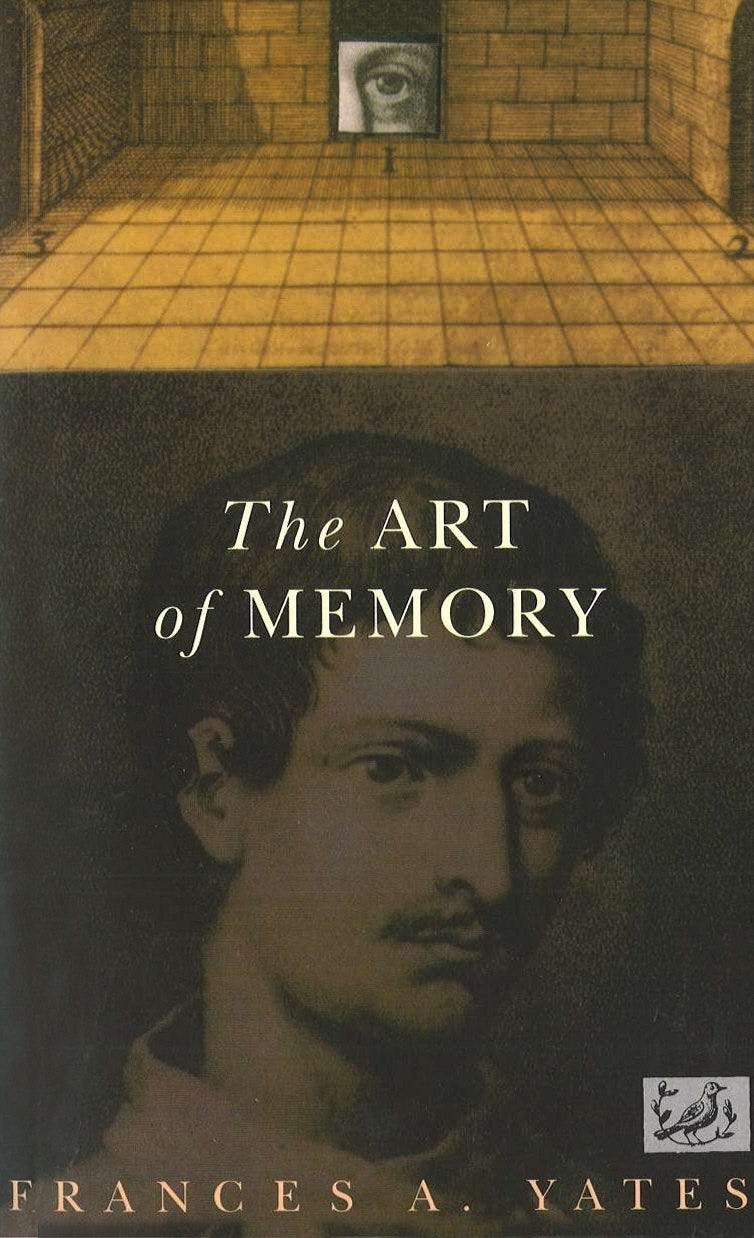
Either way, as far as I understand, the place of memory techniques in the Middle Ages has since been reevaluated. But it remains true that, as far as we know, in antiquity great emphasis was placed on memory, even if not necessarily on memory techniques. The fact that memorization and memory (which, as Yates nicely shows, in classical education one can find a dispute over which of them more deserves emphasis) disappeared from education in the twentieth century—largely under pressure from new educational methods from the school of Dewey and other American pragmatists, in addition, of course, to much more prosaic reasons—is more or less an accomplished fact in our generation. As far as general education is concerned, it seems to me there is no particular problem with the institutions of socialisation adorning themselves with the rather trite rhetoric of “developing thinking skills” and “creativity” instead of instilling knowledge that will accompany a person for the rest of their life.
But I do think it is worth mentioning that things were not always this way, or alternatively that there is much to gain from developing our ability to remember things. As is said in the Phaedrus, a conversation accompanied by knowledge is something precious. Thus, for example, in one of Hannah Arendt’s interviews—I do not wish to give more radical examples, but there are such—she explained that one of her heavy losses in the wake of the rise of Nazism was the German language. What was that German language she lost? All those dozens of poems that, to her regret, she remembered in German, and which were her little treasure. In religious education, one can encounter something similar: religious people often know whole passages of the prayer (and indirectly, of the Bible) by heart, and these inform their discussions on these and other subjects. My mother, who studied at one of the leading schools in Jerusalem in the 80s, still memorized there poems of our canonical poets and dates from history that accompany her to this day. There is something to gain here, but perhaps not for everyone.
In any case, what worries me is something else entirely—that in current education, there is nothing worth remembering in this way, nothing that will accompany us for our whole lives. As if no piece of knowledge is perceived as important enough, as one that has survived and will continue to survive the test of generations, not a single line of poetry that will accompany a person through the rest of their life that was not heard from some album meant primarily for the melody it offers. This, I think, is a sign of something else entirely, and that is the decline in the standing of conversation as a social activity of the first order. Everything can be written down, everything can be searched for. Why bother? And this, well, this really is the gateway to a wonderful new world.