


This post was written, among other things, inspired by Dr. Gila Lahav-Snir's doctoral dissertation, which I am currently working on the scientific editing of, titled "The Biblical Sacrifice" (Forthcoming).
One of the interesting aspects of Jewish apologetic writing in the modern era is the extent of its open struggle with Christianity. After a long time when Jews could not, in practice, openly criticize Christians, the Emancipation and the new political culture that swept Europe effectively allowed Jews to criticize Christians openly. The criticism of Christianity, in these contexts, has almost no real role in reaching a discussion with Christian faith. The purpose of most of these debates, of this apologetic literature, is almost entirely intra-Jewish. For example, Zvi Tau (the central rabbi of the Kav stream in Religious Zionism) might make an entire caricature of how Christianity and its influence is a "malfunction" in history and is the root of all impurity that other Jews (always other Jews) are infected with. But as we will see, besides the fact that this literature is sometimes interesting in itself, its roots do not go back to the rabbinic Judaism of the Rishonim or Acharonim, but to the beginning of Jewish literature after the Emancipation.
Specifically, of course, to the figure of Abraham Geiger. Recently, as part of my work, I came across his stunning article titled Erbsünde und Versöhnung Tod ("Original Sin and Reconciliatory Death," 1872) in which Geiger, the father of Reform Judaism, uses anti-Christian apologetics to fight against certain trends in the Jewish prayer book that he claims are the result of Christian influence. Of course, Geiger was not the first. The ways to mark subtle differences between Christians and Jews had already been paved by figures like Moses Mendelssohn. But I think this specific article demonstrates well how Jewish apologetic writing actually directed itself toward intra-Jewish purposes. Apologetics of this type rarely, if at all, was intended to confront actual Christians.
Geiger's article itself suggests that Syrian Christianity influenced the formation of the Babylonian Talmud's conception of the creation story and the story of the binding of Isaac. On the historical level, it seems to me that even if we wanted to mark Christian influence on the formation of the midrashim that Geiger attacks (which indeed approach the Christian conception of "original sin"), we would need to do a completely different kind of work today. To some extent, Daniel Boyarin, in his book Dying for God (1999), tried to begin similar work (albeit from an opposite position). Beyond this, much of what Geiger apparently believed was Christian influence (such as Isaac's willingness to sacrifice himself in the Akedah) was likely present in non-Pharisaic Jewish streams before the midrashim attributed it to him, as can be seen in many of the relevant documents discovered in the twentieth century.
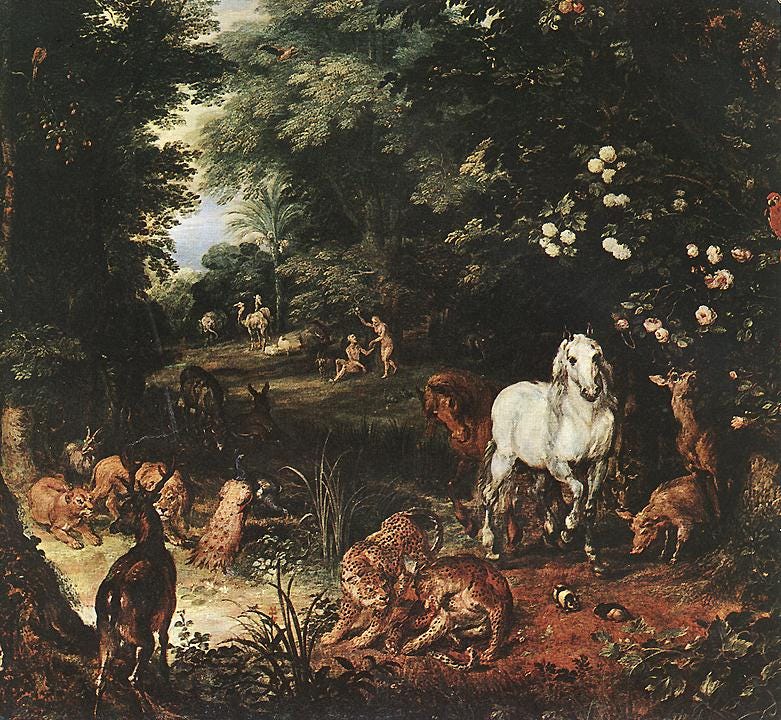
In any case, Geiger's central claim is fascinating, and on the face of it, I think there is much truth in it – and I'll leave the historical debate for another time. Christianity relies on two strong claims: (1) Humanity is in a state of sin from which it has no way to extract itself. (2) Atonement is possible through a sacrifice that will soften divine wrath and allow for the continued existence of humanity. According to Geiger, these assumptions created the problems that the story of original sin solves. Although humans are born free of sin, from the moment the first man sinned, all of humanity exists in hereditary sin. But the problem of how man will be freed from sin still remained. Jesus, in this sense, is a solution because his nature is at least partially not human, and the act of his self-sacrifice allows for atonement for human hereditary sin.
Geiger's claim is simple: in the story itself, God does warn Adam and Eve that if they eat of the fruit they will die, but in practice, this punishment never came into effect. The punishments that Adam actually receives are that he will have to work the land by the sweat of his brow to eat, and Eve's punishment is that her childbirth will be difficult and she will be subject to Adam's rule. There is no new denial here, implied or explicit, of man's ability to overcome his own sin. There is no original sin here that is passed on to descendants. Geiger continues and shows another interesting thing: that the position whereby Isaac was willing to sacrifice himself penetrated rabbinic literature (and prayer), and points to the circumstantial evidence that the idea of sanctifying the belief of the son who sacrifices himself is a continuation of the Christian idea of atonement for the inherently sinful human soul. Geiger believes that human sacrifice, even one who sacrifices himself, is foreign to the spirit of Judaism in its essence, and therefore rejects this interpretation of the binding of Isaac.
This is, in fact, the central lesson of Geiger's short article. There should be a revision to the Rosh Hashanah prayer in which foreign elements were inserted. The game was rigged from the start to make a change in Jewish liturgy that the emerging Jewish Orthodoxy opposed. But beyond this use of apologetics, it seems to me that there is still a kernel of truth in Geiger's claim: the biblical story is indeed not a story about an eternal man who, after eating from the tree of knowledge, becomes mortal. The assumption that man is subject to some original sin passed down by inheritance from the first man also does not appear in the Bible and does not play a role in it.
However, two notes need to be made regarding the tradition of interpretation. First, as I have already noted, there was evidence in non-Pharisaic Jewish streams for this type of interpretation, and undoubtedly these penetrated both the Pharisees and the Christians – some less and some more. Second, this genre of story that explains human mortality itself through a typological mythological story undoubtedly exists in the literature of the Near East that we know. The question is whether this is indeed the biblical story before us.