


Back in 2019, a curious piece appeared in The New York Times entitled “Algebra in Wonderland”. The author of this piece, Melanie Bayley, was a doctoral candidate at Oxford University. Bayley’s main point in the article is that we should read Alice in Wonderland primarily as a satirical attack on the new Mathematics of the 19th century, which became further and further removed from common sense and traditional mathematics. Later in that same year, Bayley elaborated on her claims again in the New Scientist, “Alice's adventures in algebra: Wonderland solved”.
I recommend reading Bayley’s essays in their entirety (a few mistakes notwithstanding, the writing itself is succinct and clear), but nevertheless, I shall summarise some of her arguments about Alice, since I want to talk a little bit about the controversy her claims created.
The caterpillar episode is a critique of De Morgan’s new Algebra. Bayley makes the connections between the caterpillar smoking a hookah and the origin of Algebra in the Islamic golden age (Actually, in India, but that’s a story for another time). She argues that the caterpillar represents De Morgan’s newly formalistic, logic-oriented Algebra. De Morgan’s renewed stress over such notions as logical completeness and formalistic procedure generated acceptance of what Carol likely saw as nonsense, such as the introduction of a square root of -1 (i). Originally, Algebra wasn’t understood to be potentially that independent: Algebraic results were supposed to supervene over real arithmetical or geometric operations and entities. Alice’s confusion over what she should eat to get back to the right proportions of her body is countered by the caterpillar’s seemingly nonchalant attitude to Alice’s conundrum, who tells her to keep her temper (proportion).
Bayley claims that the principle of continuity, which was introduced in the 19th century, is parodied in the “Pig and Pepper” chapter. The principle, which turned in modern topology to the principle that a given shape is the same as long as you can deform it gradually without “cutting or glueing” it, is being applied in the absurdities of the baby (which is somewhat in a state of continued deformation in the first place) turning into a pig when outside the door.
The mathematician William Rowan Hamilton developed a notion of “pure time” following Kant’s understanding of the inner sense (time). While Kant famously took time to be the origin of the objectivity of arithmetic, Hamilton saw the fundamental nature of time not in the counting of the discrete, but in the representation of the continuous. Hamilton developed the notion of Quaternions in an attempt to formalise all movement. The equations of this type exhibit three parts of spatial vectors and one part that represents pure time (today, scalar). Bayley suggests that the tea party at the Mad Hatter’s house, of which there are three members and one notably missing (time), should be taken to be just an operation of one of those Quaternions.
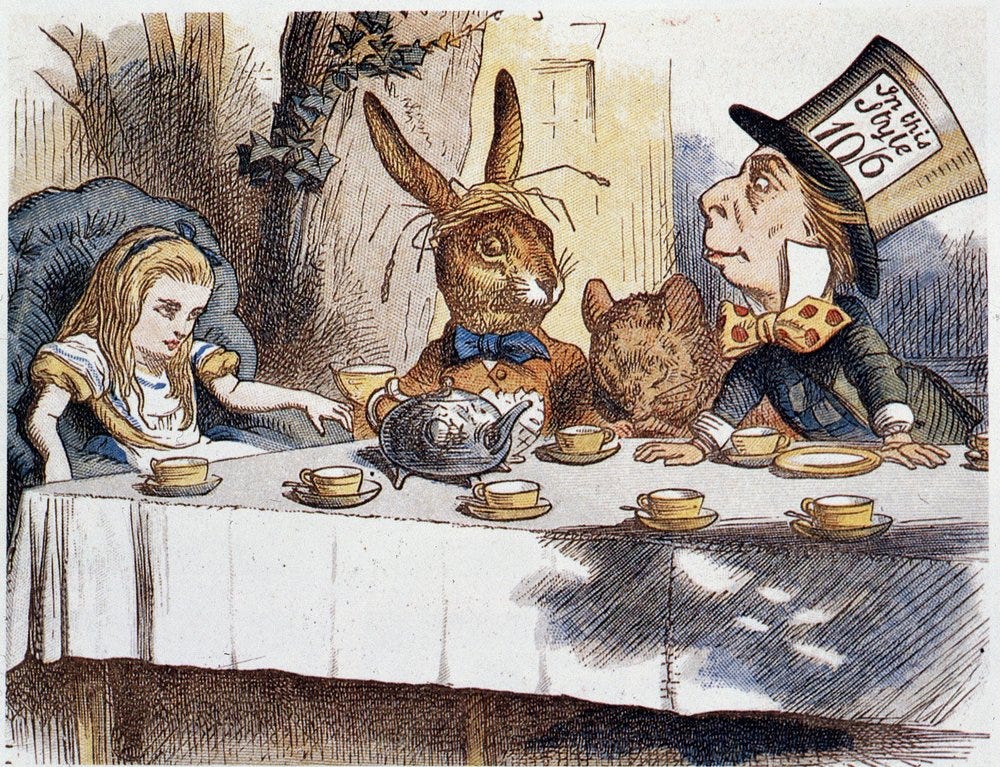
Certainly, Bayley’s interpretation is very suggestive, especially considering that Dodgson was a highly involved mathematician and logician in his time. But what is interesting in Bayley’s interpretation is, to some extent, not only how novel it is but also the response of people such as Martin Gardner, a leading Carol scholar and the author of the Annotated Alice and the Definitive Edition of Alice. Before we go deeper, I’d like to contrast the interpretation we just read with Gardner’s interpretation of these same sequences. I shall not elaborate on all the points Gardner gives a brilliant interpretation of, but I would like you to get an idea about the sort of scholarship Gardner does.
Gardner points to a slang that was prominent at the time in London, asking people, “Who are you?” (The question the caterpillar asks Alice). This catch phrase was commemorated in Charles Mackay’s book, which was extant in Dodgson’s library. Mackay explicitly describes the appearance of these catchphrases as sudden, like the appearance of a mushroom after a rainy day; The poem in the chapter is a parody of Robert Southey’s didactic poem The Old Man’s Comforts and How He Gained Them; The changing version of these passages in Alice’s Adventures Under Ground; and the then newly discovered hallucinogenic properties of certain mushrooms.
The pepper in the air refers to the tendency of lower-class families at the time to disguise the smell of bad food through such seasoning; Some remarks on the prevalence of the slang “grinning like a Cheshire cat” in 19th century England; The origins of the nursery rhyme the Dutchess sings in a poem called “Speak Gently” and a discussion of its origins; An allusion to the Platonic dialogue the Theaetetus; An interpretation of the dialogue with the cat in terms of nature vs ethics relationship; And finally an interpretation of the grin-without-a-cat as an allusion to the non-visual character of mathematical theorems.
An illustration of the British dormouse that resembles a squirrel; Remarks about Carol’s riddle as spoken by the mad Hatter; Remarks on Alice’s actual age based on the conversation in this chapter and different temporal scales; The origin of the Hatter’s song in Jane Taylor’s The Star; Pans and inside jokes that can only be gleamed from primary sources of the time Alice was written; A note on one of the early versions of Virtual Reality that depicted the tea party scene, and how it relates to the dimensionality hinted in the scene.
By summarising Gardner’s extensive notes in so brief a fashion, I do him a severe injustice. I do urge the reader to check Gardner’s edition. However, I’m out for a different point: Gardner avoided, as far as he could, literary readings. The introduction to Alice’s contains some justly scathing remarks on the tendency of some academics to go wild with psychoanalytic readings of Alice (presumably, it was once much in fashion, back when these theories enjoyed some popular credibility). Together with a scholar’s conscience that one should not offer conjectures which one can’t corroborate with firm evidence, we can see why Gardner could find Bayley’s interpretations distasteful.
Even so, I was surprised to find out that Gardner published a letter about Bayley’s interpretation. In this letter, Gardner confirms that he thinks these interpretations are “dubious”, and indeed, there is much scorn in the correspondence about what other scholars made of Alice. However, an interesting note might be that the mathematical mistake Gardner found in Bayley’s account (Parabola not being the same topologically as a circle), he did incidentally confirm Bayley’s reference to the continuity principle in the 19th century and why under certain conditions it indeed might be considered the same as a circle.
Be that as it may, I found Bayley’s interpretation plausible. It seems that I’m not alone, and a new generation of scholars went in her footsteps and started excavating what was a relatively neglected territory (with important predecessors) and finding new philosophical-mathematical hidden gems in Alice.
Down the rabbit hole, yet again.
Interesting!...perhaps, there is a link to the later discussion between the representatives of the Deutsche Physik (Lenard, Stark and perhaps including Debye) who objected the (in their eyes) too speculative abstraction underlying the theory of relativity and quantum mechanics which violated their sense that the 'experimental-observational-experiential' needed to have primacy over the 'abstracting-conceptual-ideative'. Might one see them as self-declared 'realists' more convinced by the 'normative force of the factual' than by what might unify and transcend?