


An open letter to a friend,
Last week we met at a seminar. As these things happened, the conversation slipped from the seminar’s subject to more private preoccupations. Not for the first time, it turned out that our different paths led us through the same places, though at different times. Specifically, we discovered that we both became interested in the question of the relationship between Strauss’s thought and Heidegger’s. Yet this place itself is somewhat difficult to reach, and even more difficult to agree upon, without substantial commitments that might be premature. Also, I read through Strauss’s extant works over ten years ago, and I needed to be refreshed before engaging more deeply in this conversation, hence the somewhat awkward present format. As I noted, I know of one person who has made an interesting attempt in this direction, and I’ll link to it below.
What is possible, however, is for me to substantiate the judgment that I made that Strauss has misunderstood Heidegger. To be sure, this by no means implies that Strauss has misjudged Heidegger, or what comes down to the same, that Strauss was ultimately wrong about Heidegger. As intimated earlier, judgments of this sort cannot be but premature. Hence, it is proper that I will limit my claim: What I am claiming is that, taking the standards of scholars as Strauss understood them, and not of philosophers, Strauss has failed to understand Heidegger. To paraphrase a loved line of thought of Strauss himself: Scholars make corrections and see mistakes where philosophers are blind, but philosophers keep away from abysses and pitfalls that scholars can’t fathom. It is, however, the job of the scholar to trace the line of thought of philosophers as closely as the extant texts allow them to. According to his own admission, Strauss understood himself to be a scholar, the facilitator and communicator of the conversations between philosophers. It is, however, my own private conviction that while he had serious shortcomings as a scholar, he managed to be something at once greater and different from a scholar without fully ascending to the status of a philosopher in his own terms. But this is a conversation for another time.
Overall, it can be said that no small portion of Strauss’s work was dedicated to an indirect encounter with Heidegger’s work. This is, of course, true not only of Natural Right and History, but also of the City and the Man and many other works and lectures alike. In those, he usually contented himself with battling his favourite figurehead of Heidegger instead of approaching his thought straight on: Historicism. Quite often, he did in fact give public lectures that mentioned Heidegger, but of those, only a scant few contain a recognisably substantial encounter with Heidegger’s extant thought, and it is those I will attempt here to base my judgment about. Before I start going through the relevant lectures in chronological order, I would like to point out that, given Strauss’s extensive courses on the works of various philosophers and his aforementioned intense engagement with Heidegger, to my knowledge, he never delivered a course on Being and Time. This is, as far as I can tell, not coincidental. What substantial work Strauss has done in his private correspondence has been left untouched in the present exposition, although, if I recall correctly, the correspondence with Kojeve, for instance, contains some material to be unpacked as well.
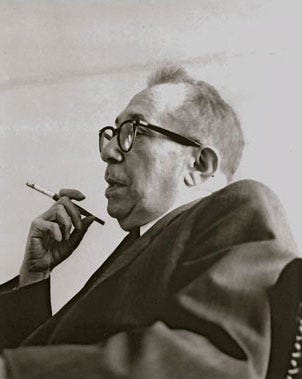
The first lecture that contains a substantial engagement with Heidegger’s thought is entitled “Existentialism” and was delivered in 1956. This is perhaps the lecture with the most substantial engagement and the most substantial mistakes. The first mistake is easy to point out: Strauss takes Heidegger – at the very least, by implication – to argue that existence precedes essence. This is, of course, a mistake, as the original quotation from Being and Time says that Das “Wesen” des Daseins liegt in seiner Existenz. The “essence” of Dasein lies in its existence. Existence implies essence. This mistake is somewhat unfortunate and completely avoidable, not only through a more careful reading of Being and Time, but also by simply reading Heidegger’s 1946 Letter on Humanism, which explicitly critiques Sartre’s (and Sartre’s pupil) reading of Being and Time in this specific respect. The work has been available to the public since 1946, and there is no reason for Strauss to have overlooked this fact. However, this mistake strongly indicates the lecture’s overall progression. Here and elsewhere, Strauss acknowledges that Heidegger forms the centre of Existentialist thought (which, whatever Heidegger thought about this ‘movement’ as a whole aside, is certainly correct) – but seems to heavily rely on Sartre’s work in understanding Heidegger, to the detriment of understanding Heidegger’s own position.
Throughout the lecture, Strauss elaborates on the question about which modes of life are preferable to others and why, a question that regards such modes of life as fundamentally extant for a choice to be made between them. Be the merits of this question as they may, at no point was this question treated as foundational in Heidegger’s work. It is, however, a question that preoccupied Sartre, and his notion of choice largely rests on it. It might be interesting to understand the relation between this question and Heidegger’s notion of choice in Being and Time, but no such attempt was made by Strauss. Heidegger’s notion of choice, at least there, is, to a large extent, hostile to the very framing of choices among extant possibilities. It is closer to a marker of a fallen understanding of the kind of being Dasein possesses, which understands “lifestyles” in fundamentally aesthetic, arbitrary terms. One should refer here to the last section of Being and Time (VI).
This and other considerations must lead to the conclusion that at least there, Strauss was overly relying on Sartre’s understanding of Heidegger, a quite unfortunate mistake. There are, however, echoes in this lecture to other texts of Heidegger’s, such as Introduction to Metaphysics ( published publicly in 1953), and at least a somewhat mediated reliance on Gurevitch’s work. Introduction to Metaphysics itself could have helped mitigate some of these mistakes, but it still was not done. The overpreoccupation with the notion of freedom, however, cannot be traced to either of Heidegger’s extant texts at the time and must be traced back to Sartre. This is true even though at the time, Heidegger already worked through the concept of freedom in his 1930 Freiburg lectures on Schelling. These actually show Heidegger’s fundamentally different understanding of this concept, but became available to the public at large only in the 80’s. This is also true for the notion of ‘responsibility’ he employs in these lectures. However, as we will see, the awareness of Introduction to Metaphysics does characterise his later lectures more clearly.
This leads to the last assertion of Strauss in this lecture that we are going to examine here: That for Heidegger, to be in the highest sense means existence. This is a somewhat strange mistake, since (a) Heidegger is very emphatic that Being is “agnostic” with respect to ‘high’ and ‘low’ and (b) Strauss himself later on appropriates this sort of understanding of being. It becomes even stranger when we consider the third lecture, but first, let’s examine the second.
The second lecture, in which Strauss engages substantially with Heidegger, is “The Problem of Socrates” from 1970. Here is perhaps a place we could use a quote, since his engagement does become more subtle:
Heidegger tries to understand phusis as related, not to phuein (to grow) but to phaosphos (light) – “to grow” is for him above all man’s being rooted in a human past, in a tradition, and creatively transforming that tradition.
There are a few issues here. The easiest one to point out is that, while it is true that Heidegger sometimes tries to understand phusis in terms of phaosphos. This, however, does not mean that he obscures the understanding of phusis as it relates to growth in Aristotle. This is evident in his later writings on Aristotle’s physics, which he wrote in 1939 but published in 1958. This is relevant even to Strauss’s larger argument (there) about Heidegger’s neglect of “nature”. This argument seems perhaps the weakest. It is true that Heidegger wavered, especially later in life, regarding the possibility of understanding physics, either ontologically or scientifically. It is, however, an unwavering commitment of his to pursue this sort of research until the 30’s, and, as was just said, he returned to it from time to time. Here, Kisiel’s excellent article “Heidegger and the New Images of Science” could be of assistance, as well as a closer look at his engagement with notions from contemporary physics as reflected in his famous lecture on The Question concerning Technology (published 1954) and the as yet unpublished but attested correspondence with figures such as Heisenberg. But I digressed a little from the limitations I set for this letter.
The bigger issue is that Strauss seems bent on interpreting Heidegger through Nietzsche. “Creative transforming” of tradition is a Nietzschean notion that Heidegger criticises in his long engagement with Nietzsche (first published in 1961). The strange things is that it seems as though Strauss is aware of this publication in this lecture. But even without these extant publications, a more perceptive reader of Heidegger should have understood what someone like Heidegger would associate with the notion of creativity and the origins of metaphysics.
In this lecture, Strauss seems to struggle with the notion that with Heidegger, the question of a causal, that is, ontical, relation is secondary to the ontological relation. He asks, “Is not this knowledge, the knowledge that the human race had an origin, a cosmological insight, if not the basis, at least basic, for Heidegger?” and it is important to emphasise that the answer is emphatically no. Heidegger lectured on this issue early and later, and in both instances, he held that the question of the emergence of man from beings is secondary. Nevertheless, he did attempt to give it different speculative answers. I wrote about it on a different occasion, and the reader is welcome to examine the sources, which, unfortunately, were not available to Strauss; otherwise, perhaps his argument might have taken a somewhat different direction.
It is also somewhat important that Strauss’s commitment to viewing Heidegger as a kind of ultimate historicist (despite what Being and Time says about the issue) bars him, in this lecture and elsewhere, from understanding Heidegger’s project adequately. If historicist means trying to understand the “categories” of each epoch, and so reach an understanding of the figures of that epoch in their own terms (Strauss gives the example of the Hindu cow vs the western cow), then it seems that the critique is limited to the historicality of the object of the research, without regard to the position of the researcher himself – both receive extensive treatment in Being and Time. If we do understand Strauss’ critique as extending also to the position of the researcher, then it is not at all clear that Heidegger is committed to anything like an absolute moment in the history of the realisation of fundamental ontology in order to carry out such research. On the contrary, it seems that for Heidegger, authentic historical research was and continues to be carried out without those researchers paying attention to the foundations of their research in something like fundamental ontology, with the possible exception of Dilthey and Count Yorck. As in Physics, it is very possible to carry out authentic research without necessarily paying special attention to the foundations (although Heidegger does think that history is a younger science, not necessarily capable of “breaking” its foundations, a breaking that does require such an awareness). Indeed, one might even argue that such attention might be distracting. Fundamental ontology can be foundational even if it has not been made explicit. Indeed, if it is truly foundational, we should expect it to be “there” even when not fully acknowledged. Making the foundation explicit does not constitute a special place in history with respect to the possibility of conducting authentic historical research. Indeed, the reverse is true: it is only because Dasein is already historical that it is possible to carry out such research.
Here, I think we find the most forceful version of Strauss’s anti-historicist argument. Strauss’s attempt to outline Heidegger’s argument in terms that sound like the Seinsgeschichte is unconvincing if one knows the material. According to Strauss, “yet we could not speak of change if there [were] not something lasting in the change; that lasting which is responsible for [the] most fundamental change [fundamental thought] is Sein:” Once again Strauss attempts to press the point of the inevitability of ontical origin, this time Sein as supra-historical substrate in the Aristotelian sense. Yet again, this question has already been addressed by Heidegger in section IV of Being and Time. Heidegger does give an account of how steadiness in conceiving time in ek-statical terms without retreating to an ontical conception, causal or substrate-oriented.
Even so, the clearest argument against historicism, as articulated by Strauss, appears in a third lecture, “Philosophy as a Rigorous Science,” from 1971. The argument essentially relies on the issue of reflexivity. If historical understanding is foundational to all human understanding in the sense that all human understanding is fundamentally historical, and hence transient, then the same must apply to the understanding that all human understanding is fundamentally historical, which makes this understanding itself transient in a manner incompatible with its fundamentality. Will leave aside, for the moment, the question of whether transience is what Heidegger understands by time. Again, it is emphatically not what he thinks. Beings (Seiendes) are indeed in time, and in this respect are also transient (especially insofar as they are part of nature!), but what constitutes temporality is the whole ekstatic structure, which functions as “the condition of possibility” for anything like transient change.
Nevertheless, Strauss’s question can be somewhat reformulated. Do we not have to assume the ek-static foundation as intransient, and hence unhistorical? Put differently: must it not be the case that the fundamental structure of human existence, at least as Heidegger understands it, is not something eternally present-at-hand? Here again, Strauss neglects to take into account Heidegger’s understanding of this structure as itself reflexive: all ek-static appropriations appropriate other ek-static appropriations. This is the crux of the argument he makes in Being and Time, section 65, paragraph 328 onwards. It is even clearer, in my opinion, in the later course Heidegger delivers in 1927, The Basic Problems of Phenomenology. Incidentally, in this section of Being and Time, he also treats the “issue” of conceiving finite existence without reference to infinity.
Finally, this lecture asserts a view that contradicts the outright notion we discussed earlier: that existence is the highest kind of being in Heidegger. Here, Strauss acknowledges that, for Heidegger, the Gods are the highest, displacing political philosophy. It seems that Strauss became more familiar with Heidegger’s thought over time and also more cautious. Here, two remarks are worth making. First, Heidegger, like other National Socialists of the sophisticated variety, dealt with political philosophy primarily through Plato’s philosophy throughout the thirties. Most of this has only recently been revealed. Second, in 1936, he also held a course on Hegel’s Philosophy of Right, and if that is not a political philosophy, I really don’t know what is.
Two last notes before I finish this already too-long a letter.
First, I have read almost everything Strauss has written over ten years ago because he is an exceptional teacher. What I wrote here by no means meant to chastise or diminish him, but merely to correct what seems to me worth correcting. I myself share Strauss’s motivation and move in a similar yet different direction to deconstruct Heidegger’s thought.
Second, as I mentioned in the beginning, what was said here by no means touches on the decisive questions at hand as to the relationship between the thinking of Strauss and Heidegger. This rather more delicate subject was addressed at various stages, and, as promised, I link to the most recent impressive attempt I saw to address this issue here. Although I should qualify that I was rather young, versed in Strauss, though not as much in Heidegger.
To many more such conversations,
Eli
I too have had trouble assessing how adequate Strauss' interpretation of Heidegger is. But to assess the adequacy of a view requires, of course, correctly understanding that view. Your interpretation -- to the degree that it can be presented in this format -- seems subject to a number of difficulties. For now, I just want to address a few thoughts about the lecture "Existentialism."
1. Essence precedes existence. Strauss certainly uses this phrase, but it is not clear that he attributes it to Heidegger. It is part of his polemical attempt to show that certain views that are not obviously connected to or implicated in existentialism -- such as some forms of positivism -- are, on deeper examination, nearly committed to it.
For example, the devotion to science, once questioned, clearly cannot receive a scientific justification. But if the devotion to science is not thus rational, it seems rooted in a groundless choice, based on the abyss of freedom -- so that Strauss can then note: "We are already in the midst of Existentialism." (309)
Similarly one who seeks with a sort of historical anthropology to catalog the available worldviews can only make real progress if all possible such views are grounded in an assessment of the human condition -- "If one takes this indispensable step one is again already at the threshold of Existentialism." (310)
Again, history of philosophy might lead one a kind of relativist reductionism so that, for example, the Stoic natural law doctrine seems to be rooted in the Greek shift from polis to empire. But this means that one's categorial system ("essences") are rooted in their actual social context ("existence"). (310)
Instead of utilizing Sartre to explicate Heidegger, Strauss is using Sartrean phrases polemically to show historians and social scientists (at least) that, far from being alien to existentialism, they may already be committed to it.
2. Modes of life. There is no doubt that in many of his works Strauss views the basic patterns from which individuals can choose as relatively well-known and -defined. But in this lecture he repeatedly notes that we cannot ever really know the limits of human possibility and creativity. Thus even if a certain choice seems demanded and fundamental, Strauss recognizes that this is a seeming truth, not a genuine or necessary one.
Again, he does not seem to attribute to Heidegger any concern with these issues. At most, he sees Heidegger as having emphasized the central role of "thrown project" in forming horizons and making meaning and understanding possible. This seems meant as a reading of the role of geworfene Entwurf as a structural moment in Daseins Sorge.
Strauss does not seem to think that this leads to any specific choices, certainly not among extant or "ready-made" options. At most, there seems here an option for a purely formal existentialism ethic, though Strauss avers that Heidegger never believed in such. (311)
3. Existence is highest. Here, Strauss clearly attributes this view to Heidegger. I am not familiar with the grounds on which to think that Heidegger claims that Being is "agnostic" about high and low. But the relevance of such a remark can only be assessed after addressing what Strauss meant by it.
In context, he states clearly the methodological point that the fundamental question of Being "must be primarily addressed to that being which *is* in the most emphatic or authoritative way." (312) Highest then means something like "methodologically prior."
And indeed, the main theme of Being and Time is an analysis of human existence. After the Introduction, the first sentence reads: "In the question about the meaning of Being, what is primarily interrogated is those entities (Seiendes) that have the character of Dasein." (65) On the previous page, Heidegger seeks to justify this: "We shall proceed towards the concept of Being by way of an interpretation of a certain special entity, Dasein..." (63). He makes it very clear that something special about Dasein gives it methodological priority in the search after the "universal" sense of Being: historicality and historiology.
In short, Strauss' point seems sound, as far as it goes.
However, Strauss is quite aware that Being and Time was never finished, and this because Heidegger came to see this approach as ultimately flawed. After the so-called Kehre or Turn, Heidegger seems to have written off B&T precisely because of this "anthropocentric" approach to the question of Being. Strauss is aware of this change, and notes that, whatever can be called "existentialism" in B&T, Heidegger chose to break from this view.
Among the objections that Strauss sees Heidegger as having leveled against the Existentialism of B&T, Strauss' #3 is an example of the paradox that follows from giving human existence a central place in addressing the meaning of Being (313). In conclusion: "Existence cannot be *the* clue, the clue to the understanding of that by virtue of which all beings are. ... the analytics of existence appears still to partake of modern subjectivism."
Let this suffice for the moment.
Elsewhere, Strauss claims that he stopped paying attention to Heidegger after the latter joined the NSDAP in 1933 -- for some twenty years. Clearly, Strauss came back to reading and thinking about "post-B&T" Heidegger sometime around the publication of Introduction to Metaphysics in 1953. What Strauss made of Heidegger's later work -- and he clearly knew a fair bit of it -- is for another occasion.