


During my readings of Aristotle, I find myself coming back again and again to the scholarly work Aristotle and the Theology of the Living Immortals by Richard Bodéüs. One of the things that has always frustrated me to some extent in the secondary literature on Aristotle is how he is often perceived as a contemporary and kindred spirit of any Oxford scholar who happens to stumble upon his works. This is not exactly a bug; it's largely a feature. As a respected professor of the philosophy of science once pointed out to me, one of the intriguing aspects of philosophy is that when you read a scientific essay from two thousand years ago, you never ask yourself, "Maybe he's right?" That question doesn't arise because we can often—through the knowledge we have accumulated, or through our books—provide better answers to scientific questions than our predecessors could. This criterion does not hold in philosophy, which is part of its charm. However, with great charm comes greater possibilities for error. The historical gap itself is not just a gap; it often obscures things about the meaning of the text that completely alters our understanding of it.
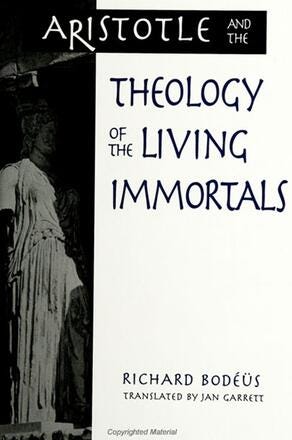
The Greeks are an extreme case in this story of obscuration. Because we find atheists among the Greeks as early as the 4th century BCE, if not the 5th (Diagoras), the premise of enlightened historiography has been that Greek philosophy was a secularizing force in Greece. However, it is very difficult to read Plato, for instance, and think of him as a secularizing force. Indeed, Plato's successors, especially in the later Academy, became the unofficial theologians of Greek polytheism. All this, of course, did not stop historians: wherever Socrates (in Plato's dialogues) speaks about the gods, it can be attributed to the famous Socratic irony. The situation with Aristotle is even more complex: According to Bodéüs, significant parts of his theory regarding the first philosophy or the realm of celestial movements is dedicated, to varying degrees, to their deification—or more accurately, to the use of traditional Greek concepts of immortal gods to explain various traits required for their philosophical theory.
Historically, the situation with Aristotle became even more complicated: it seems that many of his writings have been lost to us, particularly his dialogues. Two hundred years later, a student of the school of Alexander of Aphrodisias produced a set of commentaries of his work that became canonical, including the book On Providence, which presented views that are largely a kind of intellectual deism, rejecting (among other things) any direct intervention of the gods in human affairs. However, a careful reading of Aristotle's texts—both the fragments and works like the Topics, not to mention more 'marginal' writings like Eudemian Ethics—presents us with a rather different reference from Aristotle on the subject. This is true even when we approach the more canonical writings of Aristotle without particularly enlightened prejudices: the Metaphysics, Politics, and Nicomachean Ethics. In these works, Aristotle seriously discusses the place of worship in public order, stating that the wealthy man or the magnanimous person dedicates a significant part of his endeavors to works for the gods (in Greece—festivals, theaters, sacrifices) and debates the possible jealousy of the god toward those who engage in thinking about the sources of the cosmos.
But back to Alexander. In the Muslim Middle Ages, Alexander was established as the foremost commentator on Aristotle. Moreover, some Muslim philosophers presented deistic tendencies in their work—not to say outright heresies, depending on how we interpret the work of one, Averroes. In the Christian world, commentators like Averroes were seen as the authoritative interpreters of Aristotle, at least until the Renaissance. In other words, Aristotle's work was buried under waves and waves of interpretations. Theologians regarded this aspect, the religious aspect, of Aristotle's thought as incomplete, and later neo-Kantian historians took his historical inquiry in metaphysics and physics and turned it into a narrative of secularization, a transition from myth to logos, which still appears in textbooks to this day. One of the things Richard Bodéüs does is show how this is a misunderstanding of Aristotle and how it is a misunderstanding of the story of the Greek world in this context.
Of course, there were other voices. I think we can positively mention German philologists like Werner Jaeger and, earlier, Eduard Zeller, who at least examined all the relevant texts before shaping their positions on the subject—especially, it should be noted, the place Zeller dedicates in his commentary to Theophrastus, Aristotle's student from whom we have the most surviving works. However, here Bodéüs' book is somewhat weak, as it examines Aristotle mainly alongside later Plato, which personally troubles me, and almost completely ignores what has survived from Aristotle’s own students. But the overall picture was ultimately dictated by figures like Ernst Cassirer and Windelband, and it is the picture that is largely taught today in introductory courses on the subject worldwide (like, incidentally, in many cases, the popular course from Descartes to Kant/Hegel, which is largely a product of this school).
This is an illuminating example of how historical images and narratives seep into historical or, in any case, academic inquiries. But what is the importance of all this? Well, part of the reason it's important is that it allows us a better understanding of Aristotle's theory, which certainly did not invent unmoved movers to then worship them, just as Plato did not invent Ideas to then worship them. It allows us to understand, for example, how Muslim philosophers created celestial theology based on the writings of Aristotle that reached them—whereas for Aristotle, such a theology was probably a rather low stage of religious-historical development as he understood it.
More importantly, there are various theoretical implications to this interest. For instance, beyond the story of how to understand the Metaphysics, a scholar named Sarah Brody wrote an illuminating article (which, in retrospect, I realized is also linked to Bodéüs’ book) on the virtue of piety in Aristotle. Overall, if one is interested in understanding Aristotle’s religious set of mind, Bodéüs’ book is a must.