


In 1950, Hans Georg Gadamer, perhaps the most famous of Heidegger’s students, wrote a letter to Walter Friedrich Otto, asking for his contribution to an emerging volume of papers that would be presented to Heidegger for his 60th birthday. Yet, most of the people familiar with Heidegger’s thought and perhaps even the research surrounding his work will not be familiar with Walter F. Otto, even though within the volume of works that emerged from Gadamer’s endeavour Otto’s piece would appear first in the table of contents, and Otto sustained one of the most interesting working relationships with Heidegger in general. To the rule outlined here about the common research surrounding this relationship, there’s one notable exception: the substantial research carried out by the excellent scholar Alessandro Stavru into their working and philosophical relations. Stavru demonstrated that Otto is not merely ‘another influence’ on Heidegger’s notoriously imbued philosophy, but a constitutive figure in relation to his thought on Hölderlin and perhaps Nietzsche as well. Historically, their connection was mostly substantiated by the joint work on the endeavours of the Nietzsche Archiv in the thirties to edit and publish Nietzsche’s works. Still, as we shall see, there is a lot to be done.
Considering the allotted time and the diverse audience, I would like to indicate, to suggest, how this relationship might be unpacked to yield a more original understanding of a “footpath” in Heidegger’s thought. Specifically, I would like to unpack a few remarks Heidegger has made in his thank-you letter to Otto about his contribution to the birthday volume. You shall forgive me for skipping a few parts in the letter that are not pertinent to the current presentation:
Freiburg, Dec. 4, 1950.
Dear Mr. Otto!
First, I must thank you warmly for your beautiful “contribution” [or “essay”]. It brings “Time and Being” [the title of Otto’s contribution] - which otherwise all too easily petrify into the formal [Formalen] - closer to us out of mature experience and genuine knowledge. Although you call your consideration an “unphilosophical” one [the subtitle of his piece], it nevertheless remains philosophical through its indicative power [hinweisende Kraft].
The meaning of this contribution [Anteils] can only lie in my taking part in it myself [ich selber daran teilnehme]. That could not happen otherwise than through a thinking dialogue. I still hope it might become a speaking, spoken one, and not merely a written one. […]
Every section of your contribution gives rise to questions. Of course, this creates the danger that I might too forcefully draw what you’ve said into the realm of my own thinking. […] Today, I have only “moved forward” [from his Scotus dissertation of 1916] insofar as the questions have become more open to leaps and the lack of adequate ways of thinking has become considerably clearer.
Therefore, I am particularly pleased that your contribution shows which “phenomena” and in what way “recommend” themselves to “thinking.” This is an aid to thinking, although it does not relieve it of its own burden. […]
To unpack some of the rather cryptic remarks in this letter, we’ll start by accumulating an understanding of what Heidegger means here by assigning to Otto’s paper “indicative power”, and the nature of the implicit task he mentions of salvaging time and being from being easily “petrified into the formal”.
What is this indicative power Heidegger assigns to Otto’s paper? In 1900, Husserl, Heidegger’s teacher, published his Logical Investigations. This work transformed the young Heidegger. Among the many influential distinctions in this work, Husserl distinguished between two ‘kinds’ of signs (Zeichen). There are signs, like signs that appear in a demonstration or mathematical proof (Beweis), whose connection is necessary. Meaning, if I say A implies B, and then assert A, A will function as ‘a sign’ of B necessarily. There are, however, also signs whose function is indicative (Anzeichen). For instance, smoke in a forest. It could be that smoke ‘points to’ (hinweisen) fire, but this is not necessary. It could be that fossils underground ‘point to’ something that lived thousands of years ago, but again, it is not necessary.
Further determination of Heidegger’s understanding of “indication” is usually ascribed in the existing research to other distinctions from Husserl’s Logical Investigations as well. Husserl also distinguishes there between “essentially occasional expressions” and “objective expressions”. Objective expressions are usually nominal expressions like “Dog” or “Tree”. These expressions refer to a more or less determined meaning that is independent of the particular person uttering them. Essentially occasional expressions, on the other hand, do depend, for their meaning, on the particular person uttering them. Examples of such expressions are pronouns, demonstratives, and indexicals. If I say “I” or “You”, or “This” or “There”, in each instance the expression receives a different, more determined, meaning. When I say “I”, the meaning can be “Eli”, but when my wife says “I”, the meaning can be “Gitty”. These are essentially ‘empty’ expressions that await being fulfilled by a meaning they indicate without necessitating a specific person-independent meaning.
Drawing further from Husserl’s later work Ideas, Heidegger arrives at an important adaptation of Husserl’s distinction between formalisation and generalisation, an adaptation he presents mainly in his 1920-1 course on The Phenomenology of Religious Life. To start with, normal formalisation is distinguished from generalisation in that generalisation is always limited to a specific domain, or “material”. If I say that this colour here is red, and red is a species of colour, and colours are a species of sensory quality, then generalisation here is ‘guided by’ or ordered according to the ‘domain’ of the sensory. More, if I think about water, I can say that water is a species of things humans can sustain themselves with, and whatever humans can sustain themselves with is a species of things humans can want to have. These abstractions are determined by ‘what people may want’ as their material guiding principle. Each such generalisation is implicitly guided by a material that makes sure the generalisation will reflect a certain necessity and not merely abstract play with concepts, and so it also is with specifications, which are merely the reversal of generalisations.
Formalisations, however, function differently. When we refer to the expression “Something” as a formula, this is not a determination of the highest genus of everything there is in reality. There’s no way to combine the different generalisation hierarchies into a unified structure with a single leading genus if we wish our generalisations to keep their inner necessity. Thus, when we refer to “Something” in general, we are not performing a generalisation or specification, but a formalisation. We’re using an empty intention that can be filled with any object whatsoever, regardless of its specific material belonging. In other words, those formulas are able to receive just about anything and are not ‘prejudiced’ by any specific domain.
Heidegger takes this distinction and radicalises it in order to form his concept of “formal indication” (formale Anzeige), which he thinks of as the leading term that will unlock the essence of phenomena without prejudice. Heidegger thinks that the formulas outlined by Husserl are still prejudiced. As long as a formalisation answers a what-question – “what is ‘something’?”, “this flower, for instance” - it remains bound to a specific domain. Thus, for instance, one may indeed point to a flower when asked what the formula “something” could signify. The material which guides the filling of “something”, the domain in which such a question holds, is, according to Heidegger, the theoretical domain. This is the domain in which we look around, not involved in any specific manner with the world, as if ‘from outside’, and survey what is in front of us. This is a theoretical attitude, the assumption of which remains unquestioned.
According to Heidegger, to get at truly unprejudiced formalisations, one must take a step even further away. One must see that true philosophical formalisation, what Heidegger used to call “formal indication”, should get at the ways in which the world becomes manifest to us. At the “how” the world manifests itself. The different ways according to which different things become available or unavailable for us. The theoretical attitude is prejudiced in that its ‘material’ is organised by things that are constantly available for us. Formulas that constantly refer to what shows itself to the theoretical attitude become a sort of generalisation guided by the domain of theory. One should try to understand formalism in a more radical manner.
An example. In Being and Time, Heidegger’s magnum opus, Heidegger discusses the saying of the pronoun “I”. He says that formally speaking, each time we utter “I”, we tend to mean a specific meaning. For instance, “I” am sitting in this room. “I” am delivering a presentation. As we saw, those are specific meanings that can be allotted to essentially occasional expressions. But there Heidegger goes further. The formality of the expression “I”, taken in this way, is specifically misleading. We tend to recognise the formula “I” with a what-content, as we already saw. “I am sitting in this room.” “I am delivering a presentation.” The prejudice this sort of formality offers us is that the meaning of “I” is always at hand, constantly available. We can always point to something that is this “I” of ours, and consequently to that which is not-I.
Heidegger does not shy away from this possibility. On the contrary - he understands it as part of the formal indication of the ‘I’ itself. We constantly incline to understand our ‘I’ in terms of what is constantly available. But this determines the ‘I’ only partially - and, more importantly, misleadingly. For unless we are explicitly interrogated, or engaged in an analysis like the one we are conducting right now, we tend to be sure that the meaning of our ‘I’ is exhausted in just this way. The possibility of not being misled in such a way is, of course, also part of the formal indication of “I”. The formal indication of “I” thus includes the possibility of losing oneself in the whatness of the surrounding world as well as the original understanding of oneself as a “how” which is not limited to understanding itself in terms of its immanent sense of self. But what is formal indication for?
The purpose of philosophy, Heidegger used to maintain, is precisely to keep us open enough for the unprejudiced meaning of phenomena. Formal indication is a tool for that end, and classical formalisation is, to a certain extent, a hindrance, since it all too easily becomes, if we come back to Heidegger’s letter to Otto, petrified. The petrification is precisely the inclination to be misled into thinking the meaning of the formula has been exhausted, has become complete in the past and is in no need of repetition. The meaning of the famous Heideggerian dictum of “destruction” is precisely to get beyond such “conceptualisations” of the phenomena themselves.
This is, indeed, what Heidegger wishes to do with Otto’s contribution: To take hold of its suggestiveness, at the issues his contribution points to, indicate, and gain an understanding of what relations to the world allow access to the phenomena Otto was pointing towards. We shall not, accordingly, claim an influence of Otto’s contribution over Heidegger’s thought. We will, however, try to retain the “indicative power” Heidegger ascribed to Otto’s contribution and try to learn in what way Heidegger “took part himself”, as he said in the letter, in a thinking dialogue with Otto’s contribution.
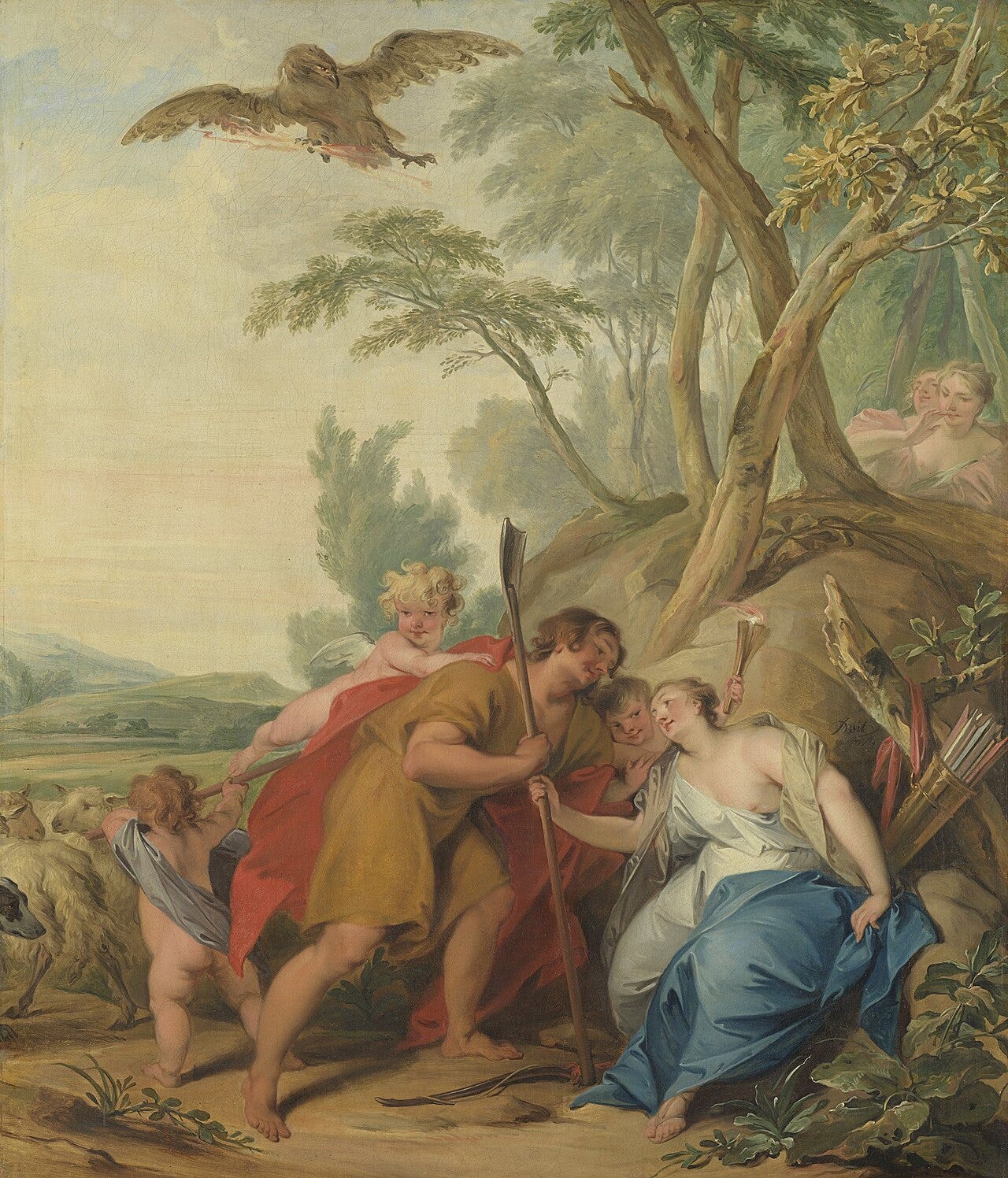
(Mnemosyne seduced by Jupiter, Jacob de Wit, 1727)
To do so, I will shortly outline a few themes in Otto’s contribution. The first theme, indeed the one that Otto opens with as his main argument, is that in addition to poetry and philosophy, one must grant that mythology offers a unique access to the phenomena of the divine. The 19th-century prejudice of relegating mythology as sub-logical has meant, according to him, the inability of our generation to lay claim to the phenomena mythology can grant us access to. Indeed, it is Otto’s claim that not even poetry is able to access some of the depths that mythology and cult may grant us. His argument then quickly runs through familiar interpretations of the phenomenon of temporality in Hölderlin’s poetry, interpretations which both Otto and Heidegger shared from the mid-30s, and as Stavru indicated, to know who among them was the first to originate is impossible.
Be that as it may, the interpretation is that it is a common experience - indeed an experience analysed in Heidegger’s Being and Time back in 1927 - to see in time a destructive element, something that ‘breaks’ everything standing and makes it fade into the ephemeral past. In terms of this experience, the past is not really distinct, and the divine may be attributed solely to the eternal, that is thus understood as opposed to the transience of human existence. However, according to all three figures we are here considering - Heidegger, Otto and Hölderlin - there’s another way of understanding this experience. Otto lays it out in a particular way: In memory, the past is transformed into something to be venerated. Indeed, after several poetic authorities such as Goethe and Leopardi, Otto speaks to how the past has a unique being precisely as something holy from which “the Word” is born. After citing yet again from Hölderlin to corroborate it, Otto evokes directly, for the first time, mythology:
Mnemosyne, the goddess of remembrance, is to the Greeks the mother of the Muses, who of all the gods are most closely bound to Olympian Zeus. They sing, to be sure, also of the present and of the future, which have their own divinity. But their noblest calling is to raise what has been into the splendour of eternity. The pride of the ancient poet is that with his song he can immortalise. And in the great age this is the true immortality: that the figure is imperishable in song. But that the poet can so sing of what is past is not merely the merit of the poetic gift. He is the receiving one, and the one who gives from out of the reception. A heightened being comes to meet him in what is past, as what-has-been, in order to kindle him. Much, to be sure, passes away like a shadow and is seemingly lost. But what is significant waits for the word that attests its eternity. In it becomes manifest that not only individual Being after death, but what-has-been in general, has an essence and has passed over into a kind of divine existence. Therefore the Muses, the heralds of the true, do not know the dark gravity of death; […]
It is at least feasible that here Otto hints at a critique of Heidegger’s existential analysis of the experience of transience in the second division of Being and Time. Indeed, Otto’s contribution intentionally reverses the title of Heidegger’s famous book, following his implied critique of Heidegger’s interpretation of temporality. A move that Heidegger himself will employ in a famous reckoning lecture he will give, accompanied by the same rhetorical reversal about a decade later. The rest of Otto’s article is devoted to exploring the divine being entailed in the present and the future.
But again, back to our initial question. What would Heidegger make of Otto’s contribution? Well, again, I can only suggest, but I think Heidegger’s involvement in Otto’s contribution was carried through the further cultivation of his own thinking in the following year to the letter. The year in which he developed his famous course, and eventually a book, “What is called thinking?” And indeed, there Heidegger starts with the question of man and seems to revise, yet again, the existential argument of Being and Time. Man, he argues, is not determined solely based on either his ability or his inclination, which may even run counter to his ability. This is a repeating theme in Being and Time, in which, as we already saw, the “I” is partially - existentially - determined through his inclination to confuse himself with extant entities. Indeed, it is in the countering of this inclination that the outstanding essence of himself is to be revealed.
Now, however, in 1951, Heidegger is more careful not to allow the possibility of self-grounding. Thinking, he holds, is always thinking of something that withdraws itself from us. Man, Heidegger maintains, is being drawn into this withdrawal of what must be thought. And Heidegger has an interesting way of driving this particular point home:
To the extent that man is drawing that way, he points toward what withdraws. As he is pointing that way, man is the pointer. […] Something which in itself, by its essential nature, is pointing, we call a sign [Zeichen]. […] But since this sign points toward what draws away, it points, not so much at what draws away as into the withdrawal. The sign stays without interpretation [Das Zeichen bleibt ohne Deutung].
Indeed, Heidegger seals the discussion about what the essence of man here is with a line from a particular poem by Hölderlin, which seems to radicalise the notion of true formalism even further:
We are a sign that is not read.
Ein Zeichen sind wir, deutungslos.
The poem, we are told, had many names before it settled on the one name – Mnemosyne. It is the last title that Heidegger holds on to for the rest of his discussion. He translates the Muse’s name into “Lady Memory.” The Titaness, the daughter of Heaven and Earth. Heidegger reiterates the mythological references in his evocation of Lady Memory, but not before explaining that the dichotomy between mythos and logos is false. Mythos, we are told, is that which makes man think of what appears, what is in being. Logos says the same. It is only with Plato, Heidegger claims, that the two got separated:
Historians and philologists, by virtue of a prejudice which modern rationalism adopted from Platonism, imagine that mythos was destroyed by logos. But nothing religious is destroyed by logic; it is destroyed only by the God’s withdrawal.
Heidegger might as well have uttered such remarks in a spoken dialogue with Otto’s contribution. Heidegger finds the original meaning of memory to be not the one attested to by metaphysics, as representation or an idea of something which is past, but the one which mythology recommends. Memory, from the Latin memor, means something that is thought, in the mind. As the mother of the muses, however, memory is “the gathering and convergence of thought upon what everywhere demands to be thought about first of all.” Memory, we are told, is thinking back, recollection. Poetry, Heidegger claims, “wells up only from devoted thought thinking back, recollecting.”
Implicitly, Heidegger gives us a staggering example of what might be ‘most important’ to think about, and what might be worth thinking about as an example of what man points to. God’s withdrawal is, according to Heidegger, what allows for the destruction of cult and mythology. Mythology is not destroyed, essentially, by a misunderstanding of anthropologists and psychologists, but by the initial withdrawal of the divine from the world. According to Heidegger, this initial withdrawal is also what made possible the separation of logos and myth. And we can trace that separation back to its more original ground only by understanding ourselves as Hölderlin’s sign - as pointing into withdrawal, into the withdrawal of what is most important to think about.
And so we reach the end of our footpath. Whether the spoken dialogue Heidegger hoped for - “a speaking, spoken one, and not merely a written one” - ever took place between the two about Otto’s contribution, the archives have not yet told us. But perhaps that is the task left to us: to take part, as he put it, in the contribution ourselves. This talk has been an attempt to do so - to let that conversation happen, belatedly, and out loud. Thank you.