


A German folktale tells the story of a young man named Hans who served his master for seven years. When the time came, Hans completed his service, and his master gave him a sack of gold and sent him on his way. Hans, cheerful and content, set off on his journey home. Along the way, he encountered a merchant with a horse, who asked him how he was doing.
“You know,” said Hans, “I’m great. I just received my wages for my work and am heading home.” The merchant eyed Hans’s sack of gold, thought for a moment, and said, “Listen, Hans, you have a long way to go. That sack looks heavy. Why not trade it for this fine horse? You’ll reach your home more easily.” Hans agreed and traded his gold for the horse. Cheerful and content, Hans continued his journey home.
At some point, he stopped to rest, as the horse appeared thirsty and tired from the road. An old farmer with a goose happened upon them. The farmer said to Hans, “Tell me, I see your horse is tired, and your journey must still be long. Why not trade your horse for my goose? You’ll have a good meal and then continue on your way home.” Hans, who was indeed hungry, looked at the goose and agreed. He took the goose, prepared himself a good meal, and continued home.
When Hans finally reached his parents’ home, they asked him, “Well, Hans, how was it?” Hans replied honestly, “Wonderful! I enjoyed the work and the journey home.”
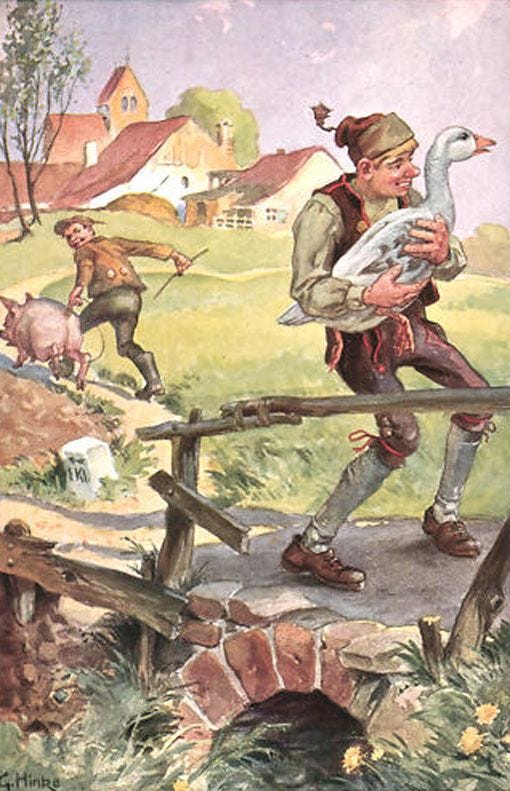
This story is fascinating for a simple reason: it’s hard not to see Hans as naïve, if not outright foolish. Yet this tale carries a moral lesson that is difficult for us to internalize in our current intellectual climate: the human relationship to luck is not trivial. Teaching Hans to “optimize” his choices and compare his outcomes to others’ would ultimately rob him of his most precious possession—his happiness. Let us not be quick to take from Hans his singular treasure. Let us explore Hans’s fate in modern political philosophy. Would he even make it home safely in our current intellectual climate?
Recently, Michael Sandel’s book The Tyranny of Merit (2020) was published. In it, Sandel offers a robust critique of meritocratic political ideologies—those that claim society should be structured to reward individuals based on personal excellence. Sandel’s criticism of such societal structures is not new. Liberals from Friedrich Hayek to John Rawls have argued that the ideal social order should not be taken to mirror an ideal moral order. For instance, the fact that someone is wealthy or a professor should not grant them higher social status than someone who works as a cobbler. According to the liberal framework, which Sandel also embraces, individuals should understand that the allocation of decent social status isn’t meant to be reflected in the liberal social structure.
What’s new in Sandel’s analysis is his exploration of how liberal politics create a social order where personal achievements are strongly tied to social status. Sandel convincingly shows that this connection is endemic to the rhetoric and politics that emphasize meritocracy. In such a society, there are winners and losers. The winners always feel entitled to their position, while the losers often harbor resentment—towards the winners and perhaps towards the entire system. Sandel demonstrates that societies with a more relaxed attitude toward the link between personal effort and social status tended to express broader social solidarity. He even shows that societies with theologies emphasizing divine grace over human responsibility exhibited a more humane approach to those less fortunate.
Sandel’s fundamental claim is that meritocracy has a dark side, recently encountered by Western politics: populism. Populism reflects resentment in the lower and middle classes who, on the one hand, believe they live in a meritocratic order—or at least a sufficiently meritocratic one—but, on the other hand, find that their personal circumstances have prevented them from advancing in life. In this situation, these classes, according to Sandel, seek authoritarian leadership or strong national identities to reclaim some sense of self-worth. This resentment also generates feelings of shame, which collective glory may redeem.
But what can Sandel teach our Hans? Here, his proposal seems weaker. Sandel is well aware of the challenges of promoting distributive justice through politics, but much of his argument is dedicated to showing how liberal reforms for equal opportunity actually obscure underlying distributive injustice. While he might praise Hans for his foundational attitude, he simultaneously seeks to teach him that politics should indeed ensure fairer distribution. As a result, Hans is left with resentment—but now transformed: from resentment towards the winners to resentment towards the entire system, which is theoretically always subject to human change and therefore human responsibility. This assumption, which Sandel critiques in theological terms, undermines solidarity and the potential for cross-class cooperation towards the common good.
This tension in Sandel’s work is not trivial. The source of Sandel’s argument, and where it is most successfully articulated, is in a very short essay by Justus Möser (1720–1794), the proto-conservative thinker of Germany, titled On the Promotion of Ability (1770). If our concern is truly for the common good, and we understand that luck, especially regarding social status, is almost anthropological rather than cultural, Möser teaches Hans precisely what he already knows: that in politics, where humans set just criteria for social advancement, resentment and social dissatisfaction will always reign. It is better to promote a politics of the common good that deliberately preserves room for arbitrariness, leaving individuals free from resentment. In Möser’s words:
A state with more excellent people than it can reward through public office will be unhappy. If this is the case, it will always be unpleasant for many to imagine that those receiving rewards are also the best among them, and that every honor also denotes the finest knight. Now that this is not so, people can comfortably think: fortune, not excellence, enabled their rise […] But if everything were based on excellence, this necessary comfort would vanish, and the cobbler happy in his craft—so long as he could flatter himself he would be doing something entirely different than fixing the mayor’s wife’s clogs were excellence honored in this world—would never again find happiness.
In other words, Sandel’s argument is correct, but it needs expansion. A politics that places full responsibility for an individual’s condition not only on them as individuals but even on all citizens or humanity as a whole will always generate resentment. This resentment will sabotage solidarity among all citizens and prevent them from advancing the common good. This is true of Clinton, but also of Sanders. It applies to Rawls but also to Marx and his successors. Hans will not emerge unscathed from our politics.