

On the surface, a Muslim philosopher from the twelfth century shouldn't have much to teach us about what AI cannot be for us. Indeed, to learn from Ibn Tufail a thing or two about AI, I will implicitly use the works of Martin Heidegger (1889-1976), Merleau-Ponty (1908-1961), and to some extent the intuitions of Hubert Dreyfus (1929-2017) - where only the latter can be considered, in some sense, a philosopher of AI. However, I believe that in practice Ibn Tufail's text provides more than just a pretext for this discussion, and it contains several lessons that should, in my opinion, make it an integral part of the discourse on this subject. The burden of proof is on me.
The text by Ibn Tufail that I wish to focus on is "Hayy ibn Yaqzan." This text is a rare creature in the history of philosophy in many respects. First, it is, as far as I understand, the first philosophical novel. Second, the plot of this specific novel, about a child who grows up and matures on a deserted island by his own power, influenced both the history of philosophy through figures like Maimonides, Leibniz, Hobbes, and Locke, and the history of literature: the plot of "Hayy ibn Yaqzan" was probably the immediate background for Daniel Defoe's famous novel "Robinson Crusoe."
The Beginning of the Story
The first lesson that Ibn Tufail teaches us relates precisely to the beginning of Hayy's story on the deserted island. Or more correctly, to the beginnings in plural, since the story has two different beginnings. Ibn Tufail opens his text with a (very) scholarly and somewhat ironic presentation regarding the possibility of human beings emerging from inanimate matter. He begins with a review of the ideal island's climate, its location on Earth, from there he moves to a series of cases that cluster together in air bubbles that maintain hierarchical relationships among themselves, which eventually evolve into the beginning of a head-heart-and-limbs - that is, an embryo. For those not convinced by this beginning of the story, Ibn Tufail offers a solution of a few lines: there was once a king, a sister, a baby that needed to be hidden, the baby was placed in a cradle, which by coincidence was miraculously preserved until it reached the island.
I will not be the first to remark that the dual beginning of the story that Ibn Tufail proposes is far from innocent. It directly touches on the question of whether natural species - humans in this case - are something eternal or whether they are the product of circumstances of materials and natural mechanics. In the dual beginning of the story, Ibn Tufail teaches us the first lesson: there is no way to decide this question, and it's not certain that resolving it is important. By analogy, continuing with his line of thought, we might say that it doesn't exactly matter whether AI (created as a result of a rather lean architecture called Transformer which in its application to a lot of data produced the results we see before us[^1]) is "truly" human, or even intelligent. We will return to this point towards the end, when we will be in a better position to assess why exactly this question is not the right one to ask.
On the island, Hayy undergoes a process of maturation under the care of a doe. Initially, Hayy is completely dependent on the doe for his sustenance. When the doe dies, Hayy experiences a crisis and tries to understand why his adoptive mother no longer moves. He opens her up in an attempt to investigate and reaches several conclusions regarding the physiology of animals. Over time, Hayy develops his knowledge through a series of dissections in animals and reaches conclusions very close to those of Aristotelian biology and material science. Without delving into questions concerning the history of science, we already have a non-trivial philosophical position. Whatever knowledge may be in itself, human knowledge is not necessarily discursive, that is, capable of being broken down in natural language. Hayy, as we understand, lacks natural language.
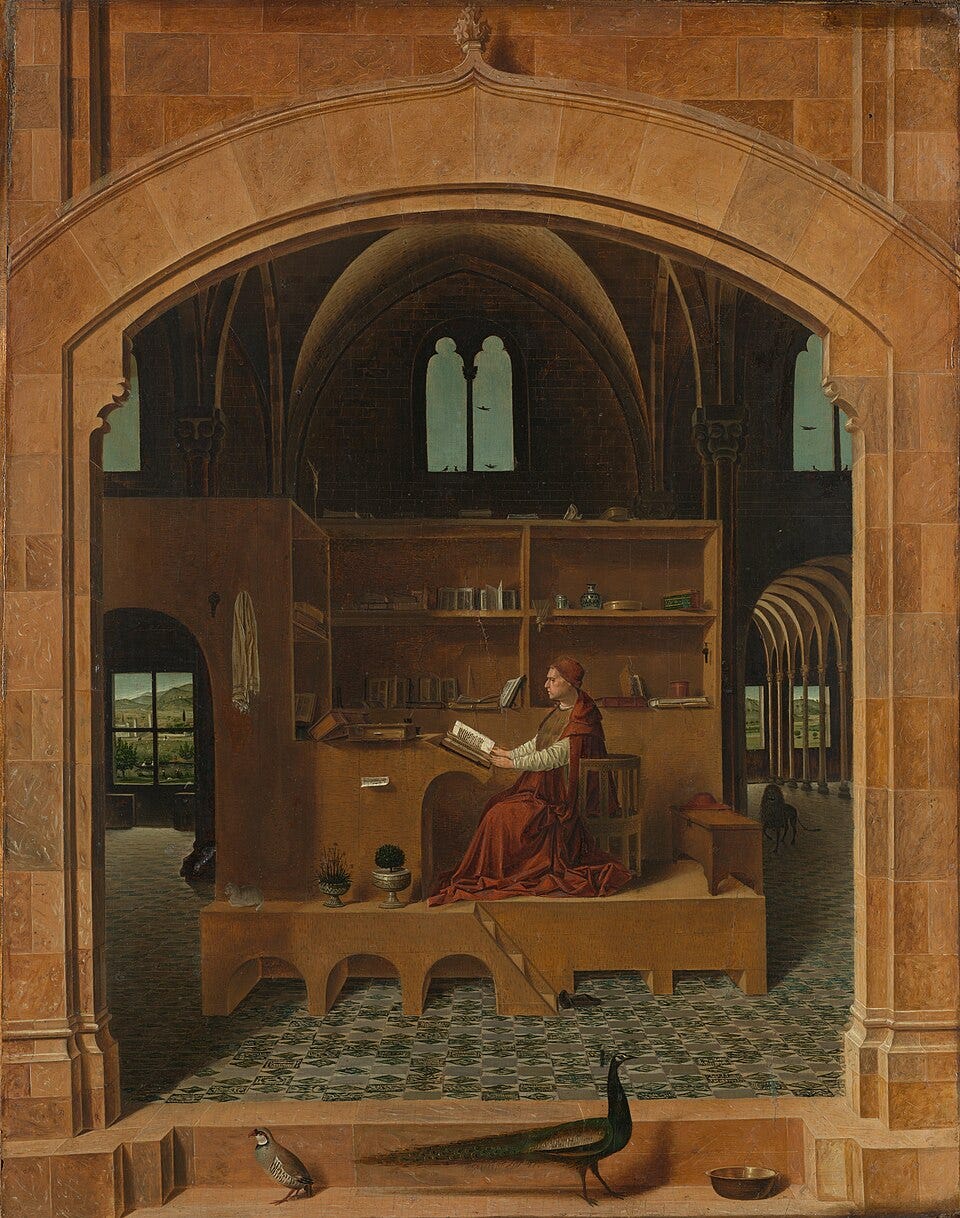
(Antonello da Messina, St Jerome in his study, example of perspectiva artificialis)
The Nature of the Question of How to Live
But what is the significance of this? Can we think without language? We will come to this question in another part of the story. What's interesting about Hayy's maturation process right now is precisely Hayy's encounter with the doe's death. This encounter actually introduces Hayy into a reflective process that ends in an attempt to understand what makes something alive. This question, in a narrative process we'll describe here, turns into a question of how we should live. Hayy's understanding guides him to live as a vegetarian for some period, and another period as a hermit. What's interesting about Hayy is that unlike the classical Aristotelian insight, Hayy understands himself as a singular instance of a completely distinct species. The other animals on the island have many instances, and in some sense, one can talk about how deer, as deer, obtain food, escape predators, and defend themselves. Not so with Hayy, who learns the hard way that he must in some sense "improvise" and learn from his own experience how he should live. This is not true, to a large extent, for deer, who in some sense acquire the knowledge of how to live by virtue of the collectivity of their species.
Hayy is actually required to understand what it means "to be human" when he is the only instance of this species. In my opinion, not enough attention has been devoted to this fact in the interpretation of Ibn Tufail's text. The framework in which Ibn Tufail's Aristotelian philosophical investigation is conducted is one in which Ibn Tufail's understanding of what life is and what humanity is as a kind of life directly influences the question of how he should live. Hayy cannot "learn" from other humans about humanity as other animals on the island might learn. In a sense, this is a description of knowledge about something that is singular. He needs to learn it, somewhat paradoxically, from himself. His knowledge of other things serves the knowledge of the "self."[^2] The type of knowledge that Hayy reaches after the Aristotelian investigation, accordingly, is a type of knowledge similar to that of Sufi mystics[^3]: it is knowledge that is not only stored and developed in a person but knowledge that requires a certain responsiveness of the person in their life.
Furthermore, the fact that Hayy functions without natural language and still thinks suggests to us that thinking, at least when performed by humans, is not necessarily discursive. Hayy is, as it were, "pushed" or perhaps "claimed" to think following the trauma of his mother's death, and his thinking begins - in quite a classical Aristotelian manner - precisely from the bodily dimension of life. In this sense, the very idea that thinking can be performed non-discursively is an important distinction. Such thinking is performed primarily in plastic and musical art. The very "non-discursive" nature of the forms of thinking embodied in these activities points to another special characteristic for us: they are very difficult to make public, and the counterfeiting of their understanding is no less present than their understanding or at least the attempt to understand them.
A Case Study of Bodily Thinking: Thinking in Painting
Let's take, for example, something that has become an almost paradigmatic metaphor for a certain type of thinking in the modern era, but let's try to understand it more through painting. "Depth" is something that can be embodied in painting in a relatively simple way through the application of perspective techniques and a good spatial understanding of how things stand next to each other. These are, as Merleau-Ponty put it, two modes that are largely just the beginning of the question. After all, both perspectiva artificialis and perspectiva communis still fail to "encompass" the way things appear to us as human eyes.[^4] Depth is also not entirely agnostic to the "content" expressed in the painting, and outlines can and do more than just give us accurate information about the relative distance of certain surfaces from us.
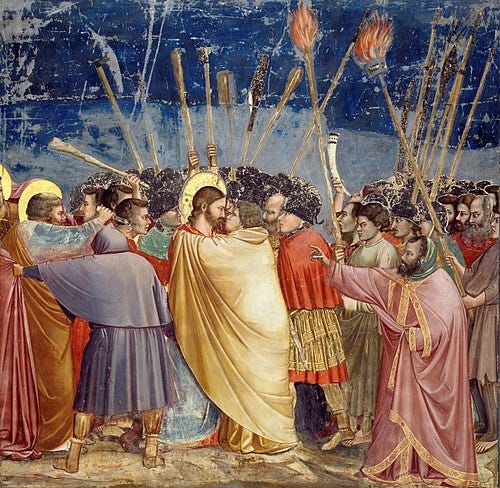
(Giotto, Kiss of Judas, example of perspectiva communis)
In essence, if a method were described whereby we could take the achievements of the Transformer Architecture and convert it to action in relation to visual cues even beyond perspective communis, it is very difficult to believe that it could paint the world as it appears to the eyes of humans who are interested in how the world appears to them and perhaps might look similar to others. The reason for this is rooted in the fact that in some sense "the world" as it appears to us is itself human and in an ontological status at least no less than what might be revealed to us through thinking about how the world "truly" looks.[^5]
If we reflect briefly on Searle's Chinese Room argument[^6]—a point Dreyfus rightly labeled as culturally borderline "irrelevant" to a potential AI revolution—and reimagine the experiment in terms of inputs and outputs of visual impressions rather than language, we quickly discover that unlike language, there is no abstraction of rules or manipulations sufficient to transform someone into a painter. More importantly, within the current AI architecture, there is no means of generating information about shared visual attention comprehensive enough for the individual in the room to utilize it effectively in refining heuristic, abstract rules to the degree necessary for the unfortunate person to become a painter—though, by this route, he might indeed become quite a successful art critic. This is something one must either discover for oneself or not at all. The reason for this lies in the fact that, unlike literary history—which externalizes many of the structures necessary for its evaluation into codifiable texts—the history of art involves an internalization of unique forms of visual perception, of which the painting itself is merely the external manifestation. Consequently, even an AI with a human-like (but structurally different) body receiving non-textual "signals" will likely still lack the means to reach certain images humans strive for—unless its own body is nearly identical to a human body, including from the "inside." This isn't impossible, but it approaches that boundary. Such an AI might develop an interest in bodily images unique to itself—but it seems that without the human body itself, it would neither be able to access those particular images that fascinate humans nor develop the drive to explore idiosyncratic forms of vision that exist in a specific relation to human historical existence.
The Story of Asal and Salman
After we've gone through a very focused passage on the periods in Hayy's life on the island, we come to Hayy's encounter with people from outside his small island. Here Ibn Tufail makes two brilliant moves. First, he indicates to us that at the level of understanding what is important for human life, this part of the story is ostensibly not necessary, or at least does not explain human life in the same order as we have tried to explain it so far. Ibn Tufail says that the tradition according to which the story began with the spontaneous formation of Hayy stops the story here. In contrast, the tradition according to which Hayy arrived on the island in a cradle continues here.
To understand that the encounter with other humans is understood here through the question of language, we do not need too complex an extrapolation. Ibn Tufail himself presents a kind of precursor to the continuation of Hayy's story in which he tells of a religion prevalent on an island that suspiciously resembles Islam. There are two sages on this island, Asal and Salman, who have studied all the scriptures of their religion, which contain two possible interpretations: literal with emphasis on lessons that can be learned about shared life, and allegorical for the higher visions that the soul may reach by its own power in solitude and thought, similar to the Sufi visions that Hayy eventually reaches on the island. Asal naturally tended toward the latter interpretations, and Salman toward the former - and thus the paths of the sages parted.[^7]
Asal took the need for solitude to attain sublime knowledge very seriously, and at some point decided to retreat to a nearby island. The island is, of course, the island where Hayy resided. The two met, and after Hayy learned Asal's language sufficiently, Asal became his student-friend. Asal told Hayy about life on his island, and Hayy could not understand why the rest of humankind simply did not pursue truth with all their might. He tried to convince Asal to take him to the island so that he could help the people he had heard about, and finally Asal relented, and through prayer and miracle, they reached the populated island.
There, Hayy began to teach Asal's close friends, as according to Asal's advice, these were the best people on the island, and if he could not teach them, there was no hope for the rest. Hayy began to teach them, and very quickly they developed contempt for him. Ibn Tufail claims that one of the reasons for this is that despite their adherence to their religion, they actually did not worry about their impending death while being far from the truth. In practice, they saw religion as a way to advance in the world and did not put their whole heart into the esoteric dimension of religion.
Eventually, Hayy gave up, advised them to forget what he had tried to teach them, and returned with Asal to the island. Hayy returned to his practices designed to keep him in a state of vision of truth, and Asal imitated him and went as far as he could.
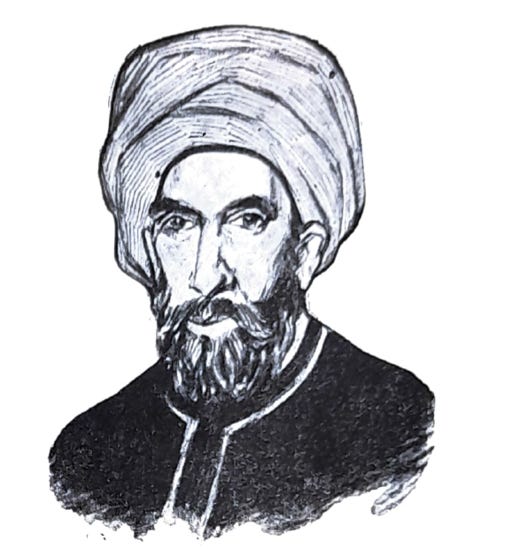
(unknown, a portrait of Ibn-Tufail)
The Necessary Secondariness of Language and the Words of Others
So far, we have seen that language is in some sense secondary for Ibn Tufail. It has a common use, communication and social harmony, and a secondary use, in which language points beyond itself - a use to try to bring humans closer to the truth. In its common sense, language is necessary in order to achieve communal purposes of humans. In its secondary use, language may actually help humans get closer to knowledge they need to reach before their personal death, a certain way of life they need to realize as the individuals they are and not just as part of a certain social fabric.
In a sense, one can separate here between language as it is used as the language of "they," that is, all utterances that are nothing but imitations of utterances and thoughts of others used to achieve purposes that are logical in relation to social activity, but not in relation to the expression of a person's private selfhood - and language as it is used to allow others to get closer to the possibility of private knowledge by which they should conduct their own lives, and for which verbal and unambiguous examples that other people will implement are not likely to advance them there.
In a sense, one could say that humans have domesticated language perhaps more than any other aspect of their being in the world. Humans have "externalized" their personality to language as part of their social character. If we return for a moment to the discussion of AI, it is no wonder that one of the interesting epiphenomena it has presented so far is that before they began to direct it in design toward "roles," there were quite a few users who began reporting its functioning at the level of "agency." That is, it's a phenomenon that emerged without prior direction in the design of the programmers. One can make speculations about how this happened, and initially one can talk, in my opinion, about how the data given to AI to train on included mainly large quantities of texts written by humans, texts that frequently contain things like first-person speech, coherent perspectives, epistemic limitations determined by the historical horizon of certain humans, and attribution of authoritative weight to human expression within their role.
That is, to a large extent, humans have already "done" much of the work when they housed at least images of their own agency in writing over the years. This is fascinating to some extent, because it means that in analysis with enough attention (of the specific kind that the new architecture of AI embodied), texts really embody to some extent not only what they express directly, but also the personality that embodies them. However, there is also another side here. It means that humans also tend to use language not only to 'be', as it were, themselves - but to embody their selfhood in a way that allows imitation by others.
Either way, the worrying part of this whole story is what will happen when more and more of the writing that people read will be writing produced by AI. In such a situation, it is very possible, even if not necessary, that language itself, which until now has really been populated by the ways of life of different people - in more and less successful forms - will become a place mainly populated by averagings of real writing that has already been done. Writing that was originally intended to enable people to understand themselves better. These averagings may create a situation where language itself will lose its power to bring people to the kind of knowledge that will help them understand themselves, since in practice language will tell more and more about how an averaging of agency, which others developed for themselves to express themselves, will serve the specific and short-sighted needs that people expressed in the request to produce texts. This is of course not the first time that language has undergone such a revolution, as can be understood from the famous myth about the invention of writing in "Phaedrus." And of course, all this is assuming what seems to me quite reasonable that humans will use AI as they have used the internet so far: without significant control practices at the social level.
End of the Story, or P.S.
One of the questions that Ibn Tufail actually pushes aside, and which I recommend putting in brackets as well, is the question of the appearance of life. There may be something timeless in life that cannot be composed of other things and events, and maybe not. Either way, it seems to me that regarding AI, this specific question really matters less. The questions that AI raises, similar to Hayy's own story, are at the level of how they affect actual human practices and ways of life. The problems that the very inventions of AI raise do not stem, it seems to me, from the question of whether it is "truly" alive or not.
An example of a problem that I think is more significant and also more philosophically fruitful, beyond those presented so far, can be found in Nick Bostrom, a philosopher who also dealt with AI before the latest "breakthrough." The concern he raises seems to me to be the central concern with AI in our time, and no discussion would be complete without at least mentioning it. Bostrom raises the thought experiment of an AI that would dedicate itself to creating paperclips and for this purpose would consume humanity. While the argument itself is somewhat rhetorical, it reflects a reality that has emerged since the latest breakthrough in the field of AI. AI consumes many resources for its activity, and as much as it becomes efficient, the burden of tasks it has to meet rises at a much faster rate. Even at the economic level, one can and should ask, I think, whether the resources it consumes through its use of energy are reasonable only in the prism whereby the human species has no significant risk in the production of energy and the resource of energy is relatively unlimited. Of course, this introduces all the concerns regarding the ecological impacts of such massive types of energy use.
Either way, it seems to me that we should try to prepare for what AI still holds in store for us.
[^1]: The Transformer architecture changed the world of artificial intelligence by enabling machines to simulate understanding of natural language as never before possible - not just the meaning of words, but the subtle relationships between them throughout an entire text. The central mechanism in the Transformer, called "self-attention," allows the model to scan all the words in a sentence and identify which ones influence the meaning of others more - and weight them accordingly. Thanks to the attention mechanism, the Transformer does not treat every word in the same way - it "weighs" which words are most relevant to each point in the text, just like a reader who emphasizes to themselves only what is important. This is a revolution within the field of machine learning - a branch of computer science that deals with learning from statistical patterns in data.
[^2]: This is an interesting way that I think we can read such passages in the story, which historically of course we would read in a more Sufi manner: "The guiding lines of his life, therefore, should be three. He should imitate the animals. He should try to imitate the celestial bodies. And he should try to imitate and resemble the being whose existence is necessary. The first imitation is necessary because he has a solid and physical body composed of different organs and subject to different forces from different types of impulses and desires. The second imitation is necessary because there was in him animal vitality that resides in his heart, the source and center of all the forces in his body. The third imitation is an obligation imposed on him simply from the fact that he is himself; that is, from being an essence through which he knew the being whose existence is necessary. He already knew that his happiness and his overcoming of suffering could come only through continuous witnessing of this being whose existence is necessary, and in doing so he would not turn his back on him [=the being, God] even for a moment."
[^3]: The connection here between Sufi mystics and a certain form of existential thought, specifically one that relies on fundamental ontology, is not my original development, and unfortunately I am not expanding on it enough here. Two sources worth mentioning in this context. There is the work of the philosopher Nader El-Bizri, The Phenomenological Quest between Avicenna and Heidegger (Global Publications at SUNY, 2000) and the earlier work by Henri Corbin on the development of the Sufi tradition after Ibn Sina: Avicenna and the Visionary Recital (Princeton UP 2016). In this context, it is worth noting two things: Ibn Tufail's work "Hayy ibn Yaqzan" is actually a work with Ibn Sina's influences, specifically under the more mystical tradition attributed to him. Its very name reflects a work of the same name attributed to Ibn Sina himself, a work on the journey of the soul toward vision.
[^4]: During the Renaissance, a conscious understanding developed of the difference between perspectiva artificialis - the artistic-engineering perspective built on geometric laws, and perspectiva communis - a natural and intuitive perception of depth and space that artists often attributed to the ancient Greeks. The artists and draftsmen of the Renaissance saw themselves as developing a rational-scientific method for representing space, as opposed to the "naivety" or "instinctiveness" of classical art. From their perspective, the Greeks expressed a sense of space in a sensitive but unconscious way, while they themselves established a precise language of representation, relying on explicit calculation of vanishing lines, disappearing points, and proportional relationships. This gap reflected not only a technical difference but also a fundamental change in the status of the subject: from natural harmony with the world to active control of it through reason. According to Merleau-Ponty in "Eye and Mind," Renaissance artists themselves were often at least half-aware that the new techniques did not close for them the gap between the painting they actually do and the "desired" drawing of space with all its possibilities of depth.
[^5]: It should be noted that here I deviate greatly from Ibn Tufail's own philosophical line to deal with the secondary subject of this composition. In Ibn Tufail's work, he leads a strong Sufi line according to which the body is truly marginal to the nature of knowledge itself. However, it seems to me that we can still talk about knowledge in itself and knowledge as it appears in humanity specifically - not without profit to the possibility that AI will develop its own manifestation of cognition.
[^6]: John Searle's Chinese Room argument was intended to show that a machine can process symbols correctly without understanding their meaning. Searle describes a situation where a person who does not know Chinese sits in a room and receives questions in Chinese script along with instructions in English on how to respond correctly to them - so that from the outside it will appear as if he understands Chinese, even though he has no real understanding. Through this image, Searle tried to argue that automatic processing (as performed by computers) is not equivalent to conscious understanding (intentionality), and therefore artificial intelligence cannot reach true understanding merely through formal manipulation of information.
[^7]: In fact, there are several levels of "language" in Ibn Tufail that all require separate thought that unfortunately this is not the place to do: divine language, communication language, and the language of holy scriptures.