


When you approach reading a thinker, do you consider whether they are a fox or a hedgehog? One of the most famous essays of the 20th century—or more accurately, the beginning of one of the most famous essays in intellectual history—is Isaiah Berlin's "The Hedgehog and the Fox" (1953), which was dedicated to the question of history in Tolstoy's thought. The reason this essay is so famous has little to do with Berlin's somewhat convoluted thesis regarding the status of history in Tolstoy's thought, but rather because at the beginning of the essay, Berlin proposed an interesting distinction between two different types of thinking people: hedgehogs and foxes. The distinction stems from a quote by Archilochus: "The fox knows many things, but the hedgehog knows one big thing."
One of the surprising things Berlin demonstrated is how, at least superficially, many of the greatest philosophers and writers in Western thought can be compared using this distinction. According to Berlin, the fox knows many things, pursues several different lines of thought, scatters in self-contradictions, and tries as much as possible to "consume" the world as it is, not as the fox would like it to be. In contrast, the hedgehog knows one big thing, has one grand idea, constantly burrows into it, and tries to structure everything according to it. If we think about it for a moment, in my opinion, we can easily classify Hegel, Aristotle, Kant, and probably Descartes as hedgehogs. In contrast, Nietzsche, Plato, Benjamin, and Pascal are distinctive foxes.
As entertaining as this distinction may be, I think it opens an interesting door to the broader question of metaphors and philosophy. In 1960, Hans Blumenberg published a small book called "Paradigms for a Metaphorology." In this book, Blumenberg gave perhaps the most systematic treatment to one of the ideas that particularly distinguished his later philosophical thinking: the absoluteness of metaphors.
Absolute Metaphors
According to Blumenberg, metaphors in the history of philosophy do not function only (and perhaps not even primarily) in an illustrative manner. They do not come, in other words, merely to clarify and make more accessible some pure theoretical or conceptual point. For Blumenberg, metaphors have an absolute dimension that cannot be reduced unambiguously to any specific conceptual content. The true power of Blumenberg's argument in his book is actually expressed not directly in the arena of philosophical thought, but indirectly through his thinking about the history of philosophy. There, Blumenberg convincingly shows how a metaphor that served one thinker for a very specific theoretical content might serve a completely different illustrative function for another thinker. But here we are still in the realm of the agreed-upon—yes, metaphors, because they are not precise, can bear more descriptive possibilities than concepts, which tend to be unambiguous by nature.
However, this is not the provocative part of Blumenberg's argument. According to Blumenberg, metaphors have an almost teleological power in the history of philosophy. They function as centers of attraction around which thought is organized, no less if not more than something through which thought is illustrated. Blumenberg tries to develop this argument and demonstrate how metaphors actually "pull" conceptual thinking after them when looking not at isolated thought, but at the function of metaphor in the history of philosophy. This, in fact, is Blumenberg's provocative argument: metaphors are absolute, and they have a regulative function in relation to thinking itself.
If we return to Berlin's metaphor, it is difficult—it seems to me—to think of someone who would take them seriously enough that they would actually guide their thinking. Nevertheless, I think it is clear, for example, that Descartes' metaphor of the city and the city planner plays such a role in his famous book "On Method." The metaphor of light and darkness, with all its Gnostic implications, occupies significant space in the study of the Enlightenment movement. Finally, there are metaphors that are difficult to escape from their control—and only after considerable effort can one do so. For instance, the metaphor, which goes back to Romanticism and German Idealism, of Thomas Aquinas's thought as a medieval cathedral, which Gilson alludes to, gripped me even after I read quite a bit of Thomas, and even Hegel. It was only after I began to read the “Summa Theologica” systematically, thanks to Ayelet Even-Ezra's translation, that I realized that the image, as beautiful as it is, is far from reality. Perhaps Thomas wanted to build a cathedral of thought, but his actual achievement was far from that, and looked more, if I may say so, like a university campus.
Regulatory Metaphors, Not Absolute
However, Berlin's metaphors might play a less absolute role than Blumenberg hoped for, but perhaps a more interesting one. Berlin's metaphors were not intended to describe the philosophical development of a certain body of thought, but to teach how to read a certain body of thought. This is a fundamentally different role, and metaphors undoubtedly have a regulatory function no less important than Blumenberg's absolute metaphors. To clarify what I mean, consider Hegel's owl metaphor. Hegel's owl teaches us—or suggests to us—that Hegel should be read from beginning to end, with the expectation that the end will, retroactively, make the progression clear. Alternatively, there is a metaphor that has been somewhat hidden in the history of philosophy but is also instructive: in his lectures on "The History of the Concept of Time," Heidegger compares his central concept, Dasein, to a snail. This metaphor is meant to be a counter-metaphor to Plato and Augustine's metaphor regarding the "little man" inside us who is actually us. The snail, Heidegger argues, even when it is inside its shell, is "wholly outside." Perhaps the snail metaphor teaches us something about the reading pace Heidegger expected from his readers, and perhaps there is something about the snail that evokes a feeling in us that might parallel the feeling we get from reading Heidegger.
In any case, metaphors also have a regulatory function in how we read. If I tell you that Nietzsche is a fox, the implication is probably that reading him as if he were a hedgehog is futile. If I tell you that Leibniz is a hedgehog, reading him as if he were a fox would probably not be as profitable. Either way, one can think of other functions metaphors have besides the absolute function Blumenberg assigns them.
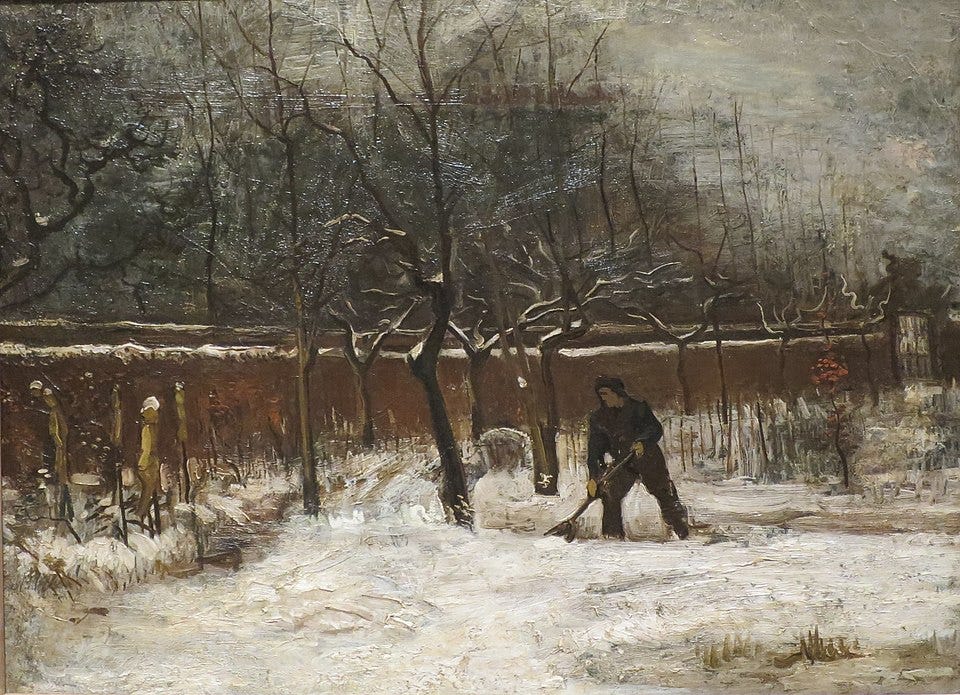
(van Gogh, The rectory garden in Nuenen in the Snow, January 1885)
My Metaphor for the Contemplative Life
A few years ago, a friend discussed with me how I understand the vita contemplativa (=the contemplative life). I began to explain about some ideas I'm developing, about the time it takes me, about how some have connections between them, that some are more boutique—that some take longer to "ripen" and others less. And then it hit me. The most accurate way (even if not absolute) to describe the contemplative life from my perspective is akin to gardening. The life of thought is comparable to tending a garden. There are various types of plants. Some require little attention, requiring you to leave them alone for a period. There are others, even among those that generally don't want attention, that will wither if they don't receive some care. There are also small flowers that don't require much beyond planting and a little rain to yield their fruit. Above all, there are demanding ones, where you are constantly wondering if you're successful enough as a gardener now to take responsibility for them.
So, what does your garden look like?
....and below the quiet, seemingly solitary plants , there are the interwoven rhizomes teeming/teaming with commensals who -unseen- make for the growth and ripening