


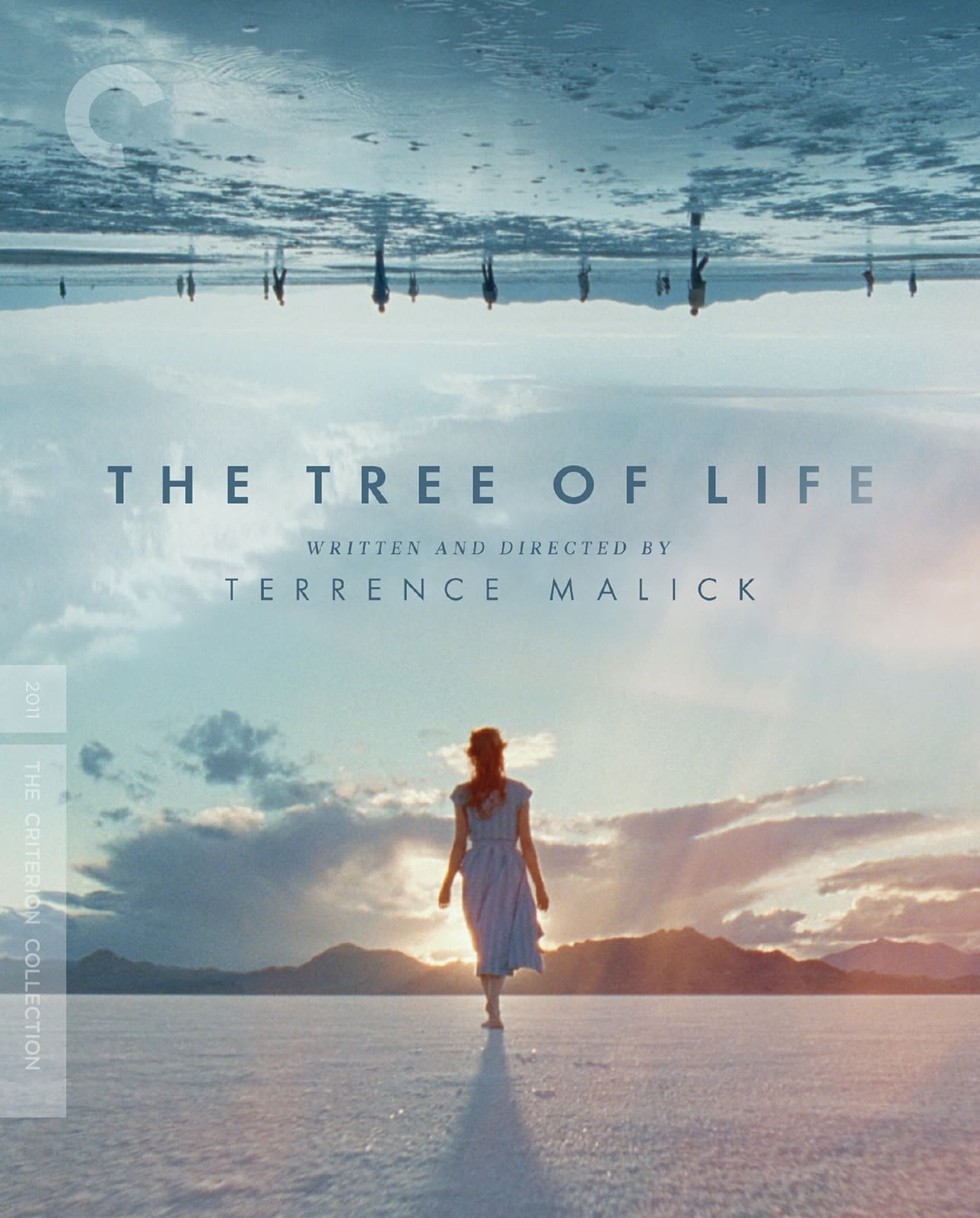
About what I think was ten years ago, though certainly less than that, I sat with a friend who at the time was writing a thesis on Hans Urs von Balthasar. I believe this single encounter gives a general impression of the orientation of that person: he thinks deeply, thinks a lot, possesses a developed religious thought, and is a true man of culture. He recommended I watch the film "The Tree of Life" by Terrence Malick. Now, one must understand how absurd this recommendation actually is. While I do know a thing or two, reading here and there, I can attest to myself that I am a philistine almost beyond repair. Anything that smells of "culture" is almost completely foreign to me, and certainly anything related to cinema (and film theory, not movies) gives me a rash. I have seen, like everyone else, a bit of Kubrick, and a bit of Bergman, but that’s where it ends. I am truly unable to sit through an hour and a half of "artistic creation" without feeling disgust, contempt, and repulsion.
But the recommendation was spot on. The marketing of it was correct: my friend told me a bit about Malick to assure me that this was not a film made by an idiot, but he refused to say a word about the film itself. I watched the film—two hours and a bit of the most "artsy" movie you can imagine—and I came out thoughtful and with renewed respect for the medium. The respect didn’t last long, certainly not long enough for me to try my luck with other films, but certainly long enough for me to watch this film a few more times. Now, I could present the film to you, but I think my friend was right; it would only ruin it. Instead, I’ll share a bit about Malick from my perspective.
Terrence Malick studied the humanities at Harvard, and with his scholarship, he went on to graduate studies with a thesis at Oxford. He had a rather fundamental disagreement with his advisor, a character in his own right (Gilbert Ryle), about the concept of 'the world' in Kierkegaard, Heidegger, and Wittgenstein. Now, it should be understood that for someone like Ryle, the mere mention of all three in one sentence is certainly a source of a developed migraine. Due to their disagreements, he withdrew from his studies, returned to the U.S., and became a journalist and essayist for venues like The New Yorker. In short, the butter and cream of society. After that, he embarked on his film career.
But let’s pause for a moment on what he did just before he became a filmmaker. Toward the end of his time at Oxford, he translated Heidegger’s essay "The Essence of Reasons" or "The Essence of Grounds" [Vom Wesen des Grundes] and published it with an introduction of his own. This introduction is very secular and very sober regarding the nature of Heidegger’s writing, showing that the author struggles with this text time and again. The text itself is essentially the essay that Heidegger published in a Festschrift for Husserl's seventieth birthday. Before you ask, a Festschrift is what academics give each other as a gift as a sign of honor and respect. The text, published in 1929, was actually intended (again, as is customary among academics to this day) to "settle accounts." First and foremost Husserl’s disregard for Heidegger’s achievements in "Being and Time," but more than that, Husserl’s criticism of Heidegger’s project, which classified him, along with Schiller, as "philosophical anthropology" (which would ironically become an independent school of thought in due course).
I will not delve into the politics of this story and how Heidegger essentially pushed the entire debate with Husserl to a footnote—although such particulars can be interesting at certain times. Instead, I want to talk a little about the text, in a vein that I believe influenced Malick’s own work later. The crux of the text is Heidegger’s attempt to redefine the principle of "sufficient reason" in Leibnizian terms. In short, the principle of sufficient reason states that everything in reality has reasons and that we must distinguish between the reasons that make the thing possible ("necessary reasons") and the reasons that actually allow us to understand why this thing is thus and not otherwise. For example, it is a necessary condition for life based on proteins (i.e., as we know it) that they exist in an oxygen environment. But what exactly is the sufficient reason for the existence of life? Many pens have broken over that. A less problematic example: it is a necessary condition for fire to burn that it needs oxygen. If we’ve struck a match, this is the sufficient condition for the appearance of our specific fire. For every phenomenon, there are countless necessary conditions, but only one sufficient condition that explains why the fire exists or does not.
Heidegger takes this Leibnizian concept and essentially attempts to understand it anew. What does it mean that a certain thing is thus and not otherwise? It lies at the core of every "why" question. He digs a little into this concept and discovers that the question assumes something called "the world"—where there is a real problem of how to understand that world. This world, in a mathematical analogy, is the "boundary" of things. It is indeed the ultimate answer to the eternal question "why." In this text, Heidegger actually returns to his first course from the beginning of the decade on Paul and argues that although the Greeks had a concept of "cosmos," the first time the concept of the world actually appears as a scrutinized concept was in Paul’s attempt to distinguish in his letter to the Corinthians between our world and the next. Only then, for the first time "the world" was placed in parentheses that allowed for the beginning of an understanding of it. This notion of the world actually appears alongside the notion of the created world, and as Heidegger notes, Augustine distinguishes between these two different notions, pointing out that Paul refers to the unbelievers as "the world": "Those who delight in the world, the unbelievers, the fleshly. The righteous are not called the world, for they indeed dwell in the world of flesh, but in their hearts, they are with God."
For Heidegger, it is this specific notion of the world (which Paul, to some extent, indeed derives from the Old Covenant) that constitutes the foundation of the transcendence that allows us to navigate the world. In fact, it is only if we can understand the world in this sense that we can begin to ask questions about why things are as they are and not otherwise, why there is something at all rather than nothing. All these "why" questions, according to Heidegger, actually return to the relationship that our understanding maintains (consciously or unconsciously, it doesn’t matter) with the world, that very thing that establishes the totality of our possibilities to be in such or such a way, or even not at all. I do injustice to Heidegger’s text, which does several other interesting things, but we are really speaking here as a pretext to talk about the film without talking about the film.
In the end, Heidegger argues, it is not correct to speak of "sufficient reason" from a causal framework in the Leibnizian style. In a sense, Kant came closer when he referred to the world as the boundary concept that allows us to speak of causality at all. Yes, everything has a cause, at least everything we encounter. Everything is conditioned. But to understand the causes of the things we encounter, we must assume, at least to some extent, some way in which they are unconditioned, some way in which the chain of causes stops and allows us to refer to the subject as complete, to the chain as closed and understandable. This unconditioned, for Kant, is essentially the "idea" of the world—and thus, in Heidegger’s view, Kant moves us forward from Leibniz. However, Heidegger seeks to take another step and claim that this kind of causal framework is fundamentally flawed. In fact, we need to focus our gaze on the "why" and understand that it ultimately relates to our enclosed and finite time, one that opens up all our possibilities of being in the world, and allows things not only to "happen" but to "occur." One that takes into account that only for someone who has something like possibilities can the question of "why" arise at all and receive some answer. It is necessary, if we return to Leibniz, that we have the space of "it is so and not otherwise." In that 'not otherwise' lies our world.
That same year, Heidegger also gave an interesting seminar on the possibility of theology in general and Christian theology in particular under his philosophy. This lecture itself is of little interest because it seems that no one (yes, not even Bultmann) managed to respond to this challenge seriously. That is until I saw Malick's film. Suffice it to say, more than anything, it is actually a theology based on Job. It is actually a different Christianity, the kind that endows the Torah not with Joshua but rather with Job—as was done in the Peshitta of Syrian Christianity. But that’s already another story from another film.
"Film theory gives me a rash." 🤣
Pity though you don't really like watching movies. Could certainly recommend some, but will first think deeply if one of these would really interest you or not. 😉