


An alien contacts us from Mars and wants to communicate with us. How would we go about it? The physicist Richard Feynman gave this example as a thought experiment. We think about how to perform this operation, and arrive at the conclusion, like most scientists who have dealt with this question, that we must build the communication on the basis of the universal laws of nature. We succeed, through constructing a number system and then representing molecules and so on, in describing to the Martian our height, what we are made of, where we are located, and more. The question arises: will we succeed in describing to the alien things related to right and left, such as the fact that most humans’ hearts are located on the left side, not the right? We’ll return to our alien later. Why shouldn’t we be able to describe this? And if we succeed, what does this say about our science and our understanding of reality? To deal with these questions, it won’t hurt if we return briefly to the 19th-century philosopher Arthur Schopenhauer (1788-1860).
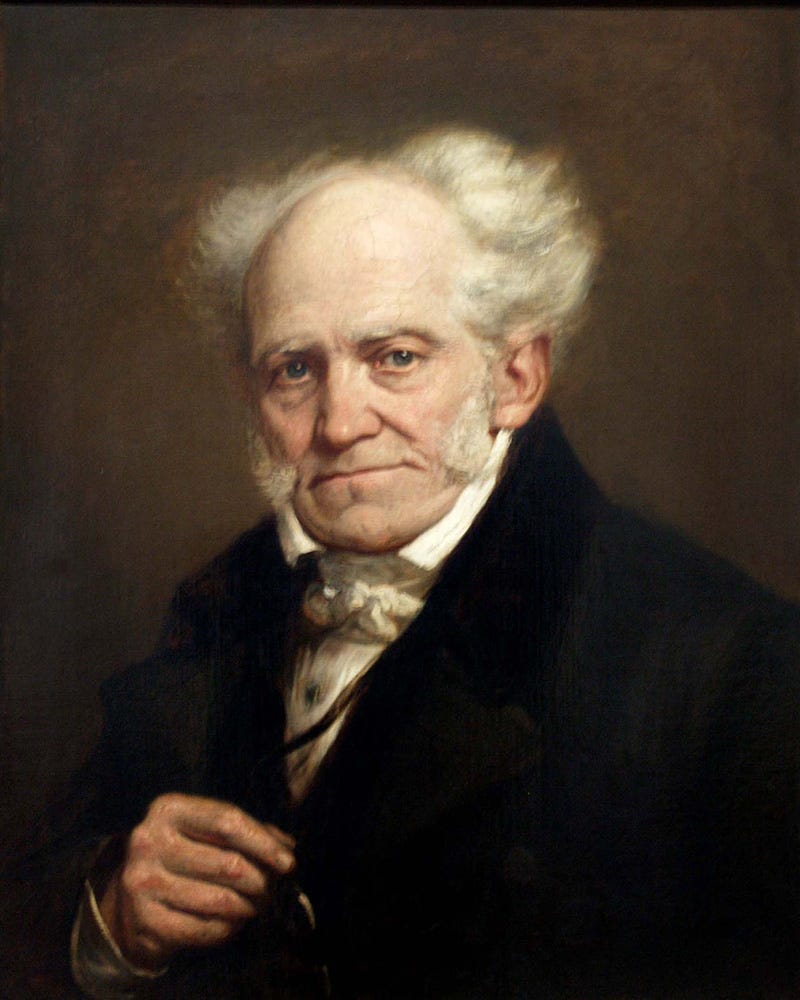
Schopenhauer is a philosopher who is sometimes forgotten in contemporary discussions in philosophy of natural sciences. One can surmise that the reason for this lies in the fact that he worked during the time of the German Idealists, who, while engaging with the science of their time, produced little fruit in philosophy of science that continued into our contemporary tradition of natural sciences.[^1] While connections can be found, as Nietzsche found in his statement that “without Hegel there is no Darwin,”[^2] the discussion of the German Idealists tended to be more abstract than was common in the scientific discourse of their time and to a great extent in ours, and parts of it seem very difficult even today.[^3] Whatever the reason may be, it seems that the dominance of the German Idealists has caused the tradition to forget Schopenhauer’s discussion of natural science concepts, and as I will try to show, not to its benefit.
In this post, I will try to present the claim that Schopenhauer’s abstract understanding of the Principle of Sufficient Reason (PSR), beyond the reduction of Kantian categories to this principle,[^4] allows us to understand a dominant discussion in contemporary philosophy of science regarding symmetry in nature—a discussion that Schopenhauer might expand with interesting conceptual implications. In particular, Schopenhauer’s understanding of the PSR as a relational and symmetrical principle that encompasses all representations of the natural world accessible to our cognition will help us understand his discussion of the relativity of categories like time, space, and ultimately causality. On the other hand, the special developments in his book The World as Will and Representation (1819-1859), according to which natural forces in particular are expressions of the breaking of the PSR that can be understood only through attributing them to our understanding of blind will, will help us understand how and when, according to Schopenhauer, certain natural phenomena manifest in ways that cannot be simply reduced to the PSR, such that we must accept these phenomena as expressions of something that doesn’t belong to the order of representation at all. In terms I will argue for here in relation to contemporary philosophy of science, these are natural phenomena that break symmetry that we would otherwise expect to find in accordance with the PSR.
As Schopenhauer repeatedly emphasizes in his two prefaces to The World as Will and Representation (henceforth: WWV), his systematic treatment of the PSR preceded the writing of his magnum opus and constitutes a prerequisite for understanding it. Therefore, it seems that a close examination of the definition he offers in On the Fourfold Root of the Principle of Sufficient Reason should guide us first of all in our understanding of Schopenhauer’s characterization of the PSR. Fortunately, Schopenhauer offers a sharp and clear characterization of the genus of concept the PSR is:
Our cognition, as our external and internal sensibility, appears as understanding (Verstand) and reason (Vernuft), divides into subject and object and contains nothing else. To be an object for a subject, and to be our representation, is the same thing. All our objects are representations for a subject, and all objects of the subject are our representations. But now we find that all our representations stand in relation to one another under lawfulness and under a form that is determined a priori, [a form] through which nothing exists by itself and independently, likewise nothing exists in isolation or disconnected, in a way that could be an object for us.[^5]
After we’ve understood at least one significant aspect of Schopenhauer’s characterization of the PSR, to understand why Schopenhauer distinguishes the activity of gravitational force from regular causal activity, we need to deepen our understanding somewhat regarding the history of the PSR. As Schopenhauer notes, Leibniz distinguished correctly, but in Schopenhauer’s view, not precisely enough. According to Leibniz, the general principle of the PSR is “by virtue of the principle of sufficient reason, we accept that no fact can be true or real, no judgment can be justified, without there being a sufficient reason why they are thus and not otherwise.”[^6] For Schopenhauer, the “sufficient reason” applies equally to all causality as such. However, the form in which this is done is initially split between mechanical causality[^7] and causality “in phenomenon,” which takes natural forces into account. Let’s take the force of gravity as an example.
Gravitational Force in Schopenhauer
Schopenhauer’s discussion of gravitational force is fascinating because it reflects his understanding of the law of gravity as a force of nature. As such, it is not necessarily universal. He points out, for example, that certain astronomers in his time still doubted the applicability of this law beyond our solar system. Similarly, he raises the question of whether the law of gravity can operate between two bodies with absolute vacuum between them.[^8] This is an important question because it violates the regular mechanical causality that Schopenhauer normally deals with: if one billiard ball hits another billiard ball, then the movement of one is the cause of the movement of the other. In contrast, with gravitational force, which works in places like the solar system between the sun and the planets orbiting it—the question arises why it “pulls” in this way (according to the mass proportions between the sun and the planets orbiting it, etc.) and not stronger or weaker. It seems to require what is called action at a distance (actio in distans), perceived among many scientists of the time as a mysterious principle, the ability to influence another body without direct contact with it—due to the clash with the atomistic worldview often adopted following the scientific revolution.[^9]
Another way to formulate the PSR would be to follow Schopenhauer himself and identify other ways in which this principle has been conceptualized in history. The justification for this presentation and its connection to Schopenhauer would be that, as Schopenhauer rightly claims, the PSR is not a principle that this or that philosopher invented,[^10] but something that has worked in philosophy from its beginning, as is also commonly presented today.[^11] When Anaximander, for example, claims that the Earth is in the center of the universe, the argument he brings for this is that only this place puts the Earth in a position where it has no special relation to any edge of the universe. If the Earth were in another place, we would have to say that its location prefers one edge of the universe over another without good reason. Later philosophers understood this argument of Anaximander’s—as well as other arguments in the history of philosophy—as an argument that relies on the PSR. If we return to Leibniz’s principle that we already mentioned, the question arises why the Earth would be closer to edge X of the universe and not to edge Y. The PSR rejects arbitrariness, and therefore the only place in the universe where the PSR actually holds is in the center. The Earth doesn’t prefer any particular “direction” arbitrarily. If it preferred a particular direction, it would break the symmetry implied by the PSR. Anaximander’s argument may be simplistic to the point of being wrong, but this methodology that makes use of the PSR has expressions, as mentioned, throughout the history of philosophy.
In this way, if Schopenhauer had assumed only the simple mechanical causality of billiard balls, many natural phenomena would seem arbitrary, ones that break the symmetry implied by the PSR, and therefore it wouldn’t be clear why something particular happens in manner X and not in manner Y. Only with the addition of natural force as an assumption (an assumption that itself, according to Schopenhauer’s method, lacks mechanical-causal explanation and is therefore mysterious)[^12] does causality in nature show necessary symmetry, non-preference. On the other hand, why a natural force has one character and not another, this Schopenhauer calls a mystery,^13 precisely because it doesn’t seem to him that there is a PSR that would explain why the natural force works this way and not another, preferring one direction and not another. After we understand the PSR a bit better, we can return to ask about the relationship between symmetry and natural forces in Schopenhauer.
Schopenhauer holds that natural forces are the most general and “lowest” (most basic) form of will in nature.[^14] In a certain sense, Schopenhauer sees in appearances of natural force an isolated, non-relational component. As we saw in the definition of the PSR above, representations are never isolated. Therefore, Schopenhauer doesn’t think of this component in the appearance of natural force as part of representation, or of the causal array in which our representations are connected. He sees in this component an expression of will. As noted, every breaking of symmetry constitutes a preference. Every such preference is a kind of arbitrary preference of will.
Therefore, natural force, according to our understanding, is necessarily a certain expression of will. If for Schopenhauer the world being representation is one side of being, will is its other side. Slightly higher on the scale above natural forces are animals. Animals, according to Schopenhauer, are more symmetrical than humans.[^15] The symmetry in this case is in contrast to humans, meaning implicitly, an expression that belongs to the order of representation and is thus more connected to the PSR. As we advance to phenomena that display more will, more uniqueness[^16], the degree of symmetry decreases. If we said that will expresses itself in natural forces as the most basic form of the force of will, then humans and their will are the highest or most complex expression of will. Humans, from Schopenhauer’s perspective, are examined by being almost completely individual in their external and spiritual form. Therefore, there exists a certain continuum, which is somewhat difficult to identify, from the most basic level of the expression of will in natural forces to the individual human, and at its end, the Idea. The Idea is completely not subject to the PSR and is embodied with greater or lesser perfection in the world through humans and art, but never in its entirety.
When the attempt to understand the expression of will in natural forces is to see it as a breaking of symmetry of sorts, we need to explain more thoroughly what Schopenhauer’s conception of the PSR looks like. As we saw, Schopenhauer views the PSR as a relational principle. According to him, nothing is entirely independent. With all the force of the expression, “Only for the subject does an object exist, only for the object does the subject have meaning.”[^17] For Schopenhauer, the entirety of the world as representation, the entire objectified world, is built from relations that stand in rational structures one with another. This is the essence of the PSR. In such a “flat” world, there would be nothing to prefer a change or a process one direction over another. Therefore, any breaking of symmetry that occurs, from natural force to the Idea, testifies to the presence of will. Indeed, the will “prefers” a certain direction. It expresses itself not in relational indifference but in a concrete preference for a certain directionality, a certain breaking of what we would have seen as perfect symmetry under the PSR.
From Schopenhauer to Contemporary Physics
One phenomenon that engages physicists and philosophers of science today is the question of symmetry. Symmetry, according to Feynman, is “associated with physical laws.”[^18] The word, he adds, has a slightly different use than is customary. He doesn’t mean something like a salt crystal that looks the same from different angles. Rather, the use is closer to thinking that the laws of physics operate the same in different circumstances.[^19]
Where is this important? In contemporary physics, there are essentially four fundamental forces (or interactions): the strong nuclear force (the strong force), the weak nuclear force (the weak force), electromagnetic force, and gravitational force. It turns out that symmetry is preserved in gravity and electromagnetic activity.[^20] If we build one mechanical clock, and then copy everything and build it in another place but mirrored (so that the entire clock essentially “flips” completely, again, to cut in the middle and switch all the parts relative to each other around the cutting axis)—the clock will work the same under the laws of gravity. The same is true for a clock that we assume includes components that rely on electromagnetism. The question of mirroring, whether right and left (or directionality in general) have meaning under the laws of physics, according to these two laws, is answered in the negative. As Feynman argues following Morrison, if we were forced to communicate with another life form from across the galaxy by telephone, we could communicate to it, based on the shared laws of physics, our height, our molecular composition. But on the face of it, we couldn’t communicate to it, if the laws of physics all preserve mirror symmetry, that our heart is located on our left side.[^21]
But according to the prediction built by Lee and Yang and the experiments conducted by Wu in 1956, it turns out this isn’t really the case with the “weak force” we mentioned earlier. There are many forms of radioactive decay. It turns out that one can design the experiment so that during radioactive decay we look at where the electron is “thrown” from the nucleus in the disintegration process. The useful explanation for this is found in Buzaglo’s article. According to Buzaglo,[^22] the situation where most electrons will be thrown in one specific direction is equivalent to the following situation: in nature there are many umbrellas at rest. All the umbrellas, at this stage, are interchangeable with one another without problem. Let’s assume that some material is stuck to the umbrellas that will start to fly off if we start spinning them quickly. Now we’ll start spinning the umbrellas. Some rotate clockwise, others counterclockwise. We would expect that generally, given more or less equal amounts of umbrellas of both types that aren’t interchangeable with each other (during spinning), the material flying off them would fly in “both directions” equally. But this isn’t the case. It turns out that nature “throws” more material in one direction than the other.
In this sense, the “weak force” that we identify in nature behaves, as we see, in a way that returns us to Schopenhauer’s conception of natural force, in the sense that it violates symmetry, and implicitly a certain way in which we would have expected to see the world if it were conducted purely according to the PSR and symmetry and didn’t have, in Schopenhauer’s words, a “second side” in the form of will. In other words, we can communicate back to the man from Mars. We’ve found a way to tell him that our heart leans left.
Schopenhauer Returns Through the Front Door
If we return to our contemporary example of the “weak force” or gamma radiation decay, we see that actually the expectation for symmetric mirroring there demonstrates Schopenhauer’s point beautifully. If the result of the experiment had been—as the best physicists and mathematicians expected, including Weyl—symmetrical, there would have been nothing left to explain. We could not only give a causal account, but it would also have been, if not exactly mechanistic in Schopenhauer’s classical sense, certainly answering to the geometric program that physics began to develop from Einstein onwards. That is, it would have been possible to speak about nature in “external” terms, according to Schopenhauer, to examine every given state in relation to its previous state and make causal connections, but also in “internal” terms, that is, to give a complete explanation for why things behave as they behave and not otherwise. But this experiment reflects—and it’s only one of several similar phenomena in contemporary science that space doesn’t permit mentioning—that symmetry breaking, in a certain sense, requires an additional or complementary explanation. In Schopenhauer’s words, a philosophical explanation that involves a deeper understanding of will and our body. But for that we need to read Schopenhauer.
It seems that Schopenhauer’s philosophy, for which we tried to offer a contemporary update, has been updated in the course of this post not only in relation to its “conceptual” detail. It seems that Schopenhauer’s philosophy, when taken more wholly, might offer not just conceptual guidance, but an interesting philosophical complement to actual scientific problems. As we saw, it’s not the same phenomena that Schopenhauer spoke about that we’ll speak about when describing the lack of symmetry in nature around us. But as Buzaglo also noted regarding the issue of eternity versus the creation of the world in the Middle Ages,[^23] it seems that this principle of symmetry and its breaking crosses scientific eras. The PSR as described by Leibniz, and then Schopenhauer, constitutes a kind of constant research motivation in the history of sciences, and it’s always in competition with positions concerning deviation from it. Contrary to what one might have expected at the beginning of the 20th century, it doesn’t seem that science is “converging” back to a completely symmetrical explanation, but rather that there’s an internal dynamic here that might remain relevant in the history of sciences in general going forward.
Footnotes
[^1]: Of course, this may also stem from lack of research, but it seems the main reason is historical, concerning the discontinuity between 19th-century German philosophy of science and 20th-century philosophy of science.
[^2]: Friedrich Nietzsche, The Birth of Tragedy and The Gay Science, trans. Israel Eldad, Schocken: Jerusalem 1985, 379. [Hebrew]
[^3]: Schelling is of course exceptional in this context, and his philosophy has interesting branches in 19th-century nature research, as even Schopenhauer admits. However, for example, Hegel’s reflection on space and time remains difficult and it’s hard to think of real successors to it in the various sciences.
[^4]: An achievement that, impressive as it is, was preceded by Salomon Maimon: Melamed, Yitzhak Y. and Martin Lin, “Principle of Sufficient Reason”, The Stanford Encyclopedia of Philosophy (Summer 2023 Edition), Edward N. Zalta & Uri Nodelman (eds.), URL = https://plato.stanford.edu/archives/sum2023/entries/sufficient-reason/. Although I don’t know if this can be proven textually, it seems that Schopenhauer’s reliance on intuition and understanding, in contrast to Kant’s dual system between intuition and concepts, at least receives a “preface” from Salomon Maimon.
[^5]: Arthur Schopenhauer, Über die vierfache Wurzel des Salzes vom zureichenden Grunde Über den Willen in der Natur, Diogenes Verlag: Frankfurt am Main 1977, 41. (Henceforth: VWSZG)
[^6]: Ibid., 22.
[^7]: In this post, I use the term “mechanical” to denote not the entire science of mechanics as it was known to Schopenhauer, but to describe the simple explanations we can give to local natural movements like the movement of billiard balls during a game. These explanations, at the level of simple mechanics, apparently don’t require natural forces to provide an explanation that at least locally might be complete.
[^8]: Arthur Schopenhauer, On the Fourfold Root of the Principle of Sufficient Reason and Other Writings, trans. David E. Cartwright, Cambridge U.P.: Cambridge 2012, 46. (Henceforth: OFRPSR)
[^9]: Hans Blumenberg, The Legitimacy of the Modern Age, trans. Robert M. Wallace, MIT Press: Cambridge M. A. 1983 [1999], 32-3.
[^10]: OFRPSR 2012, 22.
[^11]: Melamed and Lin 2023.
[^12]: Arthur Schopenhauer, The World as Will and Representation, trans. E. F. J. Payne, Dover Publications: New York 1969, 98-9. (Henceforth: WWV)
[^14]: Ibid., 131.
[^15]: Ibid., 131-2.
[^16]: Or: the isolated.
[^17]: Ibid., 7.
[^18]: Richard Feynman, The Character of Physical Law, MIT Press: Cambridge M. A. 1965, 84.
[^19]: Feynman 1965, 83.
[^20]: Ibid., 98.
[^21]: Ibid., 103.
[^22]: Meir Buzaglo, “A note on parity and modality”, in: The Journal of Philosophy, Sep 2010, vol. 107, no. 9, 492.
[^23]: See within Buzaglo’s course at Hebrew University, Lesson 5, accessed 5.11.2025: