


Passover is already approaching and I can see that I will not have the leisure to continue developing several texts that have been sitting in my drawer in the coming years. In honor of spring cleaning I am releasing a chapter from an unfinished work on certain observations regarding the concept of luck in Aristotle. I have at least two more chapters in this style, but there the level of polish, even of the parts already completed, requires even more work. In any case, even this chapter lacks a conclusion, but the general direction is to sketch the state of the problematics that Aristotle managed to clarify and then to transfer things to the phenomenological dimension. In any case, for those of you who prefer, in the words of C. S. Lewis—
If we are all going to be destroyed by an atomic bomb, let that bomb when it comes find us doing sensible and human things—praying, working, teaching, reading, listening to music, bathing the children, playing tennis, chatting to our friends over a pint and a game of darts—not huddled together like frightened sheep and thinking about bombs. They may break our bodies (a microbe can do that) but they need not dominate our minds
It seems that Augustine’s well-known dictum about time—”What is time? If no one asks me, I know what it is. If I am asked to explain it to someone who asks, I do not know what it is”—original as it may be, is more valid in the case of luck than in the case of time. The history of the concept of time is full of definitions, some better and some worse. But the vague concept of luck has received far less attention in the philosophical tradition. And not without reason. A definition of luck seems like an almost paradoxical undertaking, and those who tried their hand at it—first and foremost, Aristotle—recognized this. Aristotle was admittedly not the first to deal with the essence of luck, but his treatment, despite being scattered across several different writings, is comprehensive enough to furnish us with a preliminary language for dealing with the issue.
In Book Two of the Physics, Aristotle characterizes luck in the following way: (1) The necessary condition for luck is the presence of the accidental. (2) Luck as a cause must rely on another cause, a final cause. (3) In order for something to fall within the scope of luck, it must be of a certain order of magnitude. (4) Luck is a type of accidental cause. Let us unpack each component of the definition.
The first condition of luck is probably also the most intuitively understood condition, but as we shall see, it is also the one that poses the deepest problems. Luck presupposes contingency. In things that are entirely regular there is no room for contingency. In such things we have no opening to speak of luck either. But regularity is often a rather elusive creature. In certain domains, such as mathematics, it seems to govern everything. But whether it exists in domains like physics, for example—there is a great dispute to this very day. It plainly seems that discussion of the matter requires, one way or another, metaphysical assumptions and discussion. Furthermore: the characterization of the accidental is certainly paradoxical, because giving a positive definition (as opposed to a negative definition) of the accidental almost necessarily requires presupposing regularity of one order or another. But let us not get ahead of ourselves.
The second component of the definition is no less problematic. It seems to Aristotle that we speak of luck only in teleological contexts—ones that have a bearing on contexts in which we are required to make informed decisions. In fact, Aristotle presents us with a spectrum: to the extent that accidental things occur in the natural environment—that is, in biology or physics—we tend to assign them to chance. To the extent that accidental things occur in the arena of human action, we tend to assign them to luck. According to Aristotle’s approach, a disjunction between the two cases is possible: either luck is assigned to nature, or luck is assigned to thought—that is, to the human arena. For now, let us suspend judgment as to whether a disjunction of this kind is even possible. The condition of the final cause is a relatively strict condition: from Aristotle’s perspective, we would not tend to assign an occurrence of luck to a child, because the child lacks the ability to make a sufficiently significant or informed decision to shape the teleological context within which it operates. As an example of this principle, Aristotle provides us with an extreme case: suppose a fire breaks out in a stable. One of the horses can flee and reach us out of an instinct of self-preservation. In such a case, Aristotle would argue, the horse, in itself, survived by chance. From our perspective, as the horse’s owners, it is a matter of luck. In such a case we tend to speak of “the horse’s luck,” even though the luck is in fact ours. Similarly, we might speak figuratively of the “luck” of stones that were taken to build a temple from them, as opposed to the bad luck of stones that were not chosen for that purpose.
The third component of the definition is that in order for something to count as luck, it must be of a certain order of magnitude. The intuitive thought behind this component of the definition is that the world is full of infinite small accidents that we do not even notice, and we would certainly not tend to assign them to luck. In order for something to occur with reference to luck, it must belong to a certain order of magnitude. To a large extent, this component is ancillary to the second component and may not constitute an independent criterion.
Finally, the fourth component of the definition is the most problematic. The concept of “cause” presupposes, on its face, belonging to a certain regularity. Thus, for example, if I kick a door and it breaks, and we say that the cause of the door’s breaking is the kick, we are presupposing a certain homology between the activity of kicking and the breaking of things. If we go to the other extreme and say that there is nothing whatsoever in common between my kick and any other activity that has occurred or might occur, we would be doubtful, and rightly so, in what sense one can regard the kick as the cause of the door’s breaking: if kicks not only do not usually lead to the breaking of things, but never do so except in the single case in which we say that it did—the question arises why we think it is precisely the kick that caused the door to break. On the other hand, Aristotle does identify luck, with reservations, as a certain type of cause. It seems that Aristotle does this because in fact our concept of cause is not so rigid. Not infrequently we might regard “cause” as synonymous with explanation, and reality is composed of things whose explanation we assume even if there is no efficient causality supporting that explanation—but that is the very reason why, from Aristotle’s perspective, efficient causality is secondary in its meaning as a cause. We will be able to see this better in the example Aristotle gives on the subject, which will help us in a general way to understand the definition more deeply.
Suppose we go to the market to do shopping for a dinner we are planning. The activity of going to the market receives its meaning from the “for the sake of which” of our dinner. This is a relatively weak variation of a final cause. Suppose we encounter, in the course of shopping, a person who owes us money—and he gives us the money. We went to the market to do shopping for the sake of dinner. Because we went to the market, we received money by luck. It follows from this that the desire for dinner, or the end of dinner, becomes at the same time the accidental cause on account of which we also received money. Aristotle’s distinction on this matter is that it is not the case that usually when one shops for dinner one receives money, and hence this is not a cause in the ordinary sense. It follows that this is an accident relative to the activity of shopping for dinner. But this accident does not float in empty space: it is connected to the activity of shopping done for the sake of dinner. If we had not been shopping for dinner, we would not have received money by accident. Hence luck here relies on the final cause of the activity. It in fact presupposes some active regularity.
But Aristotle’s distinction regarding this case is broader. While we did not go to the market in order to collect money, had we known in advance that by going to the market we could find the person who owes us money and collect it from him, we would have gone to the market also, or perhaps even only, for that end. In such a case the money that would have fallen into our hands would not have been a matter of luck, but of a practical decision on our part. That is, the end of receiving the money could have been the end of our activity, but it turned out that in this specific case it was not. In other words, there is a distinction between the space of possible ends that our activity might have and the space of ends that we actually realize. Our activity itself, according to Aristotle, is not closed within the space of the ends we are actually pursuing. It is not the case for most human beings that if they went to the market to do shopping, they would withhold from themselves the attainment of an end such as receiving a considerable sum of money just because that was not the end for which they set out to the market. It seems that human beings have a principled openness to the realization of their possible ends in general, even when they are actually acting only for the sake of a certain end. This distinction is not trivial, and it still requires further deepening.
Aristotle to some extent continues this discussion of luck in his Metaphysics. There Aristotle ties the problem of contingency to the concepts of generation and corruption. In this case it seems to me worth remembering that the paradigmatic examples Aristotle has in mind in the context of natural things are precisely living things. According to Aristotle, there are things that do not arrive at generation or corruption by means of a process. That is, a human being arrives at generation through a process of fertilization that matures and then gradually acquires the properties we assign to an infant until birth, or maturity, for example. One also arrives, in most cases, at corruption through the process of aging. But there are, it turns out, things that exceed this natural causality, this continuity of processuality. But the way Aristotle proves this is interesting. He assumes that it is not possible that all things are necessary. Having assumed this, how would the world look if things arrived at being or non-being only on the basis of processes? According to Aristotle, we could ask about every thing in the world whether it occurred or not. We could say that this thing occurred if some other thing occurred. And so on and so forth, until we would arrive at the first thing, and if it occurred, then necessarily the last thing also occurred. Since we would then be required to say that all occurrence is necessary, we have a certain refutation of the claim that all things come into the world by means of a process. It should be noted that Aristotle does not prove here that occurrences in the world are not necessary. He proves here that if it is true that occurrences in the world are not necessary, then it is not possible that the world is composed only of continuous processes of generation and corruption.
Beyond the intriguing assumption Aristotle makes here regarding the universality of processual necessity in the world, Aristotle elaborates on the implications of this argument, and in doing so presents an interesting form of reductio ad absurdum proof that if everything is necessary, then conclusions that apparently cannot be accepted follow. We get from it not only that there are things that occur not by means of a process, but according to Aristotle there are certain implications here regarding the nature of time: if we take a certain stretch of time and another stretch of time, and another one and so on, from some finite time, we can always converge back to the present. It seems to me that Aristotle’s reservation in this context concerns the nature of natural causes. Natural causes, by his definition, are such as cause things to happen for the most part or always in the same manner. If every natural cause were to cause things to happen necessarily, we would be forced to accept absurd conclusions, such as that someone will die a violent death if he goes outside, or will die because he ate spicy food. Clearly such occurrences exist, but they are accidental—which is to say, it is not the case that usually if someone eats spicy food or goes outside then he dies—and for this reason, even if things did indeed happen that way, we do not tend to see the one as the cause of the other. Another way of noting this objection is that here there is a concept of causality that cannot be distinguished from the absence of causality at the conceptual level, or more precisely, a concept of causality that there is no way to distinguish from unintelligible contingency. According to Aristotle, absurd conclusions follow from this: it turns out from this that every person who is alive will in fact die because of something that has already occurred in the past. One could say that there is something in our bodily constitution that necessitates this. And although one can accept this in general terms, it is hard, or perhaps even impossible, to say that because of something that has already occurred in the past we will die a violent death or from disease—something for which the causes have not yet come into existence.
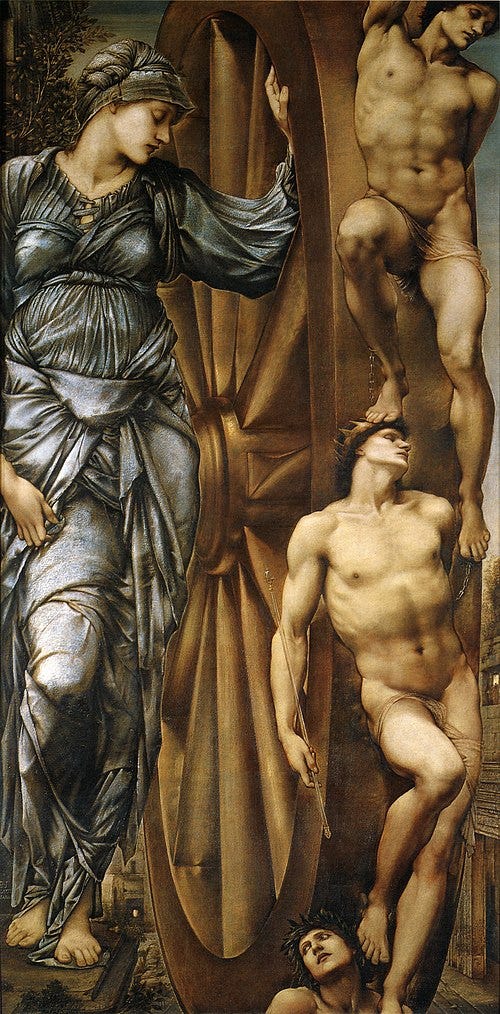
The Wheel of Fortune, Edward Brune-Jones, 1875-1883
Let us pause for a moment. That we went to the market and found someone who owed us money is something that could have occurred and could have not occurred. The point is that it was impossible to infer this from the reason for which we went to the market—the desire to prepare dinner. In this sense causality is not exclusive: as we saw above, it does not close the space of possibilities only to the realization of the one end. The process of preparing dinner is long and reaches its end only with the serving of the meal to friends. In a certain sense it is continuous, because it is impossible to decompose it into the sum of its components: at no stage before serving the meal to friends can we say that the process has been completed. If the stall in the market was closed, we will go to the supermarket, and so on; no specific component in the process is necessary in itself, only from within its reference to the coalescence of the end. But then what actually happens when we suddenly run into a person who gives us a considerable sum of money? On the face of it, it seems we are forced to explain the reason for which we went to the market in the first place—the preparation of dinner—as the accidental cause of our having received a handsome sum of money. Unlike our dinner, which came into being gradually, in analogy to what might be called “natural causality,” we have not yet completed dinner and it has already become the cause on account of which we received a handsome sum of money. Even if at this point we abandon the process of preparing dinner and it never reaches its end, this will still remain the best explanation for this occurrence. What happens in such a case is that the final cause changes spontaneously.
That is, it is precisely the processual character of the process of preparing dinner that enables its disruption. The disruption of the process changes the meaning of the process itself. Another way of putting it: precisely because it is necessary that the process of preparing dinner not be hermetic—such that not only is no particular component in it necessary, but even the process itself is subject, to a certain extent, to a change in its meaning—it follows that Aristotle has a very strange concept of what a process is. We could ask, for example, what is more important: that we managed to prepare dinner for our friends or that a significant sum of money came our way? Sometimes we will have to say that it is precisely the significant sum of money that came our way that is more important to us. In such cases, the entire story of preparing dinner will be reframed around the end of that sum of money—say, paying off debts. The question arises whether and at what point the self, or any other authority, is the one possessing the relevant authority for framing. Another way of saying the same thing is to repeat Aristotle’s argument in the Metaphysics, but this time regarding the final cause. If we suppose that there is in us a very deep desire, so deep that it dictates all our actions to the end, it follows from this that our lives were decided before they were lived. All that remains is to carry out the plan. The absurdity in this case is that we would have to regard terrible things that happen to us as a product of our will—or alternatively, we could not distinguish between different orders of our will, such that we would say that from time to time we went to the market to prepare dinner, but one time we actually did it in order to receive a considerable sum of money, even though this thought did not enter our minds when we set out for the market on that occasion. We will return to this problem.
We distinguished earlier between the space of our possible ends and the space of the end we are pursuing in practice at any given time. But if we accept the hypothesis of the fundamental desire, it will follow that our various desires are themselves a continuous product of the one desire. Accordingly, we will not be able to see the accidental meeting at the market as an accident at all, because it came about not suddenly relative to our punctual desire, but out of the broader execution of our fundamental desire. The necessity here is no less acute than the one Aristotle presented earlier from the side of efficient causality (it may in fact simply be a special case of it), and it is no less reductionist. As there, here too he is in fact exposed to the critique that it does not allow distinguishing between natural causality and accidents. The implication of this in the case of final causality is usually called fatalism, or if we are more delicate, the absence of the capacity for meaningful deliberation with respect to our actions. Deliberation requires of us that we can distinguish between things we do in order to and the for the sake of which. The one serves as a standard of measure for the other in a way that allows us to sort out which are the preferable means for the for the sake of which. But from the prism of a fundamental desire it plainly seems that we never choose something in a way that is in order to, but are always carrying out an action that fits the for the sake of which—whether we are aware of it or not. The consequences intensify if we also understand the miss, or the mistake, as a certain form of accident relative to desire. In such a case, if we pour a glass of water and the glass slips from our hands, it is necessary that we say that in a certain sense we wanted the glass to break. Or we can speak of accidentally breaking a statue of Venus in a fit of anger. Either way, while psychoanalysts are comfortable positing an all-knowing subject of this sort working behind the scenes to guide our actions, we mortals usually do not have such exceptionally extraordinary access to the theological domain.
As we have seen, this suddenness has certain implications for the character of time. If the character of time with respect to most of our activities is continuous, there must also be a certain meaning to the disruption of this continuity that does not converge back to a continuity of a different order. Another way of putting it: there is no finite unit of time from within which one can converge back to the present from some past. The character of the present lies precisely in its simultaneity, and its simultaneity does not consist simply in the presence of the realization of the end alongside the non-realization of the end (a simultaneity that characterizes every process), but rather there is in it a dimension that allows for the expansion or contraction of the ends achieved from within the space of ends that we could have had. But what we are in fact assuming here is a certain closure of the space of ends we might have. Is there indeed such a closure? And furthermore, if there is such a closure, are we not committed, at least to a certain extent, to understanding it as one that is located in the past and necessarily conditions all of our activity in the present?
This is a question Aristotle addresses precisely in the Nicomachean Ethics. In the first book, Aristotle considers what might be the ultimate end that characterizes human activity. He arrives at the conclusion that it must be a kind of happiness whose general features are self-sufficiency and well-being. But after giving this general definition, Aristotle asks the classic Greek question: when can we say of a person that he is happy? Another way of putting it: when can we say of a person that there is a certain closure to his processuality that allows crowning him as happy—that is, as one whose luck can no longer turn against him? At this point Aristotle quotes from the story of Herodotus about Solon, to which we will return here briefly because it is not irrelevant to our concerns.
Solon visited the palace of Croesus during one of his journeys. After a tour of the palace’s treasures, Croesus asked Solon—with a clear expectation of what he thought the answer should be—who was the happiest person he had ever known. Solon answered that an Athenian named Tellus was most likely deserving of that title. Croesus, somewhat confused that Solon had not flattered him, asked why. In reply, Solon answered that there were two good reasons for this. First, Tellus lived a good life by the standards of the Athenians. He was even fortunate that all his sons distinguished themselves and fathered children who survived on their own, and he was able to witness all of this. Second, Tellus died a glorious death in battle defending his homeland. Croesus, who assumed he would at least take second place, asked Solon who the second happiest person he knew was. Solon answered that there were two brothers in Argos he could think of. These were strong and handsome brothers. When some important festival arrived for the goddess Hera and their mother needed to be riding on the wagon with the oxen before her—it happened that no oxen were to be found. Immediately the two brothers yoked the wagon to their own bodies and dragged their mother six kilometers to the temple. During the journey, more and more people gathered around them who saw the spectacle and witnessed it. When their mother arrived at the temple, she prayed to the goddess Hera that her sons be granted the best thing possible for human beings. The brothers lay down to sleep in the temple after a great feast in their honor, and never woke up again thereafter. Solon draws from this the ancient lesson: that the death of a good person is better than his life. Croesus was of course not pleased, but then Solon explained to him that he would not call any living person happy, because his luck can always turn. Only when a person has died can we say of him that he is happy.
What can easily be missed is that at the end of the first book of the Nicomachean Ethics, Aristotle explicitly argues against this story of Solon that Herodotus brings us. First, Aristotle argues, happiness is certainly a kind of activity, and therefore it is not at all relevant to call a dead person a happy person. But even if that were not the case, and let us say that Solon meant that we can crown the life of the person who has just died as happy only from the moment he dies, since life is too open to occurrences of luck, still Aristotle sees a difficulty in this because according to the prevailing assumption—which seems to be shared by both him and Solon—even the dead person is to a certain extent exposed to the reversals of luck. On one hand, temples may be built for him and he may be honored; on the other hand, his descendants may not survive and disasters may befall them. To a certain extent, a person is “embedded” in the world even though he is no longer among the living. But Aristotle emphasizes the obvious difficulty: in such a case we would also have to say that the dead person, despite being dead, continues to move from good luck to bad luck and back, and this is difficult, because he is no longer alive, and these are indeed changes we usually attribute to life. But it would be no less strange in his view if we were to say that the fate of the father does not depend to a certain extent on the fate of his descendants. In the Nicomachean Ethics, Aristotle arrives at a compromise that it is not certain has anything to stand on, namely that the dead person is certainly exposed to a certain extent to the events of luck, but not to such a degree that he could be reversed from happiness to misery in his grave.
But there is yet another way to understand Aristotle’s discussion of the matter, both with respect to the quotation from Herodotus and with respect to how Aristotle understands the issue. In his book Conflicts of Modernity (2016), MacIntyre reminds us that the Greek word for end, telos, as is well known, is closely tied to bringing something to completion. MacIntyre’s original suggestion is to understand the human end as a “happy ending.” It is implied by this suggestion that the character of human life is narrative. If we return to our discussion up to this point, Solon’s critique that the death of a person is preferable to a life that luck buffets, especially when accompanied by the ostensible argument that human life is too vulnerable to the vicissitudes of luck, may hint to us that, in contrast to modern writers like Pascal and Kant, there is no generic statement here to the effect that human passions can never reach their satisfaction within the framework of life, and therefore there is no point in living life if it is all there is (Pascal), or in living it in order to reach hedonistic satisfaction (Kant). What we may have here, and this makes sense in light of Solon’s answers, is a general statement to the effect that it is hard to reach a “good ending” when no matter what we do, we remain vulnerable to distortions of the little that has been achieved. In fact there is a logic of a different kind here: what has been achieved has already been completed, and therefore by definition has ended, or died. What has ended is better than what is open—not because ending is better than opening, but because an opening without an ending is forever lacking—whereas an ending always presupposes an opening. Thus, for example, if Tellus had in the end, instead of dying in battle defending his homeland, simply fled the battlefield and helped the enemy—it is hard to believe that despite his earlier achievements, a full life, children, and so forth, we would crown him as happy. The same goes for the brothers: had their end not been tied so bravely to the most beautiful thing they would most likely ever have done in their lives, the rest of their lives, even if they had been happy by ordinary standards, could in fact have been anticlimatic in a way that would grate from the standpoint of the narrative.
It is important not to confuse the possible message, from Aristotle’s perspective, of the story concerning Solon with the common Greek pessimism. In his dialogue called the Eudemus, which has been lost to us, Aristotle apparently discussed the position, and apparently opposed it, that since human life is so dependent on the events of luck, one’s death is preferable to one’s life. The story from the dialogue became famous in late modernity in Nietzsche’s The Gay Science, who most likely encountered it while reading writings attributed to Plutarch. In that story, King Midas captures Silenus the satyr and forces him to tell him the truth about human happiness. Silenus, in response, says the dictum that has already become commonplace: “The best thing for a person is to die, and once alive, to die quickly.” In our terms, one can interpret this position in terms that say the best story is the one that will never be told—or put differently, a story that can never be spoiled by the events of luck, as Aristotle assumes in several places about the lives of the gods. It is also possible, of course, that the story of Silenus was introduced in order to contend with it later in the dialogue, where perhaps a position closer to what Aristotle writes in the first book of the Eudemian Ethics about the lives worth being born for was presented.
As noted, Aristotle pushes his discussion in the Nicomachean Ethics to the side. It is entirely clear to him that although the happiness in question necessarily involves a kind of external goods as well, it is absolutely necessary for the human end. Aristotle is not a Stoic; he cannot take seriously the ascetic possibility of the Stoic sage whose character is not affected by the events of life one way or another. From his perspective this might lead to absurdity: that even if we were living in a truly bad world, in which good virtue would regularly lead to doing evil and would make its possessor wretched and despised, we would still have to call him “happy.” To a large extent this is also the central claim that Theophrastus, Aristotle’s direct student and successor at the Lyceum, probably advanced in his book on the good life. A claim that apparently angered Cicero greatly, from whom we mainly have some idea of its content. But it is indeed closer to the Greek intuition that stood at the basis of Aristotle’s discussion in the Nicomachean Ethics. The good person needs a certain measure of constitutive luck, however relatively modest—according to Solon—so that he may live a life fitting for a person of virtue. In the Nicomachean Ethics it does appear that Aristotle closes this discussion, but only because it seems to him that he has said enough on the matter relative to the topics he wishes to discuss in the book. Elsewhere—possibly earlier—Aristotle expands his discussion of the subject.
The additional source, the Eudemian Ethics, is read somewhat less than the Nicomachean Ethics, and its historical influence is smaller accordingly. But it is precisely there that one can, in my opinion, find Aristotle’s more complete discussion of the subject of luck. In the second part of Book Eight of the Eudemian Ethics, Aristotle in fact offers a systematic discussion of the subject of luck and its connection to the final cause, or ethics. The paradigmatic case with which Aristotle begins his inquiry there is that of the lucky fool. The fool—at least in the area in which he is lucky—is important because he can in no way know, nor explain, why he succeeds in a certain field—say, navigation at sea. He is comparable, to a certain extent, as Aristotle says, to someone who keeps throwing dice and keeps getting six. His ship always reaches its destination. Other people might have been successful navigators through knowledge, but not he, in whose case we must attribute it to luck.
Aristotle raises three hypotheses for examining this type. Either the person is lucky thanks to some practical understanding he has—something we ruled out by the very nature of the problem itself—or he is lucky thanks to a certain divine providence, or there is such a thing as a lucky nature of a person. Aristotle rules out the specific divine providence with respect to this case because it seems strange to him that a god would choose to protect precisely a fool in a certain field, when it befits a god to favor the wise. From here Aristotle arrives at the only alternative remaining to him, which is that the person is lucky by virtue of the fact that he is lucky by nature. But as we have seen, in Aristotle nature is characterized by a certain occurrence repeating itself mostly in a certain manner—and luck is by nature opposed to natural causality. But if we insist, we will have to say that this person is constituted by nature such that he has luck in a certain field—and it turns out that we have expropriated luck and turned it back into a rather idiosyncratic type of personal nature. This is the luck we called earlier “constitutive luck,” which Aristotle sees as secondary to the more central type of luck that interests him: people for whom no homology obtains from within them for the fact that events of good luck happen to them, like throwing six on dice in a certain consistent way. “Constitutive luck,” Aristotle tells us, is called luck because from the standpoint of reference to human beings in general, it appears exceptional and deviant from the accepted norm we expect. But in the dialectic of the discussion, the case of the dice becomes for him more paradigmatic, because a consistent throwing of six on dice exceeds our expectation of an approximately equal distribution in enough throws of the dice, and there is no way to reduce it back to a kind of exceptional personal nature.
The conclusion of the discussion in the Eudemian Ethics is especially interesting. Based on his anthropological theory that the soul is divided between the rational part and the non-rational part: the non-rational part is responsible for desire, while the rational part is responsible for isolating the correct means for achieving the object of desire. The desiring part works in a relatively independent manner in certain cases in which a person does not calculate his actions before doing something—he simply does it. In general, in order to arrive at good results consistently, a person must subordinate his desiring part to the authority of the rational part within him. Except that among certain people, perhaps the people who are especially lucky, it seems that the desiring part has “malfunctioned” somehow, in the sense that it no longer resembles that of the rest of human beings, and precisely among some of them it seems to lead consistently to the best result contrary to general human nature—to want “when, where, and how” one should. But we saw that it is the role of the rational part to direct desire in this way. From here Aristotle suggests that there is a puzzle: it seems that luck is what causes people’s desire to be correctly directed, and this is also what we attribute to practical reason. Is practical reason, according to this puzzle, itself a kind of good luck?
Here Aristotle enters into more classical questions: we do not arrive at rational deliberation, at the giving of an account, by means of giving an account. That is, perhaps in specific cases, but it is hard to say that in an infinite regress rational deliberation comes to us from rational deliberation. It is reasonable to assume that it is a phenomenon that emerges from some other phenomenon. What, then, is the point of origin of the movement of the soul, of the logos? Aristotle offers us an alternative that he apparently foreclosed earlier, but with a renewed flavor: indeed, it is not reasonable that a god would help a fool in his enterprise, but a god who helps everyone realize the good is certainly a possibility. The god, in this sense, is exalted even above reason itself—he is the one who grants the initial thought. And incidentally we arrive at an elucidation of a rather obscure fragment of Aristotle’s that we find in Simplicius. In the summary of the section in the Eudemian Ethics, he uses almost the same language that is better known from the aforementioned fragment: “That Aristotle describes something that is beyond thought and being is clear from the fact that he says clearly, toward the end of his book on prayer, that the divine is either thought or something even more exalted than thought.”
Either way, we are called upon here to address the issue of the “origin of thought.” That is, from what point we begin our deliberations about what to do. We have some illustrations of how Aristotle thinks the thing works, and the closest example he finds in the Nicomachean Ethics is the appeal to the example of the physician, or the artisan. The physician knows that he must make the sick person into a healthy person. He contemplates in his mind’s eye the schema of the healthy person and begins to try to infer from it the steps required until he arrives at an action that he himself can perform. The trouble is that this schema, in the case of artisans, is always available from the generalization of successful cases in the past. In order to get more concrete examples on the subject, we are forced to turn to other compositions of Aristotle’s. Thus, for instance, in On the Movement of Animals, Aristotle provides us with two different examples of how the thing is carried out with respect to action. As it were, a person has in his head the proposition “people should walk,” which he specifies—or more often, does not specify—as “I am a person,” and then arrives at the operative conclusion and simply walks. Aristotle conceives of practical life there as a kind of practical syllogism.