


1.In 1919, Germany was still deep in the revolution that followed World War I. It was clear that Germany would undergo democratization processes following the defeat in the war, but the scope of the reform remained shrouded in fog. That year, Max Weber delivered what is probably one of the best lectures in the history of political science, "Politics as a Vocation." In the lecture, Weber analyzed in depth the structural changes that the modern state underwent in the 19th century. The analogy that Weber used to describe the modern state, which I think teaches us much about how the state of the twentieth and twenty-first centuries differs from its older sisters, was in relation to publicly traded companies: in a publicly traded company, it's true that technically the owners of the company are the shareholders, but in practice they don't hold the positions of the board of directors, day-to-day management, or professional operations. In this sense, the modern state belongs to the people, but in the same way that publicly traded companies belong mainly to pension and insurance holders: on paper. Those who actually control are completely different people.
Although this insight sounds negative, Weber notes its positive side. Since the state belongs to no one, this represents a new stage in the democratization of the state. Weber's famous thesis is actually a demonstration of precisely this principle. According to it, the modern state has a "monopoly on the legitimacy of violence," which is quite simple. In the past, it was normal that maintaining rule required frequent violence. The modern state succeeded in breaking this cycle by creating a situation where only the state has legitimacy to exercise violence, effectively creating a monopoly on violence. One of the blessed results of this monopoly is that the modern state doesn't normally exercise violence compared to pre-modern forms of government, and violence within it that isn't carried out by its hands, whether by nobles or hooligans, is perceived as illegitimate. Violence is legitimate only if the state has delegated its authority. While there is a monopoly on violence, it's in the hands of a body whose ownership is completely dispersed. No one simply has the means to exercise organized violence, since all violence of this type, if legitimate, is owned by the state.
2.This thesis of Weber's about the nature of the modern state that emerged relatively complete in the 19th century is not the final word. As mentioned, the question of the state's "managers" remained open. The politics of the 19th century, if I simplify Weber's analyses to the history of England, France, and the USA, was characterized by managers being chosen demagogically through their popularity with the general public or systematic activation of what we today call vote contractors. The main prize that various demagogues could offer their voters was, of course, state funding through positions needed to control the rapidly growing population. Thus, what politicians actually promised their supporters, whether directly to vote contractors or to the various party unions that began to emerge at that time or to those with money to operate these unions, was civil service positions. All public positions, according to Weber's system, down to the postman, were frequently replaced with election results.
This process, of course, corrupted the civil service beyond recognition, which was desperately needed for state services to keep up with growing populations and economy. In fact, each country found its own recipe to escape this natural process. The USA, for example, introduced a series of civil service reforms from the 1930s onward to make the civil service more professional and prevent such rapid turnover. When the American system was already approaching collapse and these reforms met resistance, Weber quotes an American who was asked why corrupt civil service should be preferred over professional civil service – the American of that time answered, "I prefer service people I spit on, rather than those who spit on me." To illustrate the situation before these reforms, if you go back to early twentieth-century America, you'll see urban politics in the style of Shas [an Israeli ultra-Orthodox political party]. Continental states, according to Weber, suffered less from this flaw because the absolute states of the 17th century already brought with them various traditions of professional civil service. These initially placed much of the state's administrative responsibility in the hands of advisors trained for it.
3.The problem that arose naturally, and which according to Weber marked THE problem of Germany at that time, is the problem of leadership. In Germany in particular, the civil service became so strong that it completely rendered the parliamentary system obsolete. But the qualities required of a good civil servant – according to Weber, primarily the execution of his superior's policy, with complete denial of his personal beliefs, even if the execution of the policy seems wrong in his eyes – are exactly the opposite qualities from those required of a politician, primarily personal responsibility for the results of the success or failure of state actions. Germany, which had just lost the war, according to Weber suffered precisely from the absence of politicians in the sense he understands them, leaders with responsibility. The result of an efficient civil service but absence of political leadership created, in his view, a state that was effectively impotent. The civil servants who bore no personal responsibility held key cabinet positions, positions that effectively rendered politicians' power obsolete.
As an attempt to present a vision against this situation, Weber sketched the figure of the ideal politician in his eyes, one who would actually be able to function as leader of this enormous enterprise of the modern state. He did this mainly by creating a distinction, which I think is precious for our times in Israel, between ethics of means and ethics of ends, a distinction that is simple on one hand but unfolds in a complex way – with specific reference to the role of the modern politician.
4.According to Weber, an ethic of ultimate ends is an ancient ethic, and it appears in most world religions in one form or another. The most available example is of course Jesus's "Sermon on the Mount." The saint, who follows this ethic devoutly, actually gives it a mantle of honor. In this ethic there is some ultimate end, let's say, the kingdom of heaven, which to achieve one must act with the right intention, and by it alone. The hidden assumption of this ethic is that if we act this way exemplarily, the inner goodness of other human beings will lead them to act this way too. The political expression of this ethic is of course not pacifist. As Weber demonstrates, ethicists of this type often allow themselves just "one revolutionary action" that is completely contrary to the vision, and which will ultimately bring redemption. Therefore, this ethic is very present among various revolutionaries who, despite their good will, history teaches us they are many things, but not really pacifists.
In contrast, the ethic of responsibility, or the ethic of means, is also an ancient ethic. According to this ethic, every person must think about the possible consequences of the actions they take and take responsibility for them – even if not, and especially if not, anticipated in advance. This is the paradox of acting responsibly in a world that is not limited to good intentions, or as Hegel once called it precisely in relation to modern parliamentary politicians, "the endless game of accusations." The central example Weber brings in this context is how belief in dharma strengthens the caste structure in India. Every person understands that they must fulfill their social duty, and they bear full responsibility for fulfilling this duty. Weber brings the example of dharma to bring the famous example of Krishna and Arjuna's dialogue from the Bhagavad Gita – a long dialogue in which Arjuna faces moral difficulties with the social duty he must fulfill and Krishna replies that nevertheless this is his duty.
5.Neither of these ethics alone, of course, characterizes ideal politics, although the ethic of responsibility at least makes politics functional. In fact, Weber demands that the leader understand that his responsibility involves constant moral risk, a moral risk that imposes special character duties on him. The first of these has already been mentioned, it's the basis: personal responsibility. This is a quality that's relatively easy to hold under normal conditions, but it stands in constant tension with another quality the politician must possess: burning passion for a particular end. The tension between these two qualities requires the politician to have passion that knows how to carry others along, but also a sense of proportion to understand reality as it is – to understand when success has fallen to his lot, and when defeat. Specifically regarding defeat, Weber expands greatly: a responsible politician doesn't attribute all the evil in the world to the stupidity or incompetence of others. That's the role of the revolutionary. The revolutionary will always claim that if his action didn't lead to utopia, it's the fault of all other human beings, never his. This is a repulsive quality, and it stems from a poor sense of proportion and reality.
The ideal scenario of the politician according to Weber, and what he sees as nothing less than spiritual greatness, is an older politician – as opposed to the figure of the young revolutionary – whose time comes when he says "This far. Here I stand and can do no other." A politician of this type is one who hasn't lost his personal responsibility, his sense of proportion, to the passion that guides him. He has passion, but he has a much better and necessary eye for which means will achieve the object of passion, and which are likely to lead to disaster. In other words, the ideal politician has tremendous execution ability, but also real restraints against certain means. His main work is to find the right means, not to dream in greater detail about what he would do if everyone else weren't constantly interfering and ruining his vision.
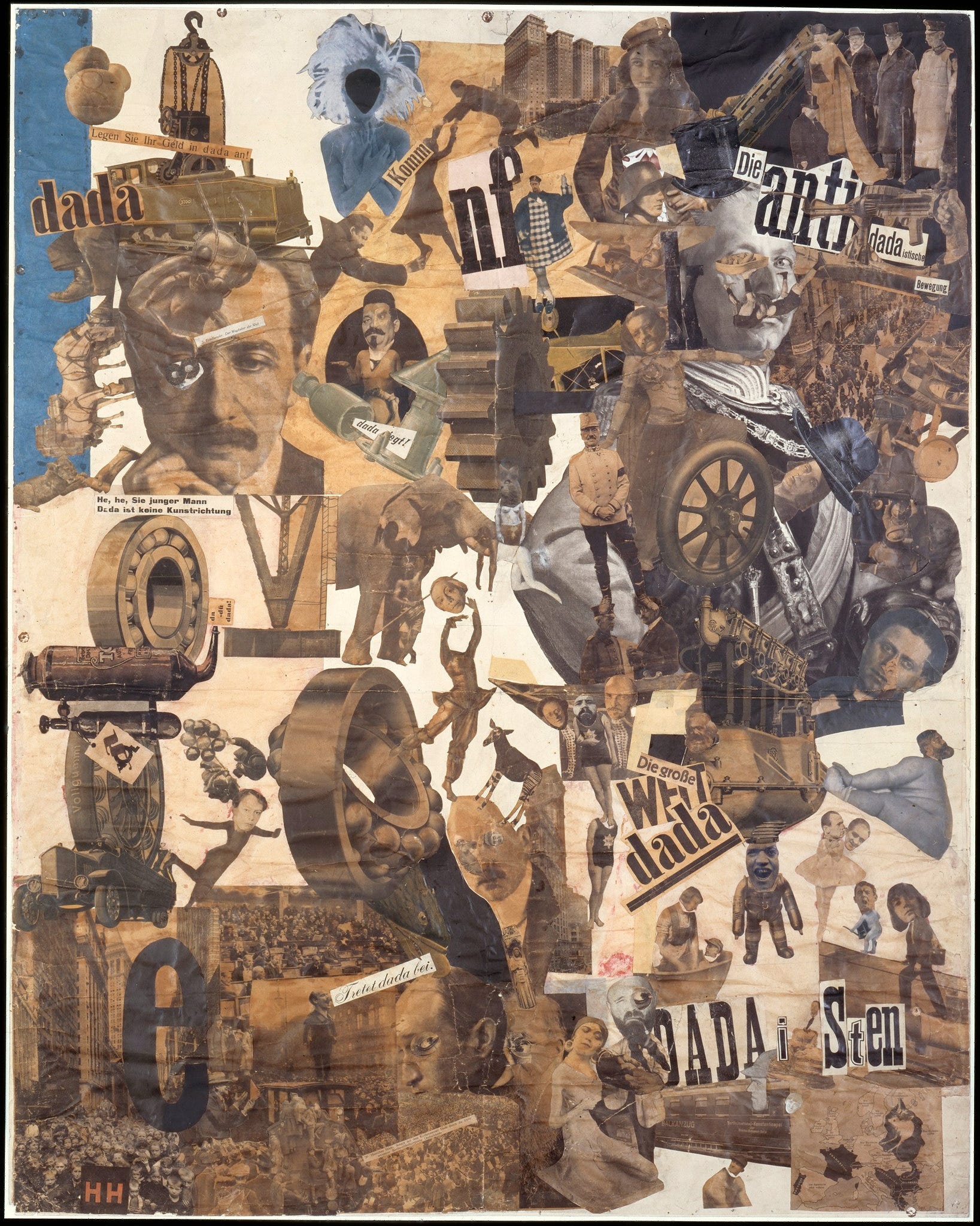
(Hannah Höch, Cut with the Kitchen Knife Dada Through the Last Weimar Beer-Belly Cultural Epoch in Germany, 1919)
6.These thoughts following Weber brought me back specifically to Foucault and the lectures he gave on "The Birth of Biopolitics" in 1978-79. Foucault, who was already closer than Weber to the figure of the state in our days, even if he didn't himself foresee the neoliberal policy of the Clinton administration, can teach us some important lessons specifically from that policy's older sister in post-World War II Germany, but more importantly – about the ideas of the economic school called Ordo-liberalism. Foucault repeatedly emphasizes, from his lectures on "Security, Territory, Population" (1977-1978), that the nature of modern government is precisely in developing new technologies of power. Technologies that, from Foucault's descriptions, I understand coalesce relatively well with population growth in Europe in the 19th century, as in his example with the development of public epidemiology or the development of political economy. The main thing about these technologies is that they try to intervene indirectly in citizens' lives not to achieve complete control over them – but to produce small social changes that accumulate to a large effect. Weber, as one of the representatives of the sciences that developed such techniques – sociology and economics – emphasizes in the context of the modern state precisely the unforeseen consequences of too crude intervention in the social order. Weber places so much emphasis specifically on the politician's personal responsibility precisely because the modern state is such fertile ground for actions from good will that may have catastrophic consequences.
I bring up Weber again because Foucault himself emphasizes the importance of understanding the background role Weber played in the birth of the Freiburg School – the Ordo-liberals – and the Frankfurt School. According to him, Weber replaced for the Germans the fundamental problem of Marx. If for Marx the fundamental problem was essentially to understand the contradictory nature of capital, from Max Weber, this problem was replaced by understanding how the contradictory nature of capital creates in society both rationality and irrationality. In Frankfurt they tried to understand which social forms could nullify the irrationality of capitalism, while in Freiburg they tried to understand how capitalism could nullify the social irrationality accompanying it. The problem, as we see, is rationality under the conditions of modern mass society, specifically in reference to its politics.
7.The Ordo-liberals interest Foucault precisely because they offer a competing theory, and in his view a dangerous one, to the theory of the socialists or Frankfurt for why Nazism, perhaps the paradigm of modern social irrationality, second perhaps only to Soviet social irrationality, occurred. If according to orthodox socialists in Stalin's style Nazism is a necessary extension of the doctrine of liberalism as Lenin's imperialism, and according to the Frankfurt folks it's a product of the dehumanization of capitalism's social system, according to the Ordo-liberals Nazism is actually a necessary product of abandoning liberalism, and primarily of abandoning social liberalism.
According to them, state intervention draws more intervention to save the previous intervention. Protectionism leads to extensive welfare policy, which leads to economic planning, which leads to a type of Keynesian policy. All these components in a sense assume each other. Nazism is of course the perfect appearance of all these components together. These components create structured alienation between a state with monstrous power and completely managed, powerless citizens. Nazism is the inevitable product of a state that seeks more and more power. The critique of the modern economy, that it alienates the individual from his community, actually points the arrow in the wrong direction: it's precisely the state's intervention in the modern economy that draws the individual out of the community and isolates him facing the state, causes him to rely on it where once his community was, and then to create a feeling of Gemeinschaft builds huge public spectacles that only through identification with them can he identify with other people in his country and restore some of his humanity to himself.
8.In our context, Foucault, much more than his other brothers on the left (and it's surprising to see how prevalent they still are in our days), identifies what the Ordo-liberals innovated in the context of liberal economic theory. According to him, the Ordo-liberals reached the conclusion that the irrationality of modern society actually stems from an assumption that was clearly shared by classical liberal economists, namely that the state is given, and the only question is how it makes enough room for the free market to function. Actually, they argued, the market doesn't function by itself. Competition doesn't happen by itself. Competition is a human product that occurs only under very specific conditions, in very specific interaction with other historical factors. The state's purpose is precisely to create those conditions that will allow free competition to appear. What this means is that the state must intervene regularly in creating conditions for competition, to supervise the market and take full responsibility for it. Foucault identifies here, as mentioned, a theme that began to interest him already in 1977, the new governance style of the modern state that doesn't intervene directly in social processes, but intervenes peripherally to influence the occurrence of beneficial social processes. Again, Foucault's own example from 1977 is modern epidemiology: instead of trying to treat each patient separately (as doctors of that time preached), give a large part of the population a small vaccine that will prevent the disease's spread within the population (as doctors of that time opposed).
Thus, for example, the Ordo-liberals assumed that it's true that in ideal theory a monopoly cannot form. But in actual history there are numerous external factors that work actively, whether in the state or among other associations, to create monopolies. The state's role, therefore, is to create legislation, as exists in Germany, whose purpose is not to prevent the free market from creating monopolies, but precisely to prevent external factors from exploiting the free market and creating monopolies within it. The ideal of the Ordo-liberals, from reading Foucault in Röpke's 1950 text "The Orientation of German Economic Policy," is to create an ideal entrepreneurial society, where everyone has different forms of initiative, support for small and medium businesses. Society's economic activity should be as decentralized as possible, and as little concentrated in national or international giant corporations. As Foucault rightly notes, this returns us to Weber.
9.According to Foucault, the Ordo-liberals actually return to an understanding of capitalism originating from Sombart, Weber and Schumpeter. For the purpose of discussion, I'll assume we don't think a welfare state (and incidentally artificial reduction of inequality required for competition) is humanity's ultimate vision, or that we reject socialist solutions of economic planning for the issue. I'll assume we remember the state has other functions besides managing the economy. The Ordo-liberals' aspiration to find "indirect interventions" in society that constitutes the real ground in which competition can grow returns us to Weber's reminder, which I think grows specifically and precisely from the nature and size of the modern state, whereby direct interventions in society often draw unforeseen consequences. In my opinion, almost every industrialized country (some more and some less) has actually been required to have its politicians actually engage in a type of regulation that tries to intervene as little as possible crudely, while trying to influence indirect factors as much as possible. The modern state is necessarily enormous, because even if it's not a socialist state (managing the economy) or alternatively a welfare state (trying to place an active counterweight against citizens' economic activity), it still needs to supervise market activity, provide education, unemployment, health, urban planning and of course – security.
Foucault is well aware of the paradox in this, and this paradox returns in my opinion to the heart of Weber's vision for the politician. The politician needs to show exceptional responsibility and sense of proportion, because the ethic of responsibility demands action for good within a social context with dangerous means. He is charged with supervising a state that is always active. Unlike, one might argue perhaps toward pre-modern politicians, who could to some degree of justice recruit to their benefit to some degree of justice only the results they wanted to occur in reality following implementation of their policy. It's possible that in much smaller states managerial responsibility is mainly direct, but I have good reason to believe that the pre-modern ethos, ironically, was much less forgiving than the modern ethos of "my fault, not my fault."
Modern politicians, on the other hand, are charged with a state that one could say almost by its nature requires more sense of proportion, to understand which intervention or, no less important, lack of intervention, will draw unwanted results. It's enormous, and therefore one could say that friction with the professional level is almost inevitable. More than the politician needs to control the state, he needs to know how to lead the professional level in the direction he aspires to. To a large extent, a politician who is constantly in conflict with professional levels in all areas is a politician who arrived with an ethic of ends where any means is kosher to achieve them – that is, not a politician, but a revolutionary. The Ordo-liberals thought about the formation of monopolies – but we won't be far wrong if we follow Foucault and say that the same logic applies even to other spheres, like an attack on a tremendous scale or breaking of the social fabric. Standing guard is the modern politician's first task.