


Our world, to a great extent, is the world of media. As Peter Sloterdijk observed, it's hard to think of another aspect in which the world differs so radically from that of our predecessors. It's also hard to think of something that plays such a crucial role in our mentality, compared to the world that preceded us, than the constant presence of media. In his magnum opus, "Critique of Cynical Reason," Sloterdijk analyzes this aspect of our world in its two halves: supply and demand. The demand is for sensations, for the new, for the current. The supply largely tries to keep up with this demand not only by hunting for new content, but also, to a certain extent, through "repackaging." All this presents us with a kind of radical and strange vision – on one hand, the news purports to represent, in a certain sense, the totality. An almost philosophical aspiration. On the other hand, a mosaic is created utterly lacking any internal logic, where the only thing connecting it is that it's presented in the same newspaper pages, on the same website.
According to Sloterdijk, modern journalism should be seen as a product of the early modern era, similar to encyclopedias. Encyclopedias tried to offer a reorganization of stable knowledge with a minimal structure to hold it together, and newspapers, in turn, offer to present changing knowledge in a minimal structure. His emphasis is on conjuncture, "both this and that." Events and reports whose connection doesn't exist outside the graphic syntax of the newspaper layout where they are placed side by side. "The attack in Iran" and "Trump sells perfume." Here Sloterdijk brilliantly maps two responses: the cynical, which he believes characterizes our civilization in general, and the rationalist, which characterizes a special human type that hasn't managed to develop within itself the cynicism required to cope with the flow of information threatening its psychological integrity.
The cynical response is the expected one. In fact, consumers aren't so naive that they stand helpless before the flow of information. They develop cynical protocols that decide for them what deserves attention and what doesn't. What's really new and what isn't. What's really important and what isn't. The anchoring of these protocols doesn't occur from some transcendental hierarchy of what's "more important" and "less important." On the contrary. These protocols organize themselves around limited resources for empathy, excitement, and thought. In this sense, the logic of these protocols is subjective.
The second response is the rationalist response. Sloterdijk identifies certain philosophical schools that adopt it, but let's set that aside for now. Here the goal is to develop a kind of mental hygiene whose purpose is at least authentic understanding. Its method is the Cartesian method: isolating at least one isolated island, usually science, where things are logical and understandable. An island where the conjunctures offered to us undergo rigorous testing, where "both this and that" has a certain internal logic. The problem that repeatedly arises in these methods, even the excellent ones, is that the isolation is done in such a way that it leaves the world generally incomprehensible. Navigation from this island onward isn't really possible. The "I don't understand" of a certain philosophical school should be understood not as an ironic dismissal of what the speaker considers nonsense, but as a declaration of helpless innocence, of childish incomprehension.
In another sense, one can arrive from this island, the island of rationality, at a kind of Stoic tranquility. An old Hasidic story tells of a worldly man who encountered a Kabbalist in the street. The Kabbalist saw that the man was carrying a newspaper and declared, "I can tell you what's written in this newspaper without looking at it." The man, expecting to be amazed by this circus act, was excited and asked, "Well, what's written in it?" The Kabbalist answered: "Bad news." The original purpose of this story was obviously to provoke a certain mockery of the endless pursuit of news. But I think there's another interesting lesson in this story, this time specifically about this particular rational type: the a priori decision that there's nothing in the newspaper that could excite me or be important to me, because I don't participate in this game of journalism. The Stoic tranquility of this position is admirable, but it contains again that same innocent childishness that believes in advance that no event occurring in the world could interest me, because I already understand the important things there are to understand. As a cynical protocol, one could still give this position some justification, but it would be wrong to think that such a person actually "understands" something different from what the cynic with more developed protocols understands. And yet, there's in the Kabbalist's position also a certain beginning of ethics, an ethics without which rationalism becomes exposed to another perversion.
Rationalism may also express itself in a pathological perversion: the individual attempt to organize this flow of information into a coherent cosmos. As Rabbi Menachem Navot once expressed, Cartesian doubt is actually a certain form of conspiratorial thinking. What began as a defense system, as hygiene, becomes an autoimmune disease. The protocols begin to produce not an almost biological defense from the information flow, but new and radical information that threatens the individual and their world. In a certain sense, the disease especially reveals itself in that the victim of the conspiracy, declaratively, is always partially the conspiracy's author or accomplice. We never conspire about events that don't concern us at all, secret connections that threaten other people. This symptom, in a sense, points to the disease's origin.
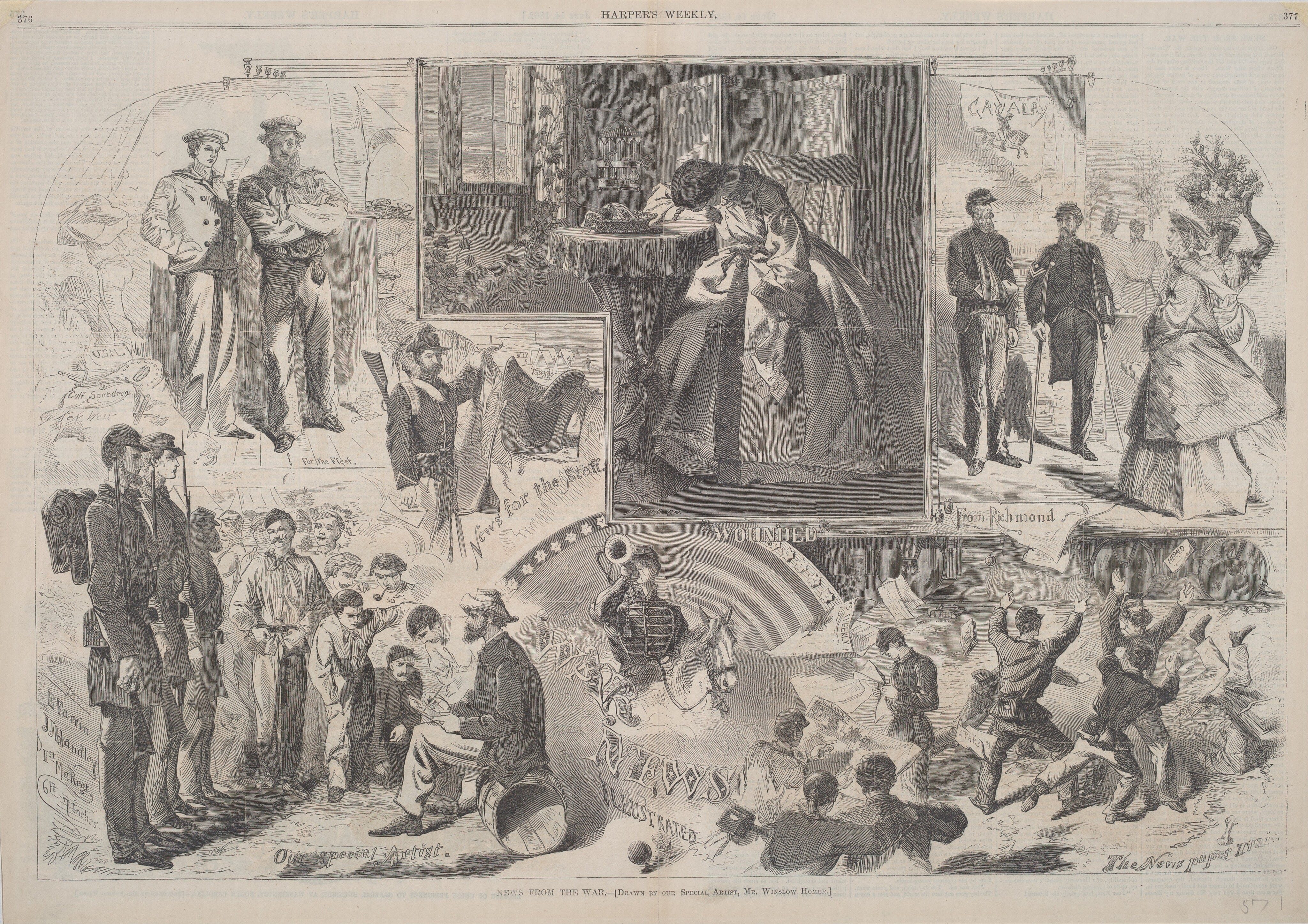
(News from the War, Winslow Homer)
To demonstrate why this is so, we'll use Chesterton's essay, "The Maniac." There Chesterton considers the mindset of a person certain that somewhere a plot is being hatched against him or his loved ones. Chesterton's analysis is that this way of thinking is expressed in two characteristics, both more psychological than concerning the content of things. As Chesterton correctly notes, paranoid thinking isn't illogical. In fact, it's remarkably logical. It's far more coherent than the "worldview" many work hard to cultivate. Therefore, attempting to reason with the paranoid about the content of their fears, if done with the goal of neutralizing them, is pointless.
According to Chesterton, the paranoia that creates conspiracies is a product of two characteristics: spiritual pettiness and logical completeness. To quote the response Chesterton offers to the conspiracy producer. I'll allow myself to bring a somewhat lengthy quote because Chesterton is a master, and I implore you to go read this essay:
If we could be the friends of the man as he unfolded his problem, we should take care not to reason with him. Our words would be such as, 'Oh, I admit that you have your case and have it by heart, and that many things do fit into other things as you say. I admit that your explanation explains a great deal; but what a great deal it leaves out! Are there no other stories in the world except yours; and are all men busy with your business? Suppose we grant the details; perhaps when the man in the street did not seem to see you it was only his cunning; perhaps when the policeman asked you your name it was only because he knew it already. But how much happier you would be if you only knew that these people cared nothing about you! How much larger your life would be if your self could become smaller in it; if you could really look at other men with common curiosity and pleasure; if you could see them walking as they are in their sunny selfishness and their virile indifference! You would begin to be interested in them, because they were not interested in you. You would break out of this tiny and tawdry theatre in which your own little plot is always being played, and you would find yourself under a freer sky, in a street full of splendid strangers.'
What Chesterton's approach – which also aims its arrows at rationalists, and even ventures into metaphysics itself – and Sloterdijk's share on this subject is that the rationalist deliberately blocks themselves from understanding the true strangeness of events, their enormous dimension. Both offer very different solutions to the problem before us, and we'll soon see how they actually complement each other.
Sloterdijk correctly notes that there's some kind of built-in interpretation in the journalistic placement of one event next to another. As if there's an equivalence, sometimes implicit and sometimes explicit, between events. There are even journalists who specialize in producing such equivalences, in producing interpretations. But very rarely can two events be placed side by side in such a sterile way that we can derive from it a judgment about causality, as if we were in a laboratory. A person who buys into the equivalences the newspaper presents would rightly be called naive. However, to a certain extent, the activity of weighing happens within our own cynical protocols while reading the newspaper. Developing self-awareness toward these weighings and their errors is the first step, according to Sloterdijk, to developing critical consciousness. The object of critical consciousness here is obviously the media, but since it constitutes such a significant component of our civilization, it has, in certain senses, emancipatory potential. The idea here is to a certain extent not to "better understand" the news, but to better understand the cynicism that guides the structure of the news itself.
On the other side, Chesterton offers a complementary solution, if not identical in content. Critical consciousness toward the news will inevitably produce a certain theory about the world. Now, this theory can be better or worse. But a certain characteristic of theories is undoubtedly related to the spiritual stature of their thinker. A person who believes the whole world revolves around them, to quote Chesterton, believes the world has a small and rather pathetic god. In this sense, developing genuine interest in things that don't concern you, and might never concern you, serves as a kind of spiritual training regarding the shape of a world where you're not the center. Accepting a certain image of everything small in the world, busy with itself, significantly moderates not only self-image but also the possible image of other people. Moreover: a person whose spiritual nourishment consists almost exclusively of newspapers risks having the equivalences they themselves produce remain at the journalistic level, that is, one that can be consumed in a medium with the newspaper's attention span.
It's certainly possible, and probably true, that there are giants in the world. But it will always be true that whatever their size, their size is not the size of the world itself.