


It seems the recent events in France have sparked a resurgence in the discourse around the decline of the West. By all means, you may keep participating in this fun genre, but I thought I’d republish a reminder I wrote about a year ago.
About a year ago, Yishai Shnerb published an excellent piece in Makor Rishon on the Islamization of Europe (If you don’t read the language, use Google Translate like an adult). I say excellent because, naturally, I agree with almost every word of it. In fact, although I am somewhat more anxious about the Islamization of the public sphere in Europe – the problem of the major cities, which he dispatched with a wave of the hand, seems to me deeper, as does the problem of education – on the whole this is an argument I have been making for several years, including the data, which are also not very new. There are many counterintuitive things in this story, such as the fact that, if we check, we’ll find that the attacks of various kinds are mostly not carried out by the first generation of immigrants but precisely by the second (which runs entirely parallel to, and perhaps raises questions about, the “secularization” thesis Shnerb proposes), and that they tend to happen more in France than in Britain.
Either way, the one extension of his argument that I suggest paying more attention to, because it is perhaps the most instructive, is actually the closing. Shnerb cites Spengler’s book (a book which, in certain respects – the non-historical ones, specifically – is rather successful, though I don’t recommend citing it in an academic paper other than critically) as having already begun the discussion of the death of Europe a hundred years ago. But in fact this discussion began two hundred years ago, in the reckoning that followed the Napoleonic Wars.
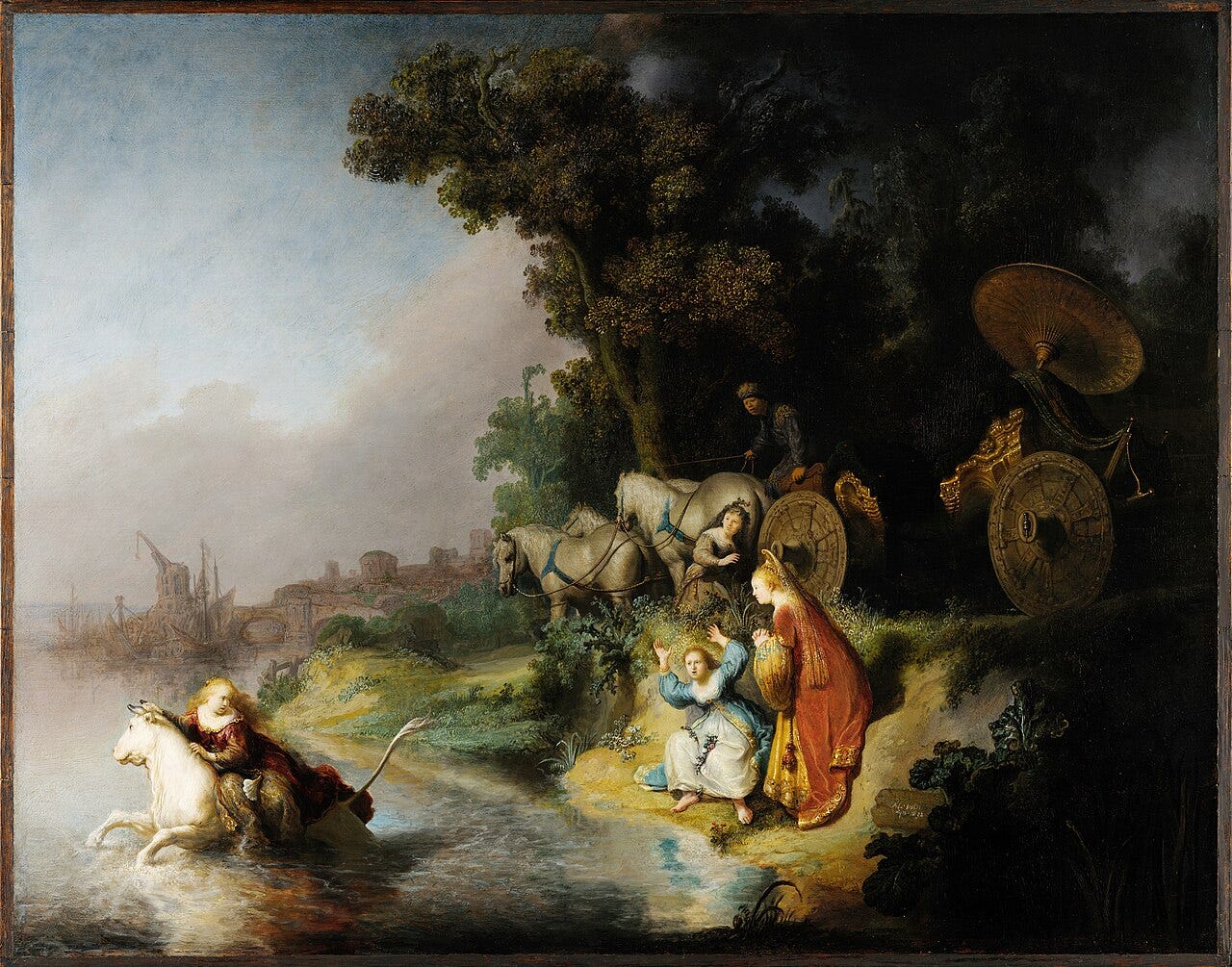
(Rembrandt, The Abduction of Europa, 1632)
This discussion passed from Joseph de Maistre (1753–1821, and a few others of his kind), through Burckhardt (1818–1897, more a general pessimism), through Nietzsche (1844–1900), through Spengler (1880–1936), through Heidegger (1889–1976) and Jünger (1895–1998), through Kästner (1899–1974), and in our day through Houellebecq (1956–). And the hand is still very much outstretched; what I’ve brought here is mainly a sample of names meant to illustrate a timeline. This is an intellectual tradition with fairly stable genre features, which has been flourishing for close to two hundred and twenty-five years and relies quite heavily on the readers’ memory being short – as indeed it truly is. The features of the genre include a vitalist discourse of the will, or lack of will, to live; a religious discourse of lost roots and home; and a civilizational discourse of built-in degeneration. Along the way, several new states were created in Europe, empires fell apart, there was a population explosion the likes of which the world had never seen before the 19th century, two world wars, and the creation of a new super-union that is an empire-that-is-not-an-empire (the European Union).
The question of Islam is not new in it either. Like Houellebecq, a hundred years back one can see René Guénon (1886–1951) suggesting that Islam preserved spiritual forces the West had lost (Houellebecq is at least self-aware at this point). Fifty years before that, Burckhardt sketches (rightly) the history of the Italian Renaissance as one structurally threatened by Muslim political powers, and had a deep awareness that the history of Islam on the continent is in fact quite old – through the Reconquista and the influences that still remained in Spain and radiated hundreds of years forward.
What is interesting about this discussion is that more than it reflects reality, it reflects wishful thinking. In Israel people are desperate, partly under the pressure of the last war, to believe that Europe’s story is over, because its foreign policy is vile and dishonorable toward us – partly, indeed, under the influence of the Muslim minorities on the policy lines promoted there by the European left. At the same time there is a real sense of loss here, because Israeli culture is held (with a large measure of justice) to be insufficiently independent to survive a severance from Europe. This duality, in various forms, has also characterized the discourse around the death of Europe more or less from its beginning to this day. To a large degree there are more prophets rebuking at the gate here (apart from exceptions like Burckhardt) than cold analysis of reality. The right everywhere, at the cultural level, is interested in suggesting that the traditional solution to the crisis is in its pocket in one way or another – and a wonderful way to do that is by means of a story of the decline of the generations.
I say it is a wonderful way, but it is in fact also a very Christian way. We have here a classic narrative of original sin, a fall from grace. The idea is to generate pressure toward more closed communities that will survive this crisis, much as the Christian monastic communities survived the barbarian invasion of Rome. Repent, children, quickly.
That said, as I noted, I think there are real reasons for political concern. More than that, I believe the State of Israel needs to understand how it navigates foreign policy at the global level in this climate. But whenever we get to proposing yet another description of the degeneration of European culture and “deep causes” that play to the historically ignorant religious intuitions of whichever public the words are addressed to, I suggest arming oneself with a pinch of salt. A cold shower of data like the one Shnerb offers is always a good idea before setting out to understand what is happening on the ground.