


Every so often, Facebook pulls me away from my "regular" intellectual pursuits toward aphorisms or fragments of thought for which I haven’t yet found a broader framework. Today, I was reminded of the late Christopher Hitchens, and I watched a 2007 discussion he had with the so-called "Four Horsemen of the Atheist Apocalypse." I hadn’t revisited that clip in nearly a decade, and while I’m unsure if my thoughts today are better than those I had back then, I’ve noticed that the positive content of their arguments for or against the existence of God no longer interests me. Even back then, I had already read philosophers who handled these topics more thoroughly, be they theologians like Alvin Plantinga or philosophers like Bernard Williams. Today, I find myself at an even greater distance—the position of a critic.
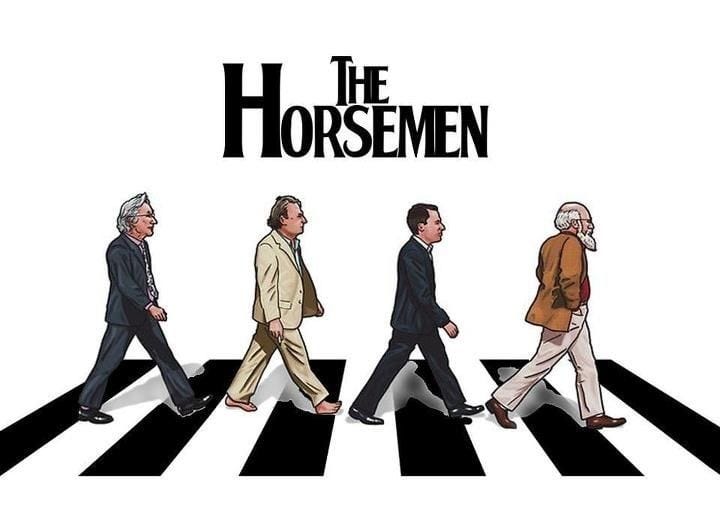
As a critic, I recall my earlier critiques of articles by Persico in Haaretz (though, to this day, I haven’t read his book). I still hold the view that it's mistaken to see atheism as a spiritual movement with a unified center of influence, comparable to that of organized religions. Any reflection I have on atheism in European history—whether on Spinoza, d'Holbach, or Nietzsche, along with their less impressive successors today—reveals that atheism lacks a single historical-positive core. Watching the Four Horsemen again (link in the comments), the only thing that struck me as significant was how much their arguments draw from contemporary political rhetoric.
The case I tried to make back then, and which I still hold, is that atheism adapts its form based on the speaker’s political commitments. In that same 2007 conversation, two critiques of theism stood out to me (theism itself being a dubious category):
– First, believers are divided into two types: the simple and the sophisticated, or the gullible and the intellectuals. Regarding the first type, all the speakers agree: there’s not much to be done but to address them in their own language—a mix of mockery and “magic words” meant to protect them from the intellectual leaps that religious authorities propagate. As for the second type, it’s far more complex, as these believers are often not only aware of the critique but have somehow internalized it. They manage to compartmentalize their thinking so that they don’t have to live the contradiction—a kind of sustained cognitive dissonance. In the discussion itself, this becomes surprising as it leads to much more interesting reflections on the dissonances that the atheists themselves maintain, for a variety of reasons.
– The second recurring critique, which I find justifiable, is the need to believe in a celestial dictator who tells us what is good and evil, without whom we would descend into savagery. This critique echoes Kant's point in his Critique of Judgment: if there are believers who need such a deity to know right from wrong, they not only lack sincere belief (for they reduce God to a mere functionary of their deficiencies) but are, more seriously, simply bad people. (I wouldn’t go that far—what mental gymnastics people use to become better doesn’t matter to me much, as long as they indeed become better.)
What unites these two critiques, along with others if you listen carefully, is the democratic instinct running between the lines. The first critique essentially protests the intellectual inequity of maintaining two classes—one that only has to "believe," and the other that enjoys a degree of intellectual freedom. This structure is seen as unfair because it’s undemocratic. The impression is reinforced when the speakers explicitly address how scientific hierarchies differ: then, unsurprisingly, the rhetoric shifts toward "evidence," "experts," "testimonies," and so on—legal rhetoric, the traditional way modern democracies maintain civic hierarchies around meritocracy, competition, and division of labor. All this while it seems obvious that these principles apply to scientific discourse more as regulative ideals (to use Kant’s phrase) than as pure historical reality.
The critique of God as a dictator, on the other hand, reflects a kind of "double truth" in the Averroist sense. It’s common—perhaps following Spengler—to distinguish between "St. Petersburg nihilism" and "German nihilism." The first, best encapsulated by Dostoevsky's slogan "Without God, everything is permitted," warrants some pause because its illusion of depth has accompanied it since its inception. First, in this view, God is seen as a guarantor of some contract, whose absence nullifies its validity. The collapse of the contract’s validity, in turn, suggests that, without God, people can do whatever they want—simple permissiveness. This is the kind of atheism against which traditional religions are best equipped. Here, the thinking is essentially criminal, personal, or at least permissive. People who adopt this mindset aren't particularly impressed by arguments for or against God—unless there’s a club (literal or metaphorical) involved. It’s no wonder, then, that traditional religions have an entire arsenal of clubs, imagined or otherwise, designed to address this specific type of person. However, it seems to me that this rhetorical framework isn’t limited to traditional religions but characterizes any society that structurally involves the threat of violence—essentially, any mass society in human history.
This is, in some sense, a corrupted form of democratic thinking—a sort of ultimate license to do anything that people value more than doing the right thing. The alternative, of course, is a society where people can do anything without punishment so that they choose the right path out of nobility of spirit. A "healthy" democracy is one that shifts between these extremes, as Plato teaches us. The German form of nihilism is more complex. As Nietzsche (if I recall correctly, in Twilight of the Idols) states, the focus here is on extracting new ultimate goals for humanity from the ruins of the old ones. This is impersonal, noble thinking, at least in the negative sense: it doesn’t consider narrow, hedonistic interests as a criterion. This isn’t a "different kind" of atheism—it’s an entirely different animal.
This creature, which harbors historical, metaphysical, and contemplative investigation, is familiar to any serious theologian. In fact, it's quite distant from "democratic atheism," much in the way a simple believer is far from a more sophisticated one—perhaps even more so. If you look at historical atheism, you can almost see Plato’s "revolving governments" in action: an aristocracy of goodwill, followed by a slightly bitter aristocracy that indulges in simple pleasures, and finally a democratic mindset beautifully depicted in Dostoevsky, whose ultimate end is a conspiratorial distrust of any normative or metaphysical authority—a suspicion typical of the tyrant.
What’s interesting about the Four Horsemen of the Atheist Apocalypse is that their merit lies in spreading the rhetoric of the Enlightenment—a rhetoric many love to mourn. Their goal is to elevate tyrannical believers to the intellectual level of moderate, modern atheists. However, their failure is in producing a nearly mass-manufactured army of evening debaters, whose sole purpose is to annoy, if not entirely derail, good people just because they believe they are wrong somewhere in their understanding of reality. This isn’t a random mistake but an essential flaw rooted in their treatment of atheism as a kind of all-encompassing worldview (Weltanschauung) on the one hand, while hiding behind a formal epistemological humility—"we’re just saying the statement 'there is a God' is false." They love to point out that the gap between deism and theism is unbridgeable, but the gap between asserting the existence of a specific metaphysical being and the implications they draw from that claim is equally unbridgeable. Yet, while traditional religions openly declare some kind of hierarchy, with intellectual freedom justified as a privilege, atheism lacks an equivalent.
Atheism, then, changes its conclusions based on the political structure it adheres to. Since it’s much younger than traditional religions, this change is more central to atheism than to its religious counterparts. However, because there is indeed an aristocratic atheist tradition, atheists with a bandit-like nature can cling to this fragile lineage. In other words, atheism is no longer a theological problem—how to deal with "permissive" people—but how to deal with a large public that swings wildly between infantilism and the most noble instincts that good education can foster.