


I’m not sure how much trouble I’m going to get into here, but I need to let off some steam before getting back to my homework.
There’s a concept that originated in the nineteenth century but made waves in the world after World War II, which I think borders on criminal in its usage. “Judeo-Christian tradition” is a kind of post-religious slogan meant to describe Western civilization, ostensibly doing Jews a favor by including them within civilization’s backbone, expecting, on one hand, to create a smokescreen as if the struggles of Western civilization against the Nazis and later in the Cold War against Communism weren’t simply a struggle of a religious force called “Christian civilization”—whatever the authentic status of this civilization’s secular development—and on the other hand, to create a smokescreen of Jewish inclusivity within a civilization that for the vast majority of time has repeatedly perpetrated crimes against Jews.
The use of this concept, contrary to what we might expect, isn’t a particular characteristic of the Western right or left. In WWII, it was used by different people like George Orwell and Albert Einstein to explain precisely what the Nazis were trying to eliminate, and accordingly, what identity people should fight the Nazis for. The term was extensively used in fighting antisemitism, but as usual, it was a temporary and somewhat weak remedy for combating the phenomenon. Later, this concept was used by post-secular liberals like Michael Walzer, for what could be thought of as establishing the legitimacy of Jewish identity in Christian spaces. From Reagan onward, this concept was also adopted by American conservatives, and to this day you can hear Jordan Peterson using this term. On the other hand, someone like Slavoj Žižek also makes frequent use of it. Both employ a rather banal Christian distortion of Jewish concepts. As mentioned, this abomination is used everywhere.
Personally, this concept bothers me, as I said, not just because of its historical distortion—but more so, because of the distortion of Jews’ place in Western thought. It’s a common sight, perhaps too common, to see Jewish conservatives like Yoram Hazony or Ben Shapiro attributing Western political and ethical thought to Jewish sources as well. Things have reached the point where there are people—and believe me, they’re not few in the literature, and even exist in Israel—who attribute to Leo Strauss the idea that Western civilization is built on the Judeo-Christian tradition and Athens, as if an innocent mistake, but one that criminally distorts the words of that man who knew to say:
Let me return for a moment to the Jewish problem. The nobility of [the State of] Israel is certainly beyond praise, the only point of light for the contemporary Jew who knows where he came from. And yet Israel does not provide a solution to the Jewish problem. “The Judeo-Christian tradition”? All this means is to blur and hide enormous differences. Cultural pluralism can be a concept, it seems, only at the price of dulling all edges.
I bring up Strauss because Strauss, more than others, noticed the absence of Jewish political thought, beyond a few key names like Spinoza and Mendelssohn. This is a problem because in the absence of high conceptualization, Jewish political activity is guided by opportunism—noble as it may be—and memory. In this sense, if I adopt some of Oakeshott’s terms, Jews in the State of Israel have a state, have a collection of practices, not so ancient, and an accumulation of experiences, memories, that guide their activity. Jewish tradition has not yet reached the maturity of political thought. Allow me to demonstrate this matter somewhat comically through Religious Zionism [Israeli-based religious movement]. In the 1990s, when the bon ton was liberal eschatology, rabbis from Religious Zionism did everything they could to support a reading of Jewish sources that would enable understanding them as heralding the redemption of societies guided by human rights and prophetic morality. In the last ten years, when the world made a sharp U-turn back to Herder’s vision of nation-states, other rabbis suddenly stir through texts to explain how Jewish tradition actually always heralded a world that respects the diversity of each national form of life. This, of course, is just the tip of the iceberg.
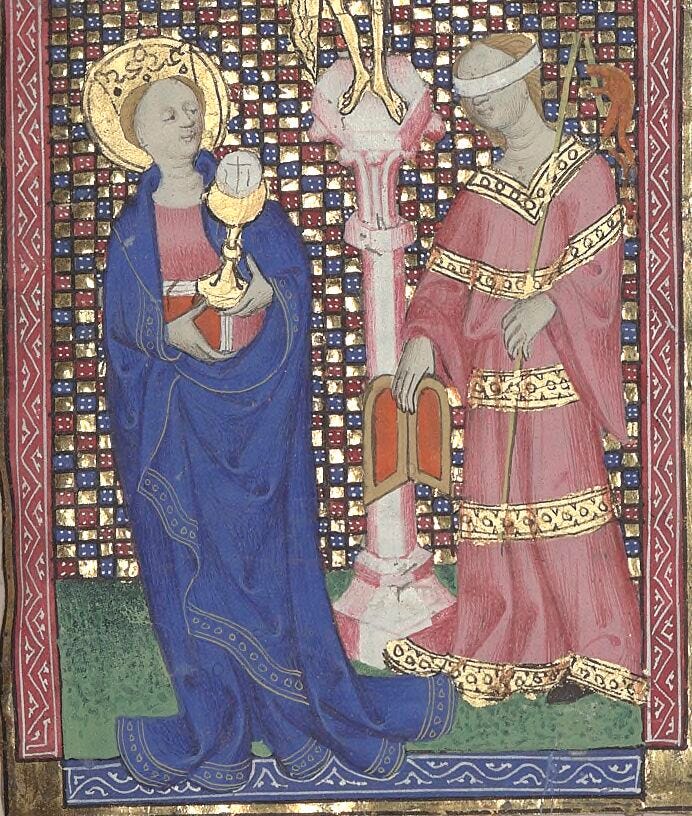
(Ecclesia and Synagoga, source)
But never mind that people try to build Jewish political thought from Maimonides’ “Laws of Kings,” as if what Jews lack in their tradition is simply another developed interpretation of canonical texts. Never mind. What’s unclear to me is the inflation of Jewish self-importance, based on nothing but ignorance. The most horrifying form of this in my eyes is the attempt to portray Renaissance Hebraism as something supporting the Judeo-Christian tradition thesis. Make no mistake: again, this is something shared by liberals and conservatives alike, each thinking this deception will somehow contribute to the Jewish political project.
In 2004, an international conference was held in Jerusalem of the world’s leading Renaissance Hebraism scholars. At the conference’s end, a journal on the subject was launched, and more importantly for our purposes, the book Political Hebraism: Judaic Sources in Early Modern Political Thought was published by Shalem Press. The book concluded with an illuminating article by Gordon Schochet titled “The Judeo-Christian Tradition as an Imposition: Present at the Creation?” Allow me to share a rather charming anecdote from the article that will somewhat illuminate the absurdity of this concept, before continuing to the main point.
In the early 2000s, the European Union began celebrating being a political umbrella organization, not just an economic one. For this purpose, it was necessary to draft a constitution for the Union. Of course, more religious states wanted Christianity enshrined in the constitution. On the other hand, more liberal circles obviously didn’t want to touch it. At some point, Turkey’s joining the Union was considered, and in response Pope Benedict—perhaps the last serious Pope the Catholic Church had—claimed that “Muslim Turkey stands in permanent opposition to Europe.” The New York Times hurried to explain to the cute Pope his mistake, in their usual paternalistic tone, but one that relied, especially implicitly, on what Strauss called the “dulling of edges” that this term serves. The New York Times explained to the Pope that he was confused, and that the values he seeks to preserve are “universal, not a Jewish-Christian monopoly.” You can’t make this up.
Either way, in his article, Gordon examines with great honesty whether Renaissance Hebraism can be called a contribution of Jewish tradition to Christian, or European, political thought. His conclusion, unsurprisingly, is negative. Hebraism, in its various forms, read the “Old Testament” from an utterly Christian starting point, which was reflected, in different ways, in the conclusion that Christianity and its concepts moved beyond the biblical people of Israel. Renaissance Hebraism is indeed a fascinating research topic, but there’s no way to harness it as a Jewish contribution to political thought if we ignore that the move Hebraism made was one of appropriating Jewish heritage, an appropriation that actually has quite an ancient history in Christian thought from its very beginning. The Jews themselves, Gordon demonstrates, didn’t really succeed in developing independent political thought.
I’m venting this steam because it seems to me that Israel is at a point where it’s close to exhausting the remaining spirit that can be gathered from the collection of practices formed here since the state’s establishment at the political level, or worse, the reservoirs of memories of disasters that befell Israel from the Holocaust to October 7th. This “brotherhood” forced upon Jews with the roots of the Christian world—and we’re going to see this in the coming years if we’re not seeing it already in both the Western left and right—serves the double standard by which the State of Israel is judged. We’ll need to find our way to political thought that has at its core the interests of the State of Israel, at least in order to stop looking for allies where they aren’t. More importantly: we’ll need to learn to think for ourselves for the long term, and not just through constant observation of potential allies who will help us survive here.
Being called “Judeo-Christian” is better than being called a “Christ-Denier” if those are the two choices
There is also the fact that the term “Judeo-Christian” suggests to people in the West that Judaism and Christianity are similar, and that Islam is a very different religion. But, in fact, Christianity is very different to Judaism, and Islam is somewhere between Judaism and Christianity.