


First and foremost, I believe we should commend the publication of Rabbi Joshua Berman’s Ani Maamin. As you’ll soon see, my reasoning for this is not primarily due to the innovative research it presents—though those innovations are certainly noteworthy—but rather because of the success the book has achieved within the Religious Zionist community in Israel. I think the central innovation of this book lies precisely in its accessibility, bridging Biblical criticism to the religious public while simultaneously granting legitimacy to expand the accepted discourse on the Torah.
While Berman’s scholarly contributions are indeed fascinating, many of the arguments he raises—such as those regarding the historicity of the Torah’s narratives or the challenges to the Documentary Hypothesis—have precedents in scholarship, some dating back nearly fifty years.
Before proceeding, I must offer an important disclaimer: I am an amateur when it comes to Biblical criticism. If you find any errors in what I write, I welcome corrections, and I will add them as appendices to this critique (one of the advantages of writing on a digital platform).
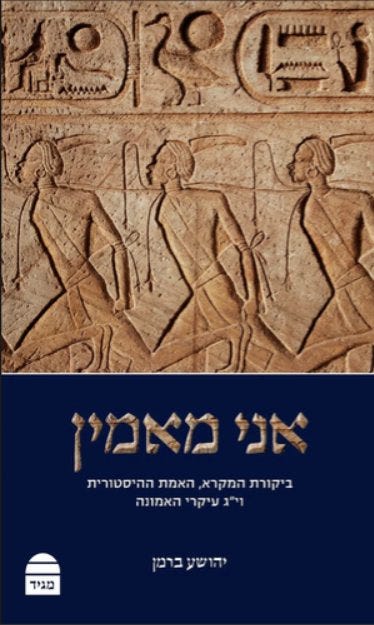
The most intriguing part of Berman’s book is his effort to establish the possibility that the Torah was written in the second millennium BCE. It is evident that Berman himself leans toward the most conservative schools of thought in Biblical criticism. However, his argument is clearly hypothetical, and as we will see, it can be read in another way. Readers looking for "evidence" against Biblical criticism as a discipline will not find it here. In fact, the book promotes a specific methodology for reading the Torah that is firmly rooted within the existing scholarly landscape, namely, interpreting the Torah in the context of ancient Near Eastern documents available to us.
Moreover, a careful reader of the book's first part will notice that even Berman's hypothesis involves, to some degree, acceptance of an alternative version of the Documentary Hypothesis. In other words, while it is possible that the core of the Torah was composed by a single author over different periods, it remains plausible that significant parts of it were written by other authors. This structural element explains why the book's second half, which addresses the halakhic question of fundamental beliefs and, specifically, the belief in Torah from Heaven, complements the first. This is not a coincidental choice—Berman is sufficiently modest and experienced to understand that what convinced him intellectually about the likelihood of the Torah's composition in the second millennium BCE may not necessarily convince a fair-minded reader. That reader may remain puzzled, so Berman offers a discussion on the legitimacy of faith, ultimately explaining the rationale behind the halakhic discourse on core beliefs in Jewish-political terms.
One of the more intriguing aspects of the book is Berman’s marketing of his "treaty-based approach" (a research framework he has developed) as an alternative to the Documentary Hypothesis. However, it’s worth scrutinizing what exactly this alternative entails. It is not an alternative to the idea that the Torah is composed of different documents, written by authors with differing ideas about the nature of Israel’s covenant with God. Rather, it challenges the notion that the authors of these sources were conscious or unconscious ideologues representing rival factions within ancient Israel. Specifically, ideologues who, at the time of writing their respective sources, understood their texts as negating or excluding the narratives promoted by competing schools with their own documents.
Berman convincingly demonstrates that for both the compiler and the authors, the contradictions—whether legal or narrative—posed no problem within the genre to which these documents belong. Furthermore, he shows that the origins of this genre lie in the 13th and 14th centuries BCE (by comparing the Torah to treaties of the Late Hittite Empire). Thus, we are presented with the possibility that not only are we not dealing here with competing ideological factions, but perhaps this is, after all, a political composition characterized by a unique harmony reflective of a rhetorical-political writing genre in the ancient Near East.
This undoubtedly represents a compelling innovation on Berman’s part, but it is not entirely unique within the scholarly landscape. As far as I understand, the comparison to the treaties of the Late Hittite Empire is not Berman’s central novelty. In Bernard Levinson’s Deuteronomy and the Hermeneutics of Legal Innovation (1997), for instance, the genre practices are traced not to the Late Hittite Empire but to the Assyrian or Neo-Assyrian Empire, which remained relevant until the 7th century BCE. The political commitments reflected in these documents—which, as far as I can tell, are not fully addressed in this popular work of Berman—are generally considered by most scholars to characterize the 8th and 7th centuries BCE.
On the theological level, Berman’s important contribution lies in his assertion that the Torah’s law is not "statutory" but, to a large extent, "precedential." This interpretation is highly appealing and, at least regarding certain legal contradictions, quite persuasive. I think Berman correctly identifies that a proper response to some of today’s theological challenges lies in emphasizing the differences between the modern understanding of law and its meaning for the Sages or in the Biblical era.
As a general principle, I believe it is essential to delve into these differences and to understand the Bible not only in the context of the ancient Near East but also Judaism as an ancient religion—if not a truly "classical" one in its conception of law. For a long time, I’ve thought in this direction, but it seems clear to me that it would have been better, for example, to study further the educational role of law in the ancient world compared to modern liberalism's deep aversion to the idea. Instead, Berman returns to his origins, presenting what he sees as the divine element in the Torah: a combination of Yehezkel Kaufmann's revolutionary model of the Bible with the moral monotheism of the late 19th century.
This disappoints me for several reasons, perhaps not all of which can be addressed here. In short: the implied reduction of Judaism to a "moral" message—which is already overstated in today’s liberal climate; the promotion of the idea that Judaism exists in the world to propagate a philosophical concept (something unfortunate for both philosophy and Judaism); the neutering of Judaism’s ability to offer critique from a "non-modern" standpoint; the tendency to project universal, culturally imperialistic messages onto the Bible; and the suppression of themes related to holiness, purity, and impurity.
Finally, there is also a simpler issue of intellectual honesty. When Berman argues that catechism is not integral to Biblical Judaism, he points out that there is no word in the Bible for "belief." This is valid, but the Bible also lacks a word for "equality," and its understanding of liberty is far removed from how 19th-century liberal nationalism or 18th-century American republicanism understood it. At best, the Bible hints at a quasi-anarchist-religious political vision or a form of constitutional monarchy.
Berman’s assumptions regarding the Hebraism of the early modern period as the ideological driver of modern political thought—rather than, say, Greco-Roman ideas—are particularly problematic. His comments on the Greeks, for instance, are strikingly deficient, and his discussion falls into familiar apologetics of liberal Judaism. For instance, while attempting to locate democracy in the Bible, he makes a point of criticizing Solon for leaving the equestrian class in a superior position in certain respects over the rest of the populace within his “democracy.” Yet within a few generations, the Greeks not only developed democracy but also theorized it in ways that are far more “advanced” (in this sense) than anything one can find in the Bible—and, it must be said, likely in the entirety of Jewish history, which is relatively impoverished in terms of political thought. Historically, too, it is the Greco-Roman intellectual tradition and its Renaissance renewal that primarily paved the way for the central political and conceptual developments of the past two to three centuries. The Bible, by contrast, mainly served as a popular rhetorical platform. This is not necessarily to the “credit” of the Greco-Roman tradition but rather an acknowledgment of the disparity in intellectual resources that modern political thinkers had at their disposal versus what might have inspired certain figures in the practical implementation of those ideas.
The theme of law is undeniably central to Judaism, but addressing this issue requires careful nuance. (A good example of work heading in this direction is Lo Yassur Shevet MiYehuda [2018].)
Returning to the book itself: the critique of the “Documentary Hypothesis,” whether from the perspective of the historicity of biblical narratives or skepticism regarding the division into separate documents (at least in its more controversial elements), is not new. As early as the 1960s, a cohort of biblical scholars led by Albright attempted to ground as much of the Bible as possible in archaeological findings (a perspective still popular in some circles). This approach received substantial criticism for its tendency to interpret archaeological findings with bias, but many of its contributions, as I understand, remain influential to this day. On the more leftist side of biblical criticism, we find the Copenhagen School, which prefers to view the Bible as the outcome of the evolution of oral traditions—similar to the Iliad, the Odyssey, or Eastern European epics—rather than as a deliberate compilation of editors working with separate documents. I mention these not because they represent any groundbreaking insight but to provide a general context for the various developments in biblical criticism that Berman engages with.
Berman’s critique of the Documentary Hypothesis ultimately converges on an a priori methodology: he argues that it is preferable to acknowledge the lack of concrete evidence for the formation of the text than to hypothesize about developments for which we have no direct evidence. As supporting evidence, Berman claims, for some reason, that only in biblical criticism is it customary to assert that an ancient text was composed of multiple documents in the absence of concrete historical proof. However, a brief glance beyond the field of biblical criticism reveals, for instance, that most scholars of Aristotle’s Metaphysics believe it was composed of two documents written at different times. Similarly, the final editing of the Iliad and the Odyssey in the early Hellenistic period is generally regarded as at least an editing and codification of various textual traditions. The Quran and the New Testament are also well-known in this regard, and I wouldn’t be surprised if similar trends exist with respect to certain Hindu or ancient Near Eastern texts. Either way, the epistemological assumption that Berman attacks is crucial: it illustrates the fundamental tension that philology (and biblical criticism in particular) has faced from its inception—between tracking the ultimate meaning of a text and its historical indicative significance.
While it is certainly possible that the biblical text is intelligible in its final form without assumptions about how it came to be—thus rendering the Documentary Hypothesis unnecessary—the historical-indicative role of the text necessitates evaluating the evidence and its biases in a way that makes it impossible to ignore the question of its formation. A case in point is the Copenhagen School, which, as mentioned, rejects the Documentary Hypothesis. Simultaneously, this school also denies the historical-indicative significance of the Bible, and it is no coincidence that this school is politically aligned with the Palestinian struggle. The bottom line is that when it comes to the meaning of the text, we may not need the Documentary Hypothesis and can suffice with analogies from the ancient Near East available to us. But as for its historical value, we cannot presume the complete meaning of a text spanning generations of historical events without critical inquiry (which is far more plausible, at least in its fundamentals, than Berman presents).
Finally, let us turn to what is truly intriguing in Berman’s book: his reintroduction, through the back door, of esotericism into Jewish writing. This move is fascinating because, in my view, it is executed at a level I can hardly find parallels for in modern Jewish literature. Here and there, one might find contemporary rabbis making seemingly cryptic remarks such as “and this is a great secret,” but such comments are not particularly noteworthy. With Berman, we receive a book composed of two parts with distinctly different aims. The first part allows the author to remain within the sociological legitimacy of Israeli religiosity by ostensibly rejecting the Documentary Hypothesis outright. The second part, however, uses the historical-genealogical discussion of the term “Torah from Heaven” to explain the development of Halakha on a social and historical level and, incidentally, grants legitimacy to certain positions he surveys unofficially—that is, without reference to the specific Halakhic rulings of our era, which may be one way or another. And while Berman himself does not hold the Halakhic authority to definitively declare that adherents to the Documentary Hypothesis are not outside the camp, his cautious introduction makes it unequivocally clear how he values Zionism and Israeli Judaism, specifically in their enabling Jews here to engage directly with the principles of their faith without the traditional fears accompanying such discussions throughout history (assimilation on one hand and persecution on the other). That said, precisely in light of this discussion, there is no small amount of irony in the return of “Persecution and the Art of Writing.”
Overall, this is a brilliant book that I believe should be regarded as an invitation for the religious public to engage in biblical studies.
Great book review. Trade subscriptions?