

Recently, I once again encountered Walter Benjamin's essay The Storyteller (1936). This renewed encounter with this beautiful essay prompted me to reconsider how much truth it contains, and what it conceals. Benjamin's typical tensions between secularization as a historical productive force versus secularization as practical earthliness that is almost part of the natural history of humans themselves shows its tensions in the different framings Benjamin offers regarding the rise and fall of the storyteller figure. There are, of course, more problematic tensions as well. For instance, Benjamin seems to think of the great epics - such as the Iliad and the Odyssey - as a kind of super-creations of which orally transmitted stories are merely variants, and seemingly as a result of this thinking, that stories were somehow meant to "lighten" and provide a more secular approach to the great and threatening myths. In this, Benjamin misses twice: he misses, not without some justification, the scholarly development of Milman Parry, which was still quite fresh at that time, regarding how the Iliad and the Odyssey are themselves likely products of an oral storytelling tradition (a theory shaped following observations of storytellers in Yugoslavia at that time), and somewhat less justifiably the formation of the Finnish epic "Kalevala." An epic that is entirely a romantic creation by a Finnish scholar named Elias Lönnrot, an epic work that he collected from journeys similar to those of the Brothers Grimm throughout Finland. Journeys in which, fortunately, he also documented many of the practices and traditions of this disappearing craft of storytelling.
Stories, Novels, and Information
In any case, Benjamin's essay has not lost its potency. It still provokes thought, and his discernment, which often expresses itself through exaggeration, remains remarkable. What I found particularly interesting this time is how throughout the essay Benjamin outlines the difference between story and novel. The novel, Benjamin argues, is, in terms of the conditions that allowed its flourishing and dissemination (not its origin), an entirely modern creation. The novel depends completely on the product called the book. The novel occupies a place in our lives only through the book. It does not come from a tradition of oral storytelling and does not return to one. The story, on the other hand, is almost identical with our ability to share our experiences with one another. Storytelling is an activity done in society, while reading a novel is an activity done in isolation - just like writing a novel. The story usually has some practical utility, or as we say in Hebrew - a "ma'aseh" [tale with a lesson, literally, a deed]. The novel, on the other hand, even if it has a useful message, certainly does not derive from its regular use. The novel actually begins to be written when the author despairs of sharing his experiences with others. The burden of remembering them is too great, they are too impossible to share through speech.
Benjamin uses Georg Lukács's well-known work on the modern novel (1916). Lukács brilliantly distinguishes that the novel is the modern artistic medium in which the subject is "the meaning of life," a meaning that cannot be expressed in the oral activity of sharing experiences. As such, time serves as the organizing principle of the novel to a greater extent than in other artistic mediums. Time actually allows a unifying framework for organizing the narrative - a kind of framework such that as the reader progresses in his reading, he approaches the "end" of the character in the novel. He supposedly devours the novel and warms himself in this burning of annihilation, a warmth he cannot attain from an analogous unity in his own life. The passion for novels, writes Lukács, is nothing but an expression of man's confusion about the interpretation of his own life. Benjamin notes that if the subject of the novel is the unity of life or the meaning of life, the subject of oral stories (even if sometimes written) is precisely what we call a moral. The story gives, directly or indirectly, good advice for life. Or as Benjamin beautifully writes, whenever good advice was of high value - fairy tales were there to provide it.
However, since modern man is less capable of allowing his experiences to speak in the form of a story, he also cannot receive advice in this form. Such a person, as Lukács observed, is imprisoned to a certain extent in his own impenetrable idiosyncrasy, an idiosyncrasy for which the appropriate artistic expression is indeed the novel. The good person, as Benjamin reminds us, is precisely the person who allows the wick of his life to be consumed by the gentle fire of stories. The archetype of the wise man is the storyteller - and storytelling is always a complex activity at the social level.
Nevertheless, both the novel and the story are actually certain forms of narrative. In contrast to both, Benjamin argues that recent times are characterized by the displacement of narrativity in favor of information. To understand what information is, we need to examine some characteristics of the story. The story, as such, usually does not contain an explanation of the story. The explanation, or interpretation of the story, is received only as a result of the process of telling it to other people. For example, we can think about the story of Little Red Riding Hood and analyze it from several angles, but such analyses will not produce for us the answer to the question of why it is told. On the other hand, when we think of a mother telling this story to her child before sleep, the purpose of the story becomes completely clear. It is possible that when this story is told in a company of adults to each other, the story will have a completely different meaning. The story, in other words, is saturated with possible models that can give it meaning, models that are realized only during the storytelling itself.
In contrast, the novel completely lacks a model. Explaining a novel, to a large extent, is to lose it. One cannot replace the experience of reading the novel, give it a sort of summary, and still preserve its inherent value. Information, unlike these two forms, contains the model, its interpretation, within itself. Information contains in itself not only the report about what it is reporting on, but also the interpretation according to which this report is reasonable. This characteristic of information aids its rapid dissemination. Stories, on the other hand, not only have to wait for the moment of storytelling itself, but sometimes they have to wait a long time before one of the more interesting models through which one can understand them comes into being at all. Information, on the other hand, can be absorbed immediately - it has one model, and it already contains it. Therefore, information loses its interest much faster than a story. The discussion of information is interesting, because in a certain way information has become in this sense similar to a somewhat earlier form of writing that emerged in the eighteenth century, modern historiography.
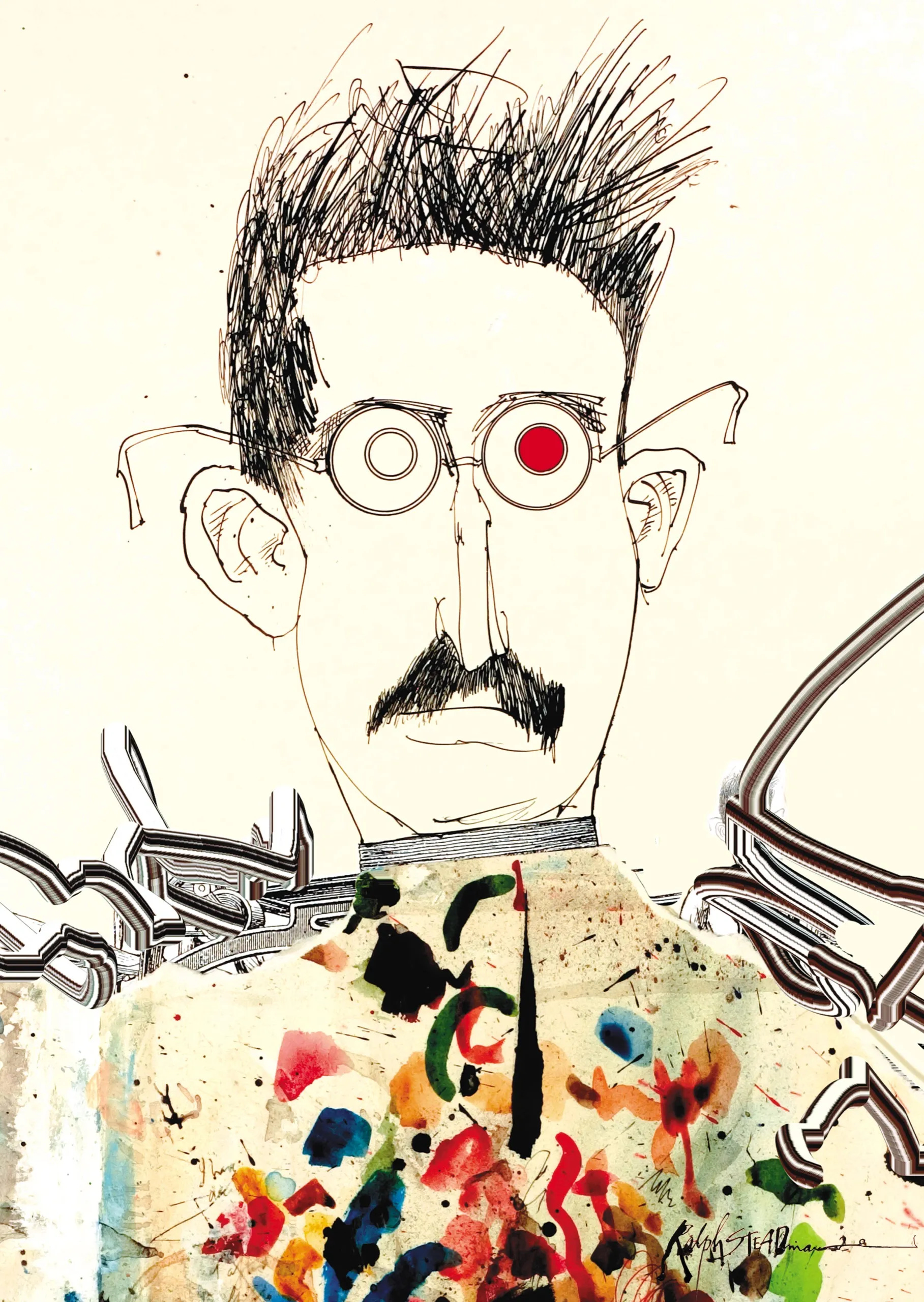
(Walter Benjamin, by Ralph Steadman)
Historiography, or the History of Life
As some of you may have recently read from me, history written in the format familiar to us is largely a product of the eighteenth century. In fact, it is the product of a mix of the medieval art of chronicles, in which history is written as a series of consecutive events without suggesting any systematic interpretation for these events, with what was attributed to the art of poetry - organizing a narrative that is plausible, in which characters act as their characterization dictates, events occur according to the general logic of the plot, and so on. This synthesis was necessary because in the eighteenth century skepticism began to develop regarding whether it was possible at all to represent past events, those that have passed and are no longer available. This skepticism, as demonstrated among others by Goethe, stemmed from the recognition that if a certain event occurred in a village earlier in the day, by evening there are at least three versions from eyewitnesses about what happened there.
The pressure of the eighteenth century was to organize the evidence so that credibility would be added to the story of history. To do this, methods were borrowed precisely from poetic writing, which as mentioned from ancient times dealt, according to Aristotle, precisely with what is likely to happen, not with what actually happened. These methods received a technical translation into a kind of "dubbing" of witnesses or historical writings, cross-checking of testimonies, and so forth. In fact, the "plausibility" that the historian often imparted to the history he wrote - think for instance of Gibbon - succeeded because the new organizing principle found for historical events is the specific and unique character of a certain time. Time, which is something invisible, suddenly became what the historian tries to describe and through which to give plausible meaning to events that occurred in history.
What is interesting for our matter is that precisely because of this, the demand for novels to be more historical began to appear. It was as if the new form of history began to organize a kind of "unity of the past" in such a way that if you told a story about a certain period, readers had already formed a renewed expectation regarding what is reasonable or unreasonable to appear in the story. Consider, for example, Sir Walter Scott's long but rather interesting apology for his "Ivanhoe." The introduction was intended to explain to the nineteenth-century reader why he might still find things - even in language! - in the novel that could not possibly appear in the period in which the novel supposedly takes place, medieval England. It is implied that Scott thought his readers would consider his novel poetically implausible - because it does not fit what they already know from the historiography of the period. In Koselleck's words, what historians really produced is the fiction of the historical factuality of time as the source of meaning organizing the unity of historical events, a time that every historian tries to understand.
However, both the novel and historiography have an unfair advantage. They both describe a "time" that has supposedly already been completed, at least in terms of memory. Or as Benjamin formulates it: Moritz Heyman once said, "A man who dies at the age of thirty-five is at every point in his life a man who dies at the age of thirty-five." But as Benjamin remarks, the sentence is correct, only the grammatical tense is wrong. This is an absolutely correct sentence if it comes to describe the memory of a certain person, but it is completely wrong when it comes to describe a person who is still alive. The indescribable time, its unity, the time in which a certain character lives is in a certain sense what the novel tries to express the meaning of. This is something that can be done only in reference to the totality of reading the novel. In this sense, the "story" of the person who is no longer alive is something that has supposedly already been completed and indeed has some unity that can be passed on in a story. This is not the case with a person who is still alive. This also explains the separation that Lukács makes towards the people who read novels: the meaning of life of the characters in the novels is one thing, and the meaningless life of the readers on the other. In this sense, both the story and historiography maintain a complex relationship with death.
The Privatization or Repression of Death
The story, according to Benjamin, receives "license" only upon the death of its subject. The phenomenon he is pointing to is multifaceted, but it seems to me that initially one can think of the multitude of stories that flood the world space from the moment a certain person passes away. In a sense, there is more "license" to release these stories into the world. In this sense, death is the authority from which stories draw. But beyond that, in this way the story receives some meaningful proximity precisely first of all to what is called "natural history." The history of the causes that led to the formation of natural things. In this sense, the story is closer, in some sense, precisely to the natural life course of humans in which one is born, becomes an infant, child, and then an adult and an elder - it all depends on how we prefer to tell natural history. Either way, it is clear that the framework of natural history is completely different from the framework of historiography that we have already seen. First, natural history is naturally perceived in a certain sense as a history of complete repetition. The history of historical time, on the other hand, is perceived as one that allows repetitions only in the form of analogies.
But beyond that, death also has two meanings. Heidegger, for instance, does a good job in that when he talks about death in "Being and Time" he separates it quite hermetically from the process of bodily deterioration of life. For Heidegger, what demarcates life at the ontological level is indeed time that provides a "boundary," a boundary such that the more we develop our preparation towards it as our personal death, the more our lives take form. We will indeed not be able to "wait" for events that will push the end of ourselves similar to how we wait in tension for the end of a character's story in a novel, but we can anticipate, in some way, our own death. In this sense, it is certainly possible to say that according to Heidegger it is even almost not strange to say that for certain people there are several "incarnations" of being in their lives. The question of how the bodily, ontic death really relates to the ontological death is linked to the question of our corporeality - a question that Heidegger touched upon only rarely.
Either way, it makes sense, then, that when Heidegger speaks of death, he sees it as something else that cannot come to expression. In another sense, even the specific way of life we have adopted for ourselves out of resolute anticipation of our own death does not have to receive expression, but it can. It can, for example, receive historical expression, from the fact that the possibility of the way of life we have adopted for ourselves will be a living possibility in our tradition. What is interesting is that for Heidegger, in the fifth part of "Being and Time," he recognizes that in his analysis in some sense the historicity of the self is better expressed in relation to historical time than in relation to what he recognizes as "natural history." This priority of human history to natural history is not incidental in his work, but it is a full derivative of how he understands death or the demarcation of selfhood itself as temporality that cannot be directly expressed.
Here too Benjamin has another, interesting story to tell. In the Middle Ages, a person's dying was quite a public process. Death was present almost everywhere in the public sphere. People came in and out of the homes of dying people. Death was in some sense a peak event in the lives of many people - and this is even before we talk about the publicity of the death of criminals. Either way, we live in times when we minimize natural death as much as we can. In this sense, both Heidegger's insistence on the absolute privacy of death and the fact that death is actually the delimitation of private and mute human temporality itself, may be a philosophical attempt to deal with the situation that as we saw Lukács identified among readers of modern novels. Heidegger actually manages to restore a sense of "coherence" to life without assuming a known end for it - but he does this precisely at the cost of denying the fundamentality of natural history and natural movement. The meaning of life is still not shareable, but at least it receives some delimited meaning.
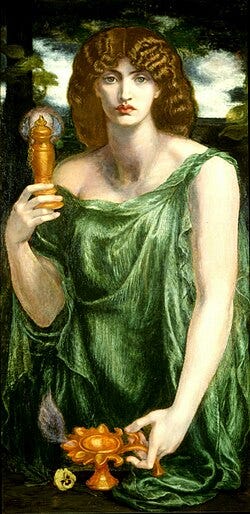
(Mnemosyne, by Dante Gabriel Rossetti)
Why Do We Tell Stories?
Finally, we are required to return to the question of why we tell stories. One of the interesting books I have studied in the last two years is Ethics in the Conflicts of Modernity (2016) by Alasdair MacIntyre. Part of what makes this book so interesting is that in this book he actually answers criticisms and elaborates his claim regarding the important role that narrative plays in our ethical lives. Like Benjamin, MacIntyre recognizes that the traditional social practice of storytelling is disappearing from our civilization, and he of course links this to the ethical crisis in which he believes our civilization is situated.
What is interesting about this specific topic in MacIntyre's book is his justification on the subject. MacIntyre provides a multitude of examples of when we use stories. We do this, MacIntyre argues, so that we can explain why we did one thing and not another. If we encounter a certain moral dilemma, MacIntyre argues, abstract principles of consequentialism or deontology will not help us. That is, they may help, but we cannot manage all our dilemmas by these means. We need to be able to tell the story of why we made certain choices and not others considering the specific circumstances in which we chose. We often need to tell the story of choices we have already made in the past with their circumstances in order to explain at all what the current dilemma facing us is.
And indeed, part of MacIntyre's convincing argument in his book is that in most cases of ethical dilemmas we do not need an expert in philosophy to advise us, but a person who knows us and "our story" sufficiently on the one hand, and himself has the ability to advise and advance us forward on the other hand. That is, stories allow us to provide an account regarding ourselves. Of course - even when we accuse and are accused, storytelling has an important role. Even when we think about what has gone well in our lives so far versus what has not, we rely on narrative.
However, very quickly MacIntyre jumps to the fact that if we are really serious about our ethical lives, we need to be able, also in relation to ourselves, to tell ourselves the story of our lives as a whole. Reflexivity supposedly yields for us a meta-narrative from which we derive our other narratives. And it is specifically this point that I find somewhat difficult in MacIntyre. To MacIntyre, it seems that his argument - or that of other neo-Aristotelians - depends on there being somewhere out there a complete story of which we ourselves are co-authors. In this I find two main difficulties: (a) It is not at all certain that we need to assume such a meta-story in order to be accountable to ourselves; the only possibility that we would need it is if someone comes and demands a comprehensive account of all the time we have lived on earth, which leads me to the second difficulty (b) The theological. MacIntyre is working here in my opinion in a not so disguised way with the image of "Judgment Day, Day of Wrath," a day when the soul stands (in Jewish language) before the throne of glory and its deeds, as the Tannaim taught us, were all written in a book through which God judges us. But this is a dubious assumption to say the least - even if you are very good Jews, it seems to me that while in tradition undoubtedly God may and often cares for the private fate, the central thing he focuses on is usually the fate of the people. The fate of the people, for its part, is not composed of all the totality of the private lives of the different Jews.
In this sense, I can only agree to some extent with Heidegger, or the caricature of the authors of modern novels: if the question is about the different incarnations in our lives, the different "temporality" of each period (to remove any doubt, I don't mean here "the period I was a student," but things on the scale of "I was a different person in Russia"), it cannot be directly formulated. Time, in this sense, cannot be represented directly. On the other hand, it seems to me that in Heidegger himself there is a very fundamental phenomenological problem in the seam that he clearly does not know how to resolve. MacIntyre might ask Heidegger, rightly, how then he gives an honest account, not of the whole of life perhaps - but at least regarding the unity of a certain period. Here it seems to me that Heideggerians will indeed encounter a problem: Heidegger sees the stability of the self as something built on the fact that the self returns to the resoluteness of its past self in a renewed resolute manner. In this sense, the self of the past is received as a kind of "heritage" that in the moment of insight we "choose" for ourselves anew. The interesting part here is that Heidegger recognizes that the actual historical tradition (or heritage) often includes within it explicit ways of life that people may authentically adopt for themselves out of an authentic holding in their anticipation of their own death. The historical heritage works analogously to how the self bequeaths itself its own resoluteness to itself - but in practice I am not clear if even the self alone is capable of bequeathing a certain mode of being from itself and choosing it without at least in some sense being able to tell this story at least to itself.
In other words, while perhaps the discursiveness of the story is not required when we anticipate our private death, it certainly becomes a kind of necessity from the moment we discuss not authenticity itself - but what gives, in Heidegger's language, the "stability" to this authenticity. Here we certainly need stories in my opinion, and not just stories, but as MacIntyre argues - also an account from others regarding who we are.
The point that seems to me missing in both of them, on the other hand, is more related to a Hungarian phenomenologist who recently passed away and whom MacIntyre confronts directly: László Tengelyi. Tengelyi argues that in life there are critical moments that affect the entire course of our lives and that cannot be analyzed in a narrative way, because it is impossible to justify or verbalize what happened in them - what he tries to outline as the "wild region" of life. Perhaps he is thinking here also of Heidegger's mute confrontation with death, although his work relies mostly on Husserl and Merleau-Ponty. Either way, the basic argument stands. Lives are also composed of such critical "turns." MacIntyre thinks that in some sense one can tell the story of the incomprehensibility of these experiences and their power in narrative. But it seems to me that this is not the problem at all: the problem relates to the fact that in some sense such "turns" in our natural lives may be narrated ambivalently from our previous lives or from our current lives, and in any case we will not achieve a completely external viewpoint that will allow us to do justice with these two "ecstasies," or to prefer one over the other in relation to their subject, the natural history of ourselves.
But what is not possible regarding our private lives, may be possible towards "history," or at least in a more general story. History as understood through the storyteller and not through the category of time. Benjamin of course gives us an example. In Nikolai Leskov's "Alexandrite" story, the background to the story is:
The ancient time when stones in the earth's belly and planets in heavenly heights still cared about the fate of man, not like today when in the heavens and beneath the earth everything has grown to be uninterested in the fate of human beings and no voice speaks to them anymore anywhere, certainly not fulfills their request. None of the stars that have not yet been discovered plays any role in horoscopes anymore, and there are many new stones, all measured and weighed and examined for their weight and fate, but they do not herald anything for us, or bring any benefit. The time when they spoke with man has passed.
From Benjamin's perspective, clearly we do not have here a historical story about the chronicles of the world. But what kind of story do we have here at all? Religious? Naturalistic? The answer is not clear enough. From where, we might ask, are such stories supposed to draw their plausibility at all.